
17 July 2026 · Editorial Team
How to Style a Tulip Table in a Small Dining Room (2026)
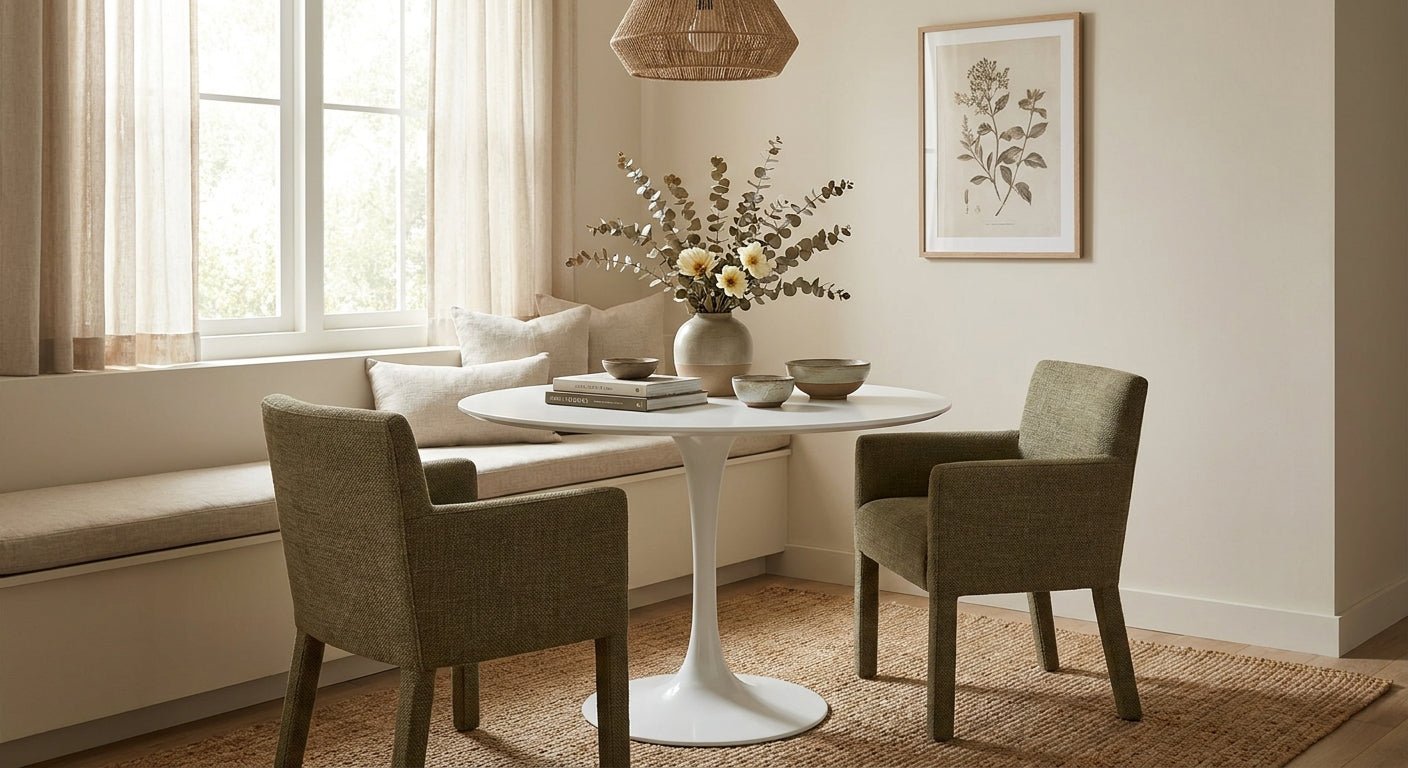
A tulip table works in a small dining room precisely because it has no legs to trip over and no bulky base eating into walkway space – the trick is picking the right size and then styling around that pedestal shape rather than against it.
TL;DR
The Aarhus round dining table in 119cm is the safe pick for rooms under 10 square metres because its pedestal base frees up floor space that four-legged tables lose to chair-leg clutter – Buy if your room is tight on width. Pair it with slim-framed chairs, keep the tabletop styling to three items maximum, and leave at least 90cm of clearance on every side for chairs to pull out. This guide covers exactly how to style a tulip table in a small dining room in 2026, from measuring the room correctly to fixing the most common styling mistakes people make with pedestal tables.
Why this matters
A tulip table looks deceptively simple, but the single-column base changes every styling rule you'd normally follow for a dining table. Four-legged tables anchor a room visually at the floor; a tulip table floats, which is exactly why it reads as larger than it is when styled correctly. Get the chair pairing or tabletop styling wrong, though, and that same lightness starts to look empty or off-balance – especially in a small room where every piece of furniture is doing double duty.
What you'll need
- A tape measure (not a guess – small dining rooms punish guesswork)
- The tulip table itself, sized to the room rather than to the number of place settings you want
- 4 to 6 chairs with slim frames or open backs
- A rug at least 60cm wider than the table on all sides
- One pendant light or a pair of wall sconces
- A single accent object for the tabletop (bowl, candle, or small vase – not all three)
For rooms under 10 square metres, the Aarhus round dining table in 119cm seats four comfortably without the table dominating the floor plan – its pedestal base means chairs tuck fully underneath when not in use, which matters when the room doubles as a hallway or home office corner.
The steps
1. Measure the room before you measure the table
Start with the room, not the furniture. Walk a tape measure across the narrowest point of the space and subtract 90cm on each side for chair clearance – that's the minimum a person needs to pull a chair back and stand comfortably. In a 3m x 3m room, that leaves you a working footprint of roughly 1.2m, which rules out anything larger than a 120cm round or a 150cm oval table. Skip this step and you'll end up with a table that looks right in a showroom photo but blocks the door in your actual dining room.
2. Choose round for square rooms, oval for narrow ones
A round tulip table works best in a room that's close to square, because it doesn't create dead corners the way a rectangular table does. If your dining space is long and narrow – a converted hallway or an open-plan strip beside a kitchen – an oval shape tracks the room's proportions better and loses less floor space to unused corners. The Aarhus oval dining table in 170cm suits exactly this layout, seating six along a run without the bulk of a rectangular table's four legs. Expected outcome: chairs sit flush to the table on both long sides with no wasted gap. Common mistake: buying oval for a square room, which leaves two corners permanently empty and visually unbalanced.
3. Pair chairs with open backs, not matching pedestals
A tulip table's single central column is the whole point of the style – don't fight it with heavy, boxy dining chairs that reintroduce visual weight at floor level. Slim wishbone-style or wire-frame chairs let light pass through the seating, which keeps a small room feeling open. Adding one tulip-style stool as an occasional fifth seat, such as the Tulip stool, extends seating for guests without needing a permanent extra chair taking up floor space day to day. Common mistake: pairing a tulip table with upholstered wingback chairs – the proportions clash and the room reads heavier than it is.
4. Anchor the table with a rug sized correctly
A rug that's too small is the single most common styling error in small dining rooms – it makes the whole set-up look like it's floating on an island rather than grounded in the room. The rug needs to extend at least 60cm beyond the table's edge on every side, so chairs stay on the rug even when pulled fully out. For a 119cm round table, that means a rug no smaller than 240cm across. Expected outcome: the dining area reads as one cohesive zone rather than a table dropped onto bare flooring.
5. Light the table, not the room
One well-placed pendant light directly above the tulip table does more for a small dining room than four recessed ceiling spots. Hang it 75-90cm above the tabletop so it doesn't compete with sightlines across the table, and pick a fixture with an open or slatted shade so light spreads sideways rather than pooling straight down. This single fixture also does the job of drawing the eye upward, which makes a low-ceilinged small room feel taller. Common mistake: relying on ambient room lighting alone, which flattens the table and leaves the dining zone looking like an afterthought.
6. Style the tabletop with restraint
A tulip table's clean lines get lost fast under clutter. Limit tabletop styling to one low centrepiece – a bowl of fruit, a single candle, or a small vase no taller than 20cm – so sightlines across the table stay clear during meals. In a small room, an over-styled table is the fastest way to make the whole space feel cramped rather than considered. Expected outcome: the table looks intentional, not staged.
7. Add one contrasting texture nearby
Because the tulip table itself is smooth and monochrome, one textured piece nearby – a boucle or velvet seat, a woven pendant shade – stops the room from feeling flat. A single accent chair in a contrasting fabric near the dining zone, rather than matching every seat, gives the eye somewhere to rest. Common mistake: adding texture everywhere at once, which crowds a small room instead of lifting it.
Troubleshooting
- The room still feels cramped after styling. Check your rug size first – undersized rugs are the most common cause of a dining area feeling smaller than it is, even after the table itself is right.
- Chairs don't tuck fully under the table. Measure the table's clearance height under the tabletop edge; some tulip-style tables sit lower than standard dining height, which stops standard chairs sliding in flush.
- The pedestal base wobbles on hard flooring. Confirm the base has adjustable feet and that the floor is level – wobble is almost always a levelling issue, not a design fault.
- The room looks empty with just the table and chairs. Add the single accent piece from step 7 rather than more chairs; extra seating in a small room usually makes the space feel more crowded, not more finished.
- Natural light gets blocked by the pendant fixture. Reposition the light off-centre by 10-15cm if a window sits directly behind the table, or switch to wall sconces instead.
- Guests can't fit around the table for six. Confirm you're using the oval 170cm size rather than a round table sized for four – round tables under 130cm rarely seat six without crowding.
Tools and resources
- Tape measure and painter's tape to mark clearance zones on the floor before committing to a table size
- A rug sized to the table dimensions in step 4
- The Aarhus round dining table in 119cm or Aarhus oval dining table in 170cm from Quell Workspaces, depending on room shape
- Slim-frame or wishbone-style dining chairs
- One pendant light rated for dining-height clearance
What to do next
If you're still deciding between a genuine Saarinen-style table and a more budget-friendly alternative, the Eero Saarinen tulip chair replica UK guide covers how to pair the matching chair with a tulip table, including what to check before you buy in 2026.
FAQ
What's the best size tulip table for a small dining room? A 119cm round table is the safe size for rooms under 10 square metres in 2026, seating four while leaving enough clearance for chairs to pull out fully.
Should chairs match a tulip table exactly? No – open-back or wire-frame chairs work better than heavy upholstered ones, because they preserve the light, floating look the pedestal base creates.
How much clearance do you need around a dining table? Leave a minimum of 90cm on every side so chairs can be pulled back and a person can stand comfortably while seated.
Is a round or oval tulip table better for a small space? Round suits square rooms; oval suits long, narrow rooms because it tracks the space's proportions instead of leaving unused corners.
What rug size works with a tulip table? The rug should extend at least 60cm past the table's edge on all sides – for a 119cm round table, that's a rug of at least 240cm across.
How do I light a small dining room with a tulip table? Hang one pendant light 75-90cm above the tabletop rather than relying on ceiling spots, which flattens the room instead of drawing the eye upward.
Can a tulip table make a small room look bigger? Yes – the single pedestal base removes the visual clutter of four table legs, which is why tulip tables read as more spacious than traditional dining tables of the same footprint.
How much does a tulip-style table cost in 2026? Pricing depends on tabletop size, material, and finish, so it's worth comparing current options directly on the product page rather than relying on older listings.
One last thing
The detail most people miss with a tulip table in a small dining room isn't the table at all – it's the chair count sitting empty against a wall. A stool that tucks away when not needed, rather than a fifth or sixth chair permanently on show, keeps a small room from feeling like a furniture showroom the other six days of the week.


