
27 August 2026 · Editorial Team
Noguchi Coffee Table Dupe Black Walnut: 2026 Verdict
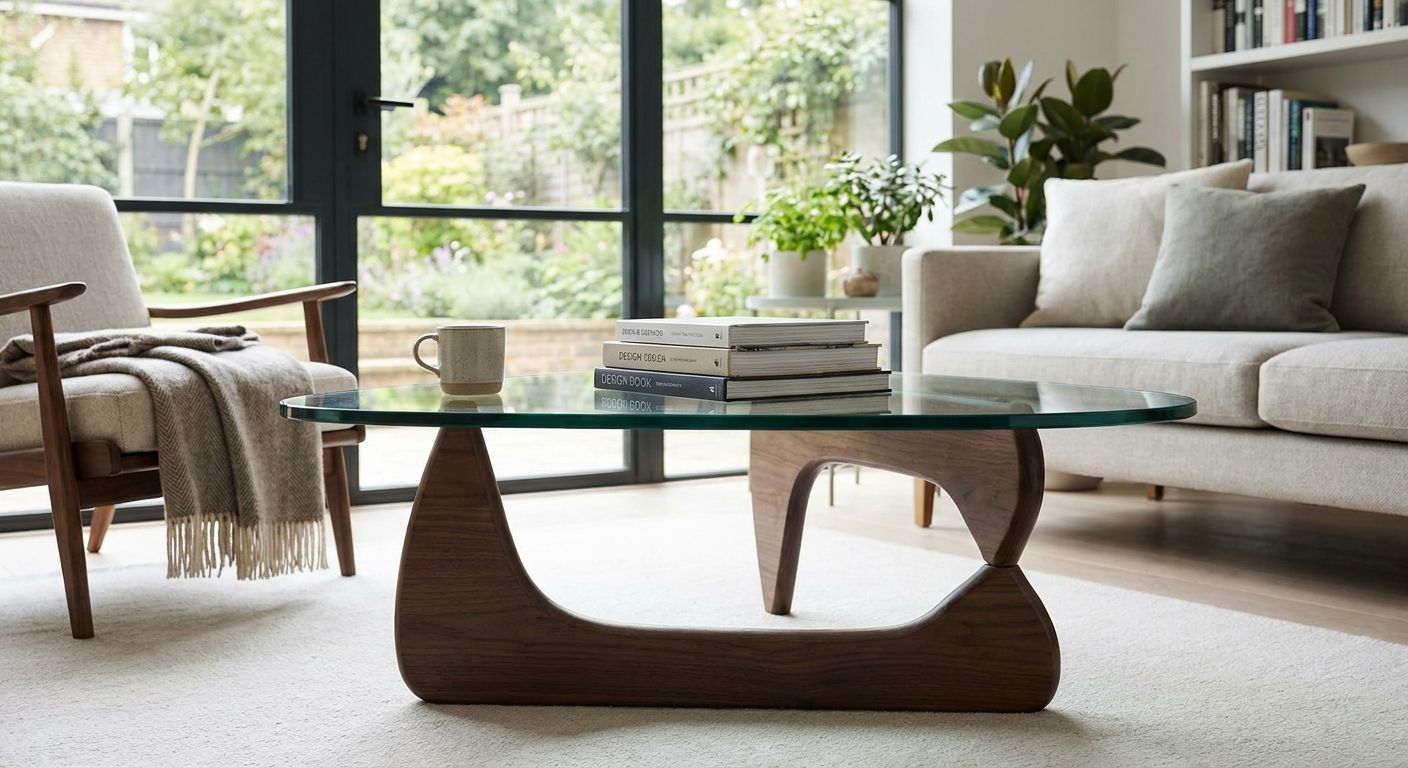
A noguchi coffee table dupe in black walnut finish gets you the biomorphic glass-and-wood silhouette without the authorised-edition price tag, but the base material and glass thickness decide whether it looks right in five years or wobbles apart in five months.
- A noguchi coffee table dupe in black walnut finish needs a two-piece interlocking base and glass around 19mm thick to sit level long-term - Buy that combination.
- Veneer over engineered wood holds grain match better than painted MDF bases dressed up as walnut - Consider for most UK living rooms.
- Skip dupes advertising 'walnut effect' printed laminate - the grain looks flat and repetitive under daylight.
- Compact-scale versions suit UK flats better than full-size copies of the original Herman Miller footprint - Consider if your room is under 20 square metres.
Why this matters
The original Isamu Noguchi table, first produced in the 1940s and still made under licence today, runs on a two-piece solid wood base roughly 40cm tall with a freeform glass top close to 19mm thick. Dupes copy the shape easily. They copy the engineering underneath far less consistently, and that gap is where a black walnut finish either looks convincing or looks like a printed skin over cheap board.
If you're comparing options on Quell Workspaces, the same scrutiny that goes into judging furniture construction for workspaces applies here: check what's under the finish before you check how the finish photographs.
Who this guide is for
This is for anyone furnishing a UK living room or snug who wants the Noguchi silhouette in a warmer black walnut tone rather than the lighter birch or cherry finishes most dupes default to. It's aimed at buyers comparing multiple sellers online, not at anyone shopping a single named retailer - the goal is knowing which build details matter before you commit.
What to look for in a noguchi coffee table dupe in black walnut finish
Base construction: two-piece interlocking vs single pedestal
The original design uses two separate wood pieces that slot together to form the base, which is what gives the table its visual lift and its stability under the glass. Dupes that swap this for a single moulded pedestal or a bolted centre column lose both the look and the balance the two-piece system provides. If a listing photo shows one continuous base shape rather than two distinct interlocking forms, it's not replicating the structural idea, just the outline.
Glass top thickness and edge finish
Glass around 19mm thick is standard on the original and on well-made dupes; anything noticeably thinner flexes at the tips of the freeform shape where there's no base support underneath. Check listings for a stated glass thickness and a polished or bevelled edge rather than a raw cut edge, which chips more easily during cleaning.
Grain match and veneer quality
Black walnut has a distinctive dark, tight grain that's hard to fake convincingly in print. A genuine veneer or solid wood base shows natural variation across the two pieces; a printed or laminate finish repeats the same grain pattern and looks flat once you view it from an angle rather than face-on in a product photo.
Footprint and scale for UK living rooms
The original sits around 130cm at its longest point, which suits open-plan US living rooms better than the average UK terrace or flat lounge. Several dupe makers offer a scaled-down version closer to 100-110cm long, which is the more practical choice for smaller rooms without losing the shape.
Finish tone consistency
"Black walnut" as a finish name isn't standardised across sellers - some mean a near-black stained walnut, others mean a mid-brown walnut with black-tinted glass or black metal accents. Ask for an actual photo of the wood tone in daylight, not just the studio listing shot, before you decide it matches your room.
Top picks: how the main configurations compare
The interlocking solid base, full-size. Solid walnut or thick walnut veneer over a genuine two-piece base at the roughly 130cm original scale. This is the closest structural and visual match to the licensed design, and it holds up best over years of daily use in a family living room. Buy if you have the floor space and want the most faithful build. More styling context and named UK options sit in this Noguchi coffee table replica guide.
The veneer-over-ply value pick. Same two-piece base shape, but the wood is a walnut veneer layer over engineered ply rather than solid timber. It's noticeably lighter to move and costs less, and the veneer still shows real grain rather than a printed pattern. Consider this for a first home or a room where the table won't take heavy daily wear.
The compact-scale pick. Scaled to roughly 100-110cm rather than the original's 130cm, this suits flats and smaller lounges where the full-size table would dominate the room. The proportions of the freeform top shift slightly at smaller scale, so the silhouette reads a little more rounded than the original. Consider for space-constrained UK rooms.
The printed-laminate finish. Base and top dressed in a photographic walnut print over MDF or particleboard. It photographs fine at a distance but the grain repeats and flattens out under normal room lighting, and the finish doesn't age the way real wood does. Skip unless the table is genuinely short-term or low-budget use only.
What to avoid
- Single-pedestal bases marketed as "Noguchi style" - the whole point of the design is the two interlocking pieces; a single column loses the structural and visual point of the shape.
- Unstated glass thickness - if a listing doesn't mention the glass gauge, assume it's thinner than the roughly 19mm standard and expect more flex at the tips.
- "Walnut effect" or "walnut finish" wording without a wood type - this phrasing usually signals a printed surface over composite board rather than any actual walnut veneer.
For styling the table once it's in the room, this guide to styling a Noguchi coffee table covers placement and pairing choices that suit the black walnut tone specifically.
Verdict comparison table
| Configuration | Base material | Approx. length | Verdict |
|---|---|---|---|
| Interlocking solid base, full-size | Solid walnut / thick veneer | ~130cm | Buy |
| Veneer-over-ply value pick | Walnut veneer over engineered ply | ~130cm | Consider |
| Compact-scale pick | Veneer or solid, scaled down | ~100-110cm | Consider |
| Printed-laminate finish | Printed skin over MDF/particleboard | ~130cm | Skip |
FAQ
What is a Noguchi coffee table dupe?
A Noguchi coffee table dupe is an unlicensed reproduction of Isamu Noguchi's biomorphic glass-and-wood coffee table design, sold without Herman Miller or Vitra licensing. Quality varies widely by base material and glass thickness, which is why checking construction details matters more than the photo.
Is a black walnut finish dupe as sturdy as the original?
Sturdiness depends on the base construction, not the finish colour. A two-piece solid or thick-veneer walnut base with glass around 19mm thick performs closer to the original than a single-pedestal or printed-laminate version regardless of what the finish is called.
How much does a Noguchi coffee table dupe cost in the UK in 2026?
Prices vary by base material, glass thickness and scale, with solid wood and thicker glass sitting at the higher end of the market in 2026. Comparing listed materials rather than price alone is the more reliable way to judge value.
What's the difference between walnut veneer and solid walnut on a dupe?
Solid walnut is timber throughout the base piece, while veneer is a thin walnut layer over engineered wood or ply underneath. Both can show genuine grain, but solid walnut generally handles scratches and long-term wear better than veneer over composite board.
Does black walnut finish match the original Noguchi walnut tone?
Black walnut runs darker than the lighter cherry or birch tones the original design is often shown in, so it's a deliberate style choice rather than a like-for-like match. Check daylight photos from the seller rather than studio shots to judge the actual tone.
Can you get a smaller Noguchi coffee table dupe for a UK flat?
Yes, several sellers offer a compact scale around 100-110cm long against the original's roughly 130cm footprint. The proportions shift slightly smaller-scale but the freeform silhouette stays recognisable.
How do you tell good replica glass from thin stock?
Check the stated glass thickness before buying - around 19mm matches the original standard, and anything unstated or visibly thinner is more likely to flex at the unsupported tips of the freeform shape. A polished or bevelled edge is another sign of a better-finished top.
Is a two-piece base necessary on a Noguchi dupe?
The two-piece interlocking base is central to the original design's balance and look, so a single-pedestal substitute changes both the structural idea and the visual silhouette. It's worth treating as a non-negotiable feature rather than a style variation.
One last thing
The detail most buyers miss is that the two base pieces on a genuine-style dupe should sit at a slight angle to each other, not parallel - that off-set is what creates the tension and balance the original design is known for, and a flat, symmetrical base underneath a walnut finish is usually the fastest tell that the structure was simplified to cut cost.


