
29 August 2026 · Editorial Team
How to Adjust an Eames Replica Office Chair (2026 Guide)
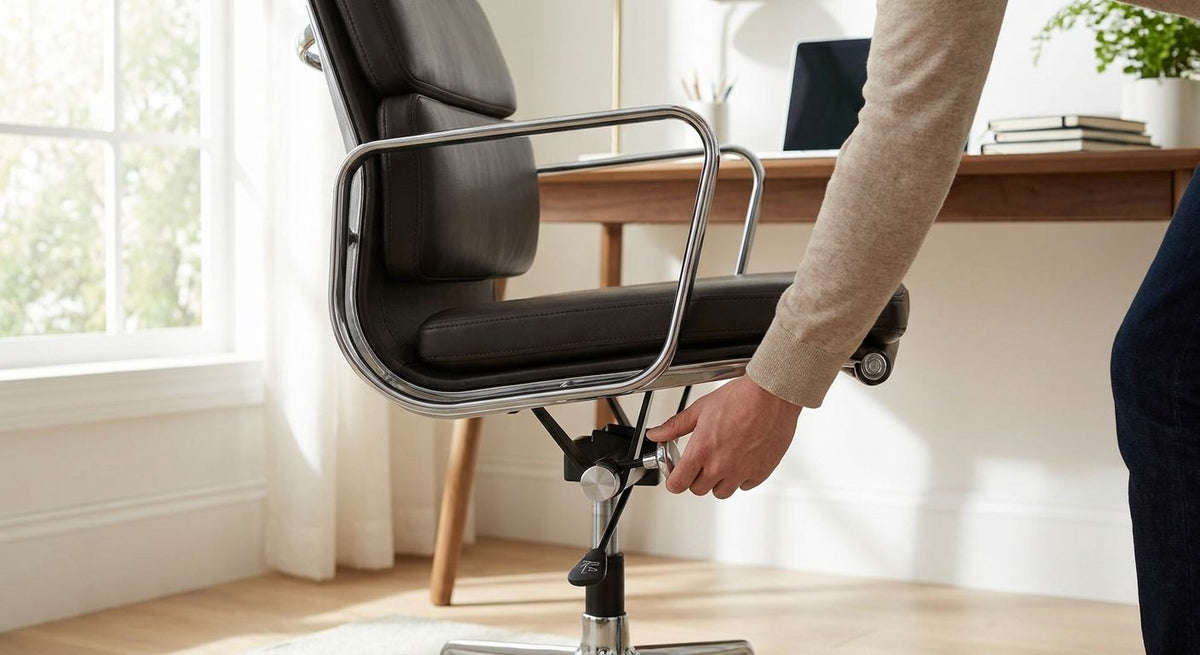
An Eames replica office chair reaches all-day comfort through four adjustments, done in this order: seat height, tilt tension, recline lock, then armrest height. Skip that sequence and every later adjustment ends up compensating for a seat height that was never right in the first place.
- Set seat height first on any Eames replica office chair - every other adjustment depends on it.
- Tilt tension controls how much resistance you feel when leaning back, not how far the chair reclines.
- Recline lock should sit in the second of three notches for desk work, the last notch for reading breaks.
- Armrests only help posture when they sit level with your elbows once your feet are flat on the floor.
- A high-back ergonomic chair like the Quell Workspaces Billy Office Chair adds lumbar support that fixed-back replica shells don't have.
Why this matters
Most complaints about an Eames replica office chair - lower back ache by 3pm, shoulders creeping up towards the ears, a seat that feels either too high or too low no matter what you do - trace back to one adjustment being skipped, not a fault with the chair itself. The classic Eames shell and management chair designs were built around a swivel base, a gas-lift lever and a tilt tension knob, and replica versions in 2026 carry the same three controls in the same rough positions. Get familiar with what each one actually does and the chair works the way it was meant to.
If your current chair has no seat-height lever or tilt mechanism at all, that's a different problem to solve, and it's worth comparing against a chair built specifically for long desk sessions, such as the Billy Office Chair from Quell Workspaces, which pairs adjustable height with a shaped lumbar zone.
How do you adjust an Eames replica office chair for all-day comfort?
Work through these steps in order every time you change desks or hand the chair to someone else:
- Sit down first, then adjust. Body weight changes how the gas lift and tilt tension behave, so never set the chair up empty.
- Set seat height so your feet sit flat on the floor and your knees form roughly a 90-100 degree angle. Pull the height lever while seated, use your legs to lift or drop, then release to lock.
- Turn the tilt tension knob (usually under the front of the seat) until leaning back takes gentle, even effort - not a shove, not a free-fall.
- Set the recline lock to the middle notch for typing and screen work, saving the furthest-back notch for phone calls or thinking breaks.
- Adjust armrests, where fitted, so your elbows rest at roughly 90 degrees with shoulders relaxed - too high and shoulders hike up, too low and you'll lean sideways.
Repeat step 2 whenever you swap chairs between desks - seat height is the adjustment most people forget to redo, and it's the one that undoes every other setting if it's wrong.
Seat height: get it right first
Seat height decides everything downstream. Set it too low and your knees sit above your hips, tipping the pelvis back and flattening the lower spine's natural curve. Set it too high and your feet dangle, putting pressure under the thighs instead of through the feet. The gas-lift lever on a replica Eames office chair is almost always under the front-left of the seat - pull it up to release the lift, shift your weight to raise or lower, then let go to lock at the height you want.
Tilt tension: matched to how you lean, not your body weight
The tilt tension knob changes how much resistance the backrest gives when you lean into it - turn it clockwise for more resistance, anticlockwise for less. The goal is a recline that takes deliberate effort to start and holds steady once you're there, rather than one that either won't move or drops away the moment you lean back. Test it seated, not standing, since the mechanism reads your position through the seat pan.
Recline lock: three positions, not one
Most Eames-style tilt mechanisms lock at three points: upright, a mid-recline for typing, and a deeper recline for reading or calls. Leaving the lock disengaged lets the chair rock freely, which feels relaxed for ten minutes and tiring after an hour, because your core does the stabilising work the lock is meant to do. Locking the mid-position is the closest match to a standard desk-height setup.
Armrests: height and width both matter
Armrests only earn their place once seat height and tilt are already correct. Set arm height so your elbows sit close to 90 degrees with your shoulders down, not shrugged. On chairs with pivoting or width-adjustable arms, bring them in until forearms rest without your shoulders rotating inward - a common cause of shoulder tightness by mid-afternoon.
Why comfort on an Eames replica office chair varies so much
- Desk height relative to the chair - a desk that's too high forces the seat up until feet no longer sit flat.
- Monitor height and distance - screens set too low pull the neck forward regardless of how well the chair is adjusted.
- How long the tilt tension has been set for someone else - shared chairs in hot-desk offices are the most common source of a "stiff" or "loose" recline complaint.
- Whether the chair has a fixed or adjustable lumbar zone - some Eames replica shells have a curved backrest with no separate lumbar adjustment, so posture correction has to come from seat height and tilt alone.
- Task type across the day - a setup dialled in for typing will feel wrong during a video call, which is exactly why the recline lock has more than one notch.
- Flooring and castor type - hard floors need different castors to carpet, and the wrong pairing makes the chair feel like it's fighting you when you shift position.


Related questions
Why does my Eames replica chair feel too low no matter how high I raise it?
A chair that maxes out too low usually means the gas lift has reached its full extension, which is common on replica models built to a shorter standard seat range than the desk it's paired with. Pairing the chair with a lower desk, or a model with a taller lift range, solves it faster than any recline or tilt adjustment.
Is it normal for the tilt tension knob to feel stiff when new?
Yes - a tilt tension knob on a new Eames replica office chair is often set to a mid-range default and needs turning to match your weight and lean style. Work it through its full range once while seated so you know where your comfortable setting sits, rather than assuming the factory default is correct.
Do all Eames replica office chairs have adjustable armrests?
No - fixed-arm and no-arm versions are common across replica ranges, particularly on shell-style designs that follow the original Eames aesthetic closely. If armrest adjustment matters to your setup, check that spec before buying rather than assuming it's included.
FAQ
How do you adjust the seat height on an Eames replica office chair?
Sit in the chair, pull the height lever (usually under the front-left of the seat) and shift your weight to raise or lower it, then release to lock once your feet sit flat and knees sit near 90 degrees.
What does the tilt tension knob do on a replica Eames chair?
The tilt tension knob controls how much resistance the backrest gives when you lean into it, not how far back the chair goes - turn it clockwise for firmer resistance, anticlockwise for a looser recline.
Why does my Eames replica office chair feel wobbly when I lean back?
A wobbly recline almost always means the tilt lock is disengaged or the tension knob is set too loose for your weight - lock the mid-recline notch and tighten the tension until leaning back takes deliberate effort.
Should the recline lock stay engaged all day?
For typing and screen work, yes - lock the mid-position so the backrest holds steady; unlock only for reading breaks or calls where a deeper recline feels natural.
How do I know if my Eames replica chair's armrests are set correctly?
Armrests are correct when your elbows rest near 90 degrees and your shoulders stay relaxed rather than hiked up - adjust height first, then width if the arms pivot.
Is an Eames replica office chair as comfortable as an ergonomic mesh chair?
It depends on the adjustments each model offers - a shell-style replica with only seat height and tilt gives less correction than a dedicated ergonomic chair with a separate lumbar zone, so the best choice depends on how many hours a day you're sitting.
Why does my chair feel fine at one desk but wrong at another?
Desk height changes the correct seat height, so a setting that felt right at one desk can force your shoulders up or your knees too high at another - re-run the seat height step whenever you change desks.
Do Eames replica office chairs need re-adjusting over time?
Yes - gas lifts and tilt tension knobs can drift slightly with heavy daily use, so it's worth checking seat height and tension every few months rather than assuming a one-time setup lasts indefinitely.
One last thing
The single adjustment people skip most on an Eames replica office chair isn't the tilt knob - it's re-checking seat height after moving desks. A setting that felt perfect at one desk in January can leave your knees jammed above your hips by the time you've moved stations twice in 2026, and no amount of tilt tension or armrest fiddling fixes a seat height that's wrong from the start.


