
23 July 2026 · Editorial Team
Mid Century Modern Home Office UK: 2026 Build Guide
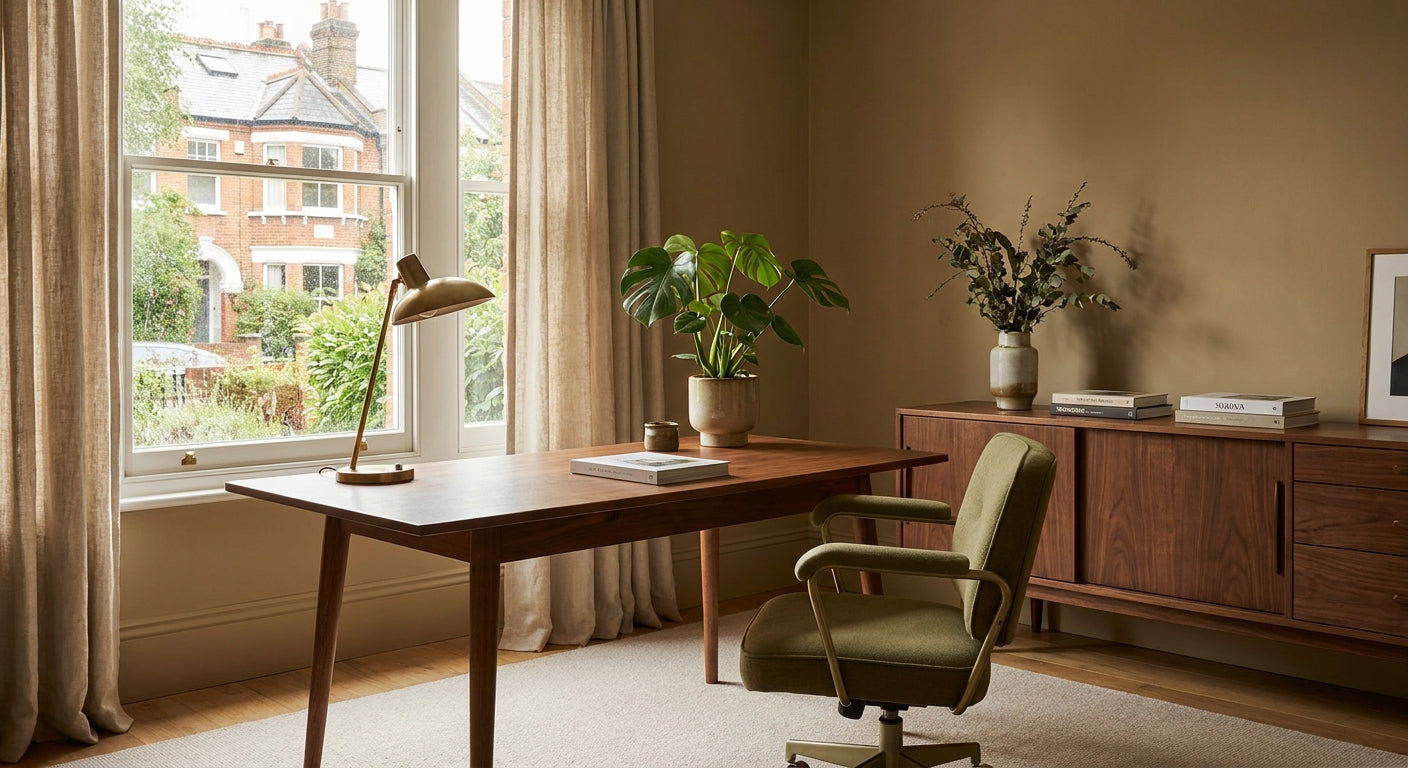
A mid-century modern home office UK setup in 2026 pairs warm walnut and teak furniture with acoustic control that actually stops your video calls sounding like they're happening in a stairwell. Here's the build order that works, room by room, without gutting your budget on furniture that photographs well but fights the noise in the room.
- A mid century modern home office UK build in 2026 needs walnut tones, tapered legs and real noise control, not just a nice chair.
- A soundproof private work pod solves echo in period rooms with hard floors and glass — fit it before you buy furniture.
- Skip glossy black desks and chrome task chairs; they fight the warm, low-profile look this style demands.
- Correctly proportioned furniture at a moderate price beats expensive pieces that don't fit a small box room.
Why this matters
Most home office guides talk about desks and lamps and skip the thing that actually ruins a mid-century room: sound. Period houses have hard floors, high ceilings and single-glazed windows, and every one of those surfaces bounces noise straight back at you on a call. You can get the walnut sideboard and the tan leather chair exactly right and still sound terrible on Zoom because nobody addressed the acoustics before the furniture went in.
This matters more in 2026 than it did a few years ago, because hybrid work has pushed serious video-call volume into rooms that were never designed for it — box bedrooms, garden buildings, converted alcoves. Fixing that after the fact means ripping out furniture you just paid for. Fixing it first means the room works from day one.
What you'll need
- A room with at least 2.2m of usable floor space for desk, chair and one storage piece
- A colour reference: walnut, teak, burnt orange, olive or mustard, and off-white or warm grey walls
- A desk with tapered or splayed legs, ideally 1.4m to 1.6m wide
- One statement seat — a lounge or accent chair, not a second desk chair
- A soundproof private work pod or acoustic panelling if the room has hard floors, a bay window, or shares a wall with a living space
- A pendant or arc floor lamp with a warm colour temperature (2700K to 3000K)
- Half a day to arrange furniture before you commit to wall fixings
Start with replica furniture for home offices as a reference point for pieces, prices and what a period-correct silhouette actually looks like before you order anything.
The steps
1. Set your acoustic baseline before you buy furniture
This fixes the biggest source of complaints from anyone who's built a home office in a period property: echo. Hard floors, single glazing and plaster walls with no soft surfaces create reverb that microphones pick up far worse than your ears do.
Walk the room and clap once. If you hear a sharp slap-back, you have a reflection problem, not a furniture problem. A soundproof private work pod solves this in one move because it creates a controlled acoustic box inside the room, independent of the walls and floor around it. If a full pod doesn't fit the space, felt panels behind the desk and a rug on hard flooring will cut most of the slap-back.
Common mistake: buying acoustic foam that looks industrial and clashes with the warm, wood-led palette. Panelling and pod exteriors can be finished to match the room — check finish options before you order.
2. Choose a low, warm colour palette
Mid-century interiors run on warm neutrals and one or two saturated accent colours — think burnt orange, olive, or mustard against walnut and off-white. This isn't decoration for its own sake; the warm palette is what makes the wood tones and brass or black hardware read as period-correct instead of generic "wooden desk."
Pick your accent colour first, then work the furniture and textiles around it. A single orange or olive chair against a walnut desk and off-white wall does more work than five smaller accent pieces scattered around the room.
3. Anchor the room with one statement chair
A lounge or accent chair — not your desk chair — sets the tone of the whole room. It's the piece a visitor notices first, and it's where you sit for calls that don't need a keyboard.
The Bugsy lounge chair works here because it has the low, curved silhouette this style calls for without the fragility of genuine vintage pieces from the 1950s and 60s. Place it at an angle to the desk, not facing it directly — mid-century rooms rarely arrange furniture in straight lines.
Common mistake: picking a chair that matches the desk wood exactly. Slight contrast — walnut desk, black-frame chair, or teak desk, tan leather chair — reads as more authentic than a perfectly matched set.
4. Build the desk zone around proportion, not size
A desk that's too large for the room kills the mid-century look instantly, because the style depends on visible floor space and slim, tapered legs doing the visual work. A 1.4m to 1.6m desk with splayed legs will look correct in most box rooms; anything wider needs at least 2.5m of wall to breathe.
Keep the desktop clear. Mid-century workspaces are defined by what isn't on the surface as much as what is — one lamp, one tray for cables, nothing else.
5. Layer in mid-century lighting last
{""}Lighting is where most home offices default to cold white LED and lose the warmth the whole room is built on. Swap it for a warm arc floor lamp or a pendant with a visible brass or wood detail, set to 2700K to 3000K, not daylight white.
Test it on a video call before you finalise placement. A lamp that looks perfect to the eye can throw an orange cast on camera if it's the only light source in the room — pair it with one cooler fill light near your webcam.
6. Add texture with panels that double as visual interest
If the pod route isn't right for your space, acoustic wall panels in a geometric or slatted pattern do double duty: they cut reverb and they read as intentional wall art rather than a soundproofing afterthought. Place them behind your desk chair, which is what your video-call background actually shows.
7. Finish with low storage and one plant
Mid-century rooms sit low — sideboards, credenzas and shelving units built into the design keep the sightline open rather than stacking storage to the ceiling. Add one large-leaf plant in the corner opposite the window; it's a period-consistent detail that also softens hard-floor acoustics slightly.


Troubleshooting
- Room still echoes after adding furniture. Soft furniture alone rarely fixes reverb in a hard-floored room. Add a rug at minimum, and treat the wall directly behind your desk chair first — that's the surface your microphone hears most.
- The pod doesn't fit under a sloped or low ceiling. Measure clear height at the exact placement spot, not the room's tallest point; older houses often lose 20 to 30cm at the eaves. Some pod formats are built specifically for tighter footprints — check dimensions against the room before ordering.
- Warm lighting makes you look orange on calls. Add a second, cooler light source at eye level near the camera rather than replacing the warm lamp — the warm tone is doing the room's job, the cold light is doing the camera's job.
- The desk looks right but the room still feels cluttered. Mid-century rooms fail when storage creeps upward. Swap any tall shelving unit for a low credenza and move overflow items into a cupboard outside the room.
- A statement chair looks good but isn't comfortable for long calls. Reserve it for short calls and casual reading; keep a properly adjustable desk chair for anything over 30 minutes at the keyboard.
Tools and resources
- A tape measure and a note of ceiling height at the exact spot where furniture or a pod will sit
- A warm-white bulb (2700K to 3000K) for testing lighting before committing to fixtures
- A rug or acoustic panel for any room with hard flooring
- Reference imagery for tapered-leg desks and low credenzas before you start browsing listings
- A short list of finish options if you're pairing a soundproof pod with the room's existing wood tones
What to do next
Once the acoustic layer and the anchor chair are in place, spend a full weekend using the room before buying anything else. Test the lighting on a real video call, sit in the statement chair for an actual working session, and only then decide whether you need a second lamp, more storage, or a different desk width. Furniture bought to fill a gap almost always looks wrong six months later; furniture bought to solve a problem you've actually felt in the room tends to stay.
FAQ
What defines a mid century modern home office UK style in 2026?
A mid century modern home office in 2026 combines warm wood tones like walnut or teak, tapered furniture legs, low-profile storage and one saturated accent colour against off-white or warm grey walls. Acoustic control has become part of the definition as more UK homes run daily video calls from converted rooms.
Is real vintage furniture worth it for a home office?
Genuine vintage mid-century pieces are usually not worth it for a working office because they weren't built for daily desk use and can be fragile under regular weight and movement. A well-proportioned reproduction piece in the right silhouette holds up better for everyday work.
How much does it cost to build a mid century modern home office in the UK?
Costs vary widely by room size and finish level, from a few hundred pounds for furniture and lighting in a small room to several thousand once acoustic pods or panelling are added. The acoustic layer is usually the single biggest line item if the room has hard floors or shares a wall.
Can an acoustic pod fit in a period house with low ceilings?
Many acoustic pods are sized for standard UK ceiling heights, but sloped ceilings and eaves in older houses can reduce clear height by 20 to 30cm at the placement spot. Measure the exact spot before ordering rather than the room's tallest point.
What colours work best for a mid century modern home office?
Warm neutrals — walnut, off-white, warm grey — paired with one saturated accent like burnt orange, olive or mustard define the look. Cold whites and glossy black finishes tend to clash with the wood tones the style depends on.
How do I stop echo in a home office with hard floors?
Add a rug, acoustic panelling on the wall behind your desk chair, and soft furniture where possible; for daily calls, a dedicated acoustic pod removes the room's reflections entirely rather than reducing them. Test with a single hand clap before and after to hear the difference.
Is mid century modern different from Scandinavian style?
Mid century modern favours warmer wood tones, tapered legs and bolder accent colours, while Scandinavian style leans toward lighter woods, whites and more muted, cooler palettes. The two overlap heavily but mid century modern reads warmer and slightly bolder in colour choices.
Do I need planning permission for a garden office pod in the UK?
Most freestanding garden pods under permitted development rules don't need planning permission if they meet height, footprint and boundary distance limits, but rules vary by council and property type. Check with your local planning authority before ordering if the structure will be visible from a boundary.
One last thing
The detail most people skip is testing the room on an actual call before buying a single piece of furniture. A hand clap tells you more about whether your mid-century modern home office will work in 2026 than any photo of a walnut desk ever will — fix the echo first, style the room second.


