
20 July 2026 · Editorial Team
Bauhaus Home Office Ideas 2026: Step-by-Step Guide
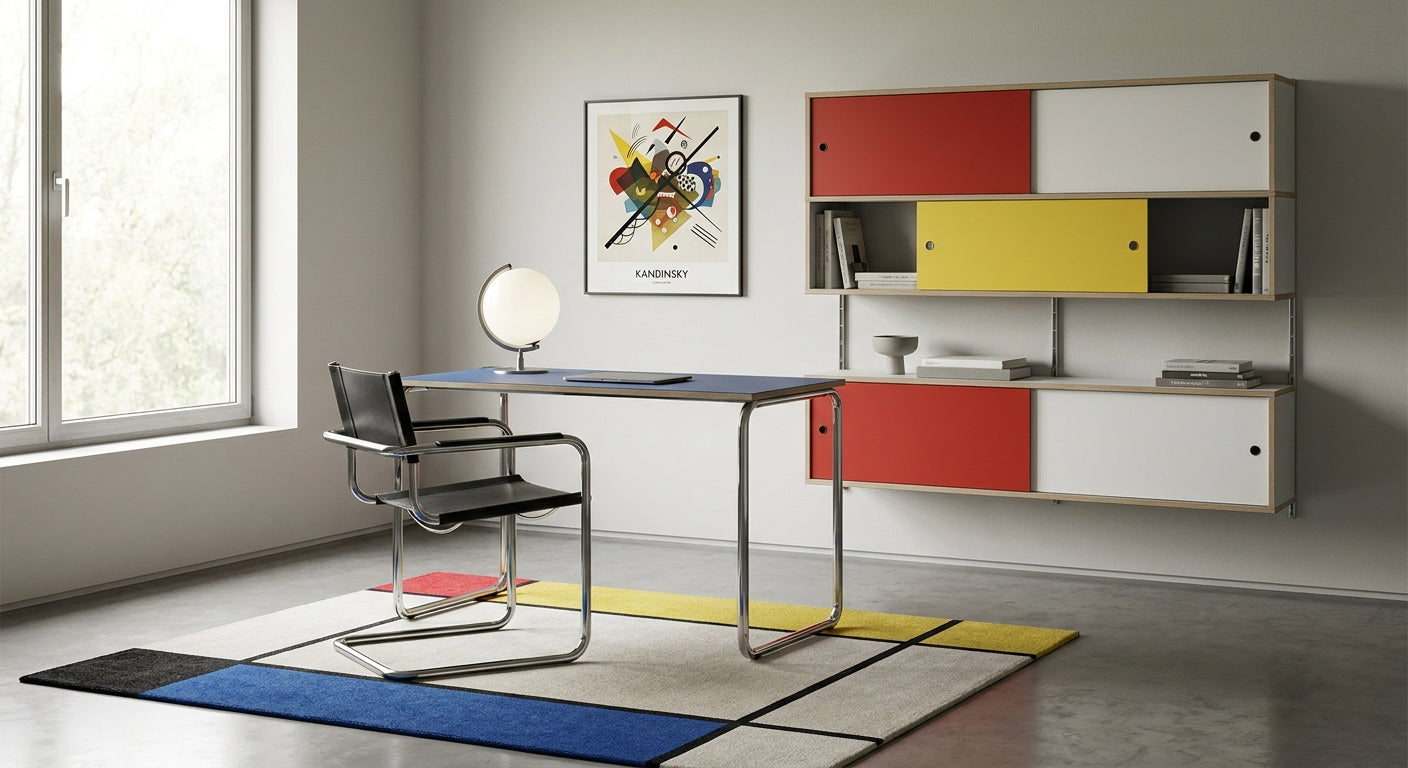
Building a Bauhaus-inspired home office in 2026 means working from a grid, not a mood board: pick a tight colour set, function-first furniture, and one acoustic fix for calls, then stop adding things.
TL;DR: For bauhaus home office ideas that don't end up looking like a cold showroom, start with a 2:1 grid layout, cap your palette at four colours (black, white, and two primaries), and add one soundproofing element for video calls. The Billy Office Chair covers the function-first seating brief for this look — Buy. Skip ornamental hardware, curved trims, and anything upholstered in a busy print; Bauhaus design in 2026 still runs on tubular steel, matte black, and honest materials.
Why this matters
Bauhaus principles were built for small, functional rooms almost a century before anyone worked from a spare bedroom, which is exactly why the style translates so well to a home office in 2026. The rules are blunt: form follows function, no ornament without purpose, and every material should look like what it is. That discipline stops a small home office from turning into a pile of "nice" pieces that don't work together.
It also solves the practical problems home offices actually have. Open shelving and primary colour reads well on video calls. Tubular steel furniture, like the Billy Office Chair, takes up less visual space than upholstered alternatives, which matters in a room under 12 square metres. The one thing Bauhaus design doesn't naturally solve is noise — the movement predates open-plan flats and shared walls — so that's the layer you have to add yourself.
What you'll need
- A desk with a flat, unadorned surface — timber veneer or matte laminate, not glass or high-gloss
- One task chair with a visible tubular steel frame
- A four-colour palette: white or off-white walls, black trim, and two primaries (red and blue, or red and yellow)
- Geometric lighting — a single pendant or an articulated desk lamp, no ornate shades
- Open or grid-format shelving instead of closed cabinetry
- One acoustic element for calls — an absorption panel or a private booth if space allows
- 2-4 hours for the layout and colour work, spread over a weekend
The steps
1. Draw the grid before you buy anything
Bauhaus rooms are built on a grid, not a focal point. Sketch your room as a simple 2:1 rectangle and place the desk on one axis and the storage on the other — this stops the eye jumping around a small space. Skip this step and you'll end up buying furniture that looks right individually but fights for attention once it's all in the room. The common mistake is centring the desk under a window for light and ignoring the grid entirely, which usually leaves an awkward dead zone behind the chair.
2. Fix the palette at four colours, no more
Walter Gropius's Bauhaus used red, blue, yellow, black, and white — pick two of the primaries and hold the rest of the room to black, white, and natural wood tone. Four colours total, including neutrals. The mistake most home offices make in 2026 is treating Bauhaus as "minimalist neutral," which misses the point — the primary colour is the whole signature. One accent wall or one accent chair is enough; two is already too many.
3. Choose furniture that shows its structure
Bauhaus furniture doesn't hide its frame — tubular steel, exposed joints, and cane or leather seats that let the structure read clearly. The Billy Office Chair works here because the frame is visible and the proportions are kept deliberately plain rather than sculpted. If you need a second seat for a reading corner, look for the same visible-frame logic rather than anything upholstered and rounded — a stool with a simple geometric base, like the Tulip Stool, fits the brief without adding visual weight.
4. Layer in geometric lighting, not decorative lighting
Bauhaus lighting is engineered, not decorative — think exposed bulbs, simple discs, and articulated arms rather than shades and finials. One pendant over the desk and one articulated task lamp is enough for a home office of 8-15 square metres. The mistake to avoid: buying a "designer" lamp with a heavily sculpted shade — it reads as decorative, which contradicts the whole point of the style.
5. Solve the acoustics the Bauhaus movement never had to
Open-plan flats, shared walls, and back-to-back video calls didn't exist in 1926, so this is the one problem you have to solve outside the original playbook. A flat acoustic panel on the wall behind your desk cuts flutter echo without adding visual clutter, and it can be finished in a single flat colour so it doesn't break the palette rule. This is the step most home-office guides skip entirely, and it's the reason calls sound harsh in an otherwise well-designed room.
6. Add a private pod if the room does double duty
If the home office also functions as a spare bedroom, playroom, or shared space, a single-person acoustic pod solves the noise problem more completely than panels alone — you get a sealed space for calls without needing a separate room. It also keeps the rest of the space open and uncluttered, which is consistent with the grid-first approach from step one. This only applies if you have the floor space for it; in a genuinely small room, panels and door seals do most of the work instead.
7. Edit ruthlessly once the room is furnished
Bauhaus design is finished by subtraction, not addition — walk the room after furnishing it and remove anything that doesn't serve a function. A plant, a single graphic print, or a clock is fine; three decorative objects on one shelf is not. The most common failure in a 2026 home office redo is stopping at "furnished" instead of pushing through to "edited."
Troubleshooting
- The room feels cold or clinical. Add one warm material — a natural wood desk surface or a leather seat pad — without adding a second accent colour.
- The primary colour looks too loud in a small room. Move it off the largest wall and onto a single furniture piece or door instead; the effect reads as considered rather than overwhelming.
- Calls still sound echoey after adding a panel. One panel usually isn't enough behind a hard desk and a window — add a second panel opposite the first, or check whether the desk itself is glass or high-gloss, which reflects sound.
- The space feels sparse rather than minimal. Minimal and empty aren't the same thing — check the grid from step one; sparse rooms are usually missing a shelving element, not colour.
- Budget won't stretch to full furniture replacement. Start with the chair and one accent colour; the frame-and-primary-colour combination does most of the visual work even before the rest of the room catches up.
Tools and resources
- A tape measure and painter's tape for marking the grid on the floor before committing to furniture placement
- Sample pots in your two chosen primaries, tested on the wall for at least 24 hours before painting
- Billy Office Chair for the seating brief
- Tulip Stool for a secondary seat with a matching visible-frame profile
- A private acoustic pod if the room needs to double as a call space and a shared space
What to do next
Once the room layout and palette are settled, the furniture sourcing is the part most people get wrong — mixing eras or buying pieces that look Bauhaus in a photo but don't share the same proportions in person. A dedicated buying guide on Bauhaus furniture replicas covers which pieces hold up in the UK market and which ones to skip.
FAQ
What is the Bauhaus style for a home office? Bauhaus for a home office means function-first furniture with a visible frame, a palette capped at black, white, and one or two primary colours, and no decorative detail without a purpose. It's the same movement behind the tubular steel chair and the primary-colour grid — applied to a room instead of a single object.
Is Bauhaus the same as mid-century modern? No — Bauhaus predates mid-century modern by roughly two decades and is stricter about ornament and colour, while mid-century modern allows more organic shapes and warmer materials. The two overlap enough that furniture from either era often works in the same room.
How much does it cost to redo a home office in Bauhaus style? Cost depends entirely on how much furniture you replace versus repaint and rearrange — the palette and grid changes in steps 1 and 2 cost only paint and time, while the chair and lighting are the main line items if you're starting from scratch.
What colours are used in Bauhaus design? The core Bauhaus palette is red, blue, yellow, black, and white — for a home office, pick two colours total plus the two neutrals and hold the room to that set.
Do I need a soundproof pod for a Bauhaus home office? Only if the room doubles as another space in the home; a single acoustic panel behind the desk solves most echo problems in a dedicated office without needing a full pod.
What furniture defines Bauhaus style? Tubular steel frames, cane or leather seats, and geometric lighting define the look — furniture that shows its structure rather than hiding it under upholstery or ornament.
Can a small room still work in Bauhaus style? Yes — Bauhaus was designed around small, functional spaces, and the grid-first approach from step one actually performs better in a tight room than in a large one, where the eye has fewer distractions to manage.
Is Bauhaus design still relevant in 2026? Yes — the function-first, no-ornament logic solves problems that are more common now than in 1926, including video calls, shared rooms, and small home offices, which is why the style keeps resurfacing in 2026 design guides.
One last thing
The detail most people miss when copying Bauhaus rooms from photos: the movement's furniture was designed to be mass-produced and cheap, not precious. That means the honest move in 2026 is to spend the budget on the chair and the acoustic layer — the two things you actually use every day — and keep the decorative spend at zero.


