
18 July 2026 · Editorial Team
Ligne Roset Togo Dupe Full Sofa: 2026 Buying Verdict
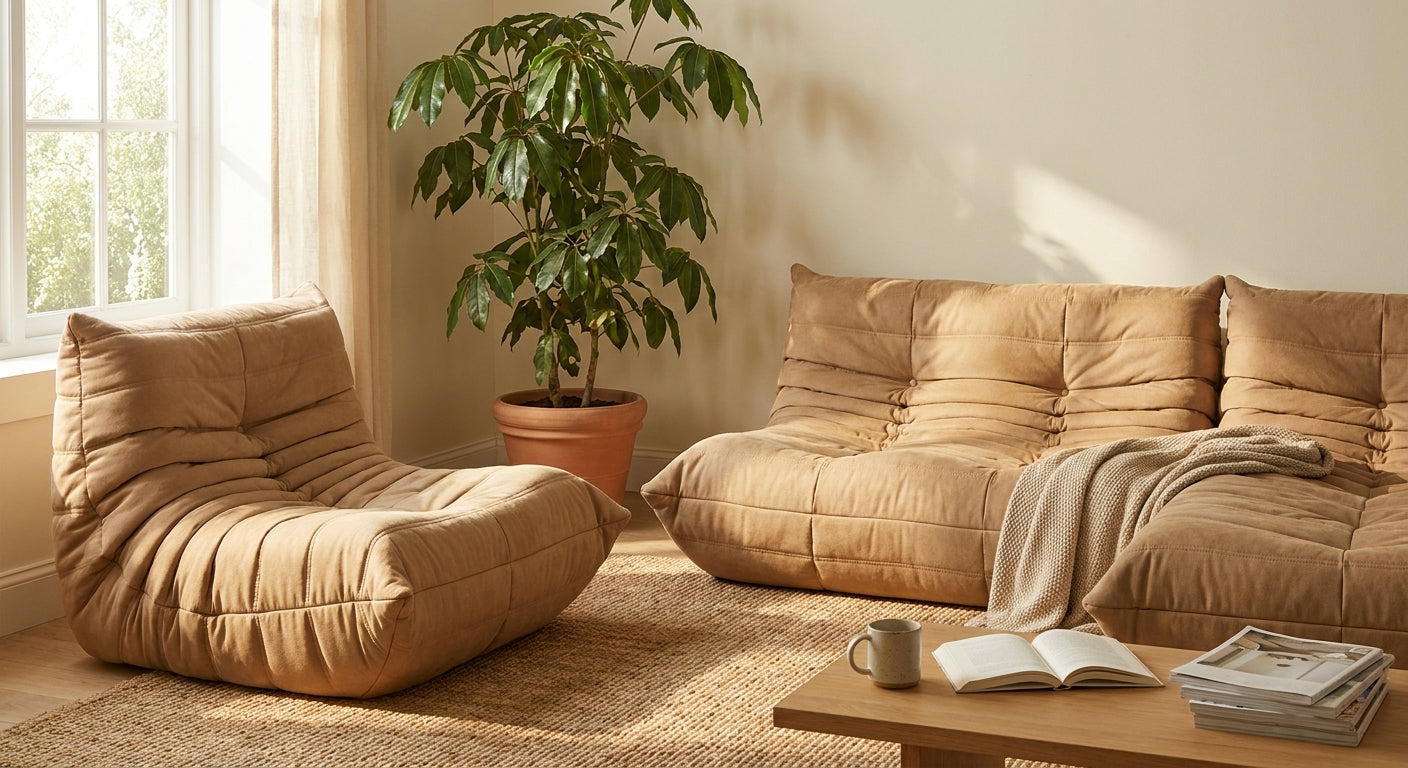
A Ligne Roset Togo dupe full sofa gets you the low-slung, cushion-stacked silhouette of the 1973 original without the four-figure invoice — but the format you pick (full sofa, two-seater, or single chair) changes the verdict more than the fabric does.
TL;DR
The three-seater Togo dupe full sofa is the strongest buy for a main living room seat in 2026, provided it uses a CMHR foam block rather than a soft polyfill fill. The single armchair module is the smartest low-risk entry point if you've never lived with a floor-height sofa before. Skip the ultra-budget bean-bag-style copies under roughly £400 — they lose shape within a year. If you want the exact silhouette with room to expand later, buy modular and add seats as budget allows.
Why this matters
The original Ligne Roset Togo has stayed in continuous production since 1973 and still retails well into four figures for a three-seater in 2026. That price gap is exactly why the dupe market has exploded — but it's also why quality varies so wildly between a £450 copy and a £1,800 copy that both call themselves "Togo style". Buy on silhouette alone and you'll likely end up with a sofa that looks right in photos and sags flat within 18 months.
The format question matters just as much as the fabric question. A full-size Togo dupe suits a household that actually sits together; a single chair module suits a reading nook or a small flat where floor space is tight. Get the format wrong and no amount of correct piping will fix it.
How we ranked
Each format below is assessed against four criteria: structural fill (foam density and CMHR compliance), frame construction (does it have an internal frame or is it foam-only), footprint versus typical UK living rooms, and realistic longevity based on how these constructions behave under daily use. This is not a single-brand comparison — it's a format comparison, because the same construction quality can show up under different labels depending on who's manufacturing that season. Verdicts are Buy, Hold, Wait, or Skip, and they're built to help you filter listings rather than chase one specific retailer.
The ranked list
1. Three-seater full sofa — the flagship pick
The original Togo three-seater runs about 235cm wide and 102cm deep, and most decent 2026 dupes stay within a few centimetres of that. This is the format that reads as "the" Togo silhouette in a room — low arms, no visible legs, cushion-stack construction from back to seat to bolster.
Look for a CMHR foam density in the 30-35kg/m³ range; anything softer collapses at the seat edge within a year of daily use. A three-seater at this spec typically ships on a 4-8 week lead time from UK and EU-based upholsterers in 2026, similar timelines to other made-to-order soft furniture. Verdict: Buy if the listing states foam density and zip-off covers; Hold if neither is disclosed.
2. Two-seater loveseat — the space saver
Drop to a two-seater and you lose roughly 60-70cm of width but keep the exact same seat height (around 41cm from the floor) and the same low-arm proportions. This is the right call for a flat under 400 sq ft or a second reception room where a full three-seater would dominate.
The trade-off: two-seaters see more corner-fold wear because the same body weight compresses a shorter foam run more often. Check the two-seater vs three-seater comparison before ordering if you're torn on size. Verdict: Buy for smaller rooms, Consider if you might upgrade to a three-seater within two years — buying modular avoids the resale hassle.
3. Single armchair module — the low-commitment entry
A standalone Togo-style armchair costs a fraction of the full sofa and lets you test whether you actually like sitting that low before committing a room to it. Seat height sits around 35-40cm off the floor, noticeably lower than a standard armchair at 45cm-plus, and that difference trips up more buyers than any fabric choice does.
This format also works as a modular add-on if the manufacturer sells matching corner and seat pieces separately — you can build toward a full sectional over 2026 and 2027 rather than buying it all at once. Verdict: Buy for first-timers and small spaces; it's the safest way to learn whether the silhouette suits your body before you commit to three seats of it.
4. Corner sectional / chaise build — the family lounge
Add a chaise or corner module and total footprint jumps past 280cm in one direction, which only works in open-plan living rooms or converted lofts. The upside is genuine lounging depth — most corner builds hit 160cm-plus front to back on the chaise side, deep enough to lie down fully.
The risk here is structural: without an internal frame connecting modules, corner sections can drift apart under regular use and leave a visible gap at the seam within months. Verdict: Consider only if the retailer confirms a connecting frame or bracket system between modules, otherwise Wait.
5. Mini / kids Togo dupe — the playroom novelty
Scaled-down versions sized for children or as an accent piece sit around 90-110cm wide and use the same stacked-cushion look at roughly 60% scale. These aren't a substitute for adult seating and shouldn't be judged against the full sofa criteria above — they're a decor piece, not a daily-use sofa.
Verdict: Skip if you're shopping for actual living room seating; Buy only if you specifically want a playroom or nursery accent chair.
6. Ultra-budget bean-bag-style copy — the one to avoid
At the bottom of the market, some listings drop the internal CMHR foam block entirely and fill the shape with loose bean-bag beads or low-density polyfoam. These hold the silhouette for the photo but lose 20-30% of their seat height within the first six months of regular sitting.
If a three-seater-sized listing sits meaningfully below the typical made-to-order price band for that size in 2026, that's the tell. Verdict: Skip, regardless of how convincing the product photos look.
Comparison table
| Format | Typical width | Seat height | Best for | Verdict |
|---|---|---|---|---|
| Three-seater full sofa | ~235cm | ~41cm | Main living room seat | Buy |
| Two-seater loveseat | ~165-175cm | ~41cm | Small flats, second reception rooms | Buy |
| Single armchair module | ~90-100cm | ~35-40cm | First-timers, reading nooks | Buy |
| Corner/chaise sectional | 280cm+ | ~41cm | Open-plan lounges | Consider |
| Mini/kids version | ~90-110cm | reduced scale | Playrooms, accent pieces | Skip (as main seating) |
| Bean-bag-style budget copy | Varies | Drops fast after 6 months | Nobody, long-term | Skip |
Where to buy
- Ask for the foam spec before the fabric swatch. Density and CMHR compliance tell you more about a three-year-old sofa's shape than any colour choice will.
- Confirm lead time in writing. Made-to-order Togo dupes typically run 4-8 weeks in 2026; anything promising next-day delivery on a fully upholstered piece is either drop-shipped stock or a lower-spec build.
- Check the return policy on fabric-specific orders. Bespoke covers are usually final sale, so order a swatch first rather than trusting a screen colour match.
For a broader read on sourcing before you commit, the guide on buying replica furniture without overpaying walks through the pricing tells that apply across replica sofas generally, not just this one silhouette.
FAQ
What's the best Ligne Roset Togo dupe format for a small flat? A two-seater or single armchair module is the better call under roughly 400 sq ft — the three-seater's 235cm width dominates smaller reception rooms.
Is a Togo dupe full sofa comfortable for daily sitting? Yes, provided the foam density sits in the 30-35kg/m³ range; softer fills feel comfortable in-store but compress and sag within a year of daily use.
How much does a Togo dupe three-seater cost compared to the original? Exact pricing varies by retailer and fabric, but dupes generally sit well under the four-figure cost of the Ligne Roset original, which is the entire reason the category exists in 2026.
Should I buy the corner sectional or start with single modules? Start with single modules if budget or space is uncertain — you can build toward a full sectional over time, and it avoids committing to a footprint you might regret.
Do Togo dupes come with removable, washable covers? Many do, but confirm zip-off covers before ordering — not every listing includes them, and a fixed cover limits cleaning options long-term.
How long is the lead time on a made-to-order Togo dupe? Expect 4-8 weeks for a made-to-order build in 2026, similar to other bespoke upholstered furniture; stock listings ship faster but usually use lower-spec fill.
Is the mini or kids version worth buying as an adult accent chair? No — it's scaled to roughly 60% of the adult sofa and reads as a novelty piece rather than functional seating for adults.
What's the biggest mistake people make buying a Togo dupe? Buying on silhouette and price alone without checking foam density or frame construction — that's the single biggest predictor of whether the sofa still looks right in 2027.
One last thing
The seat height is the detail nobody photographs and everybody notices after the return window closes — at 35-41cm off the floor, a Togo dupe sits noticeably lower than a standard sofa, and that's either exactly the lounge feel you wanted or the reason it ends up unused within six months. Sit in one, if you can, before ordering the three-seater sight unseen.


