
23 July 2026 · Editorial Team
Wishbone Chair Replica Quality Guide 2026: What to Check
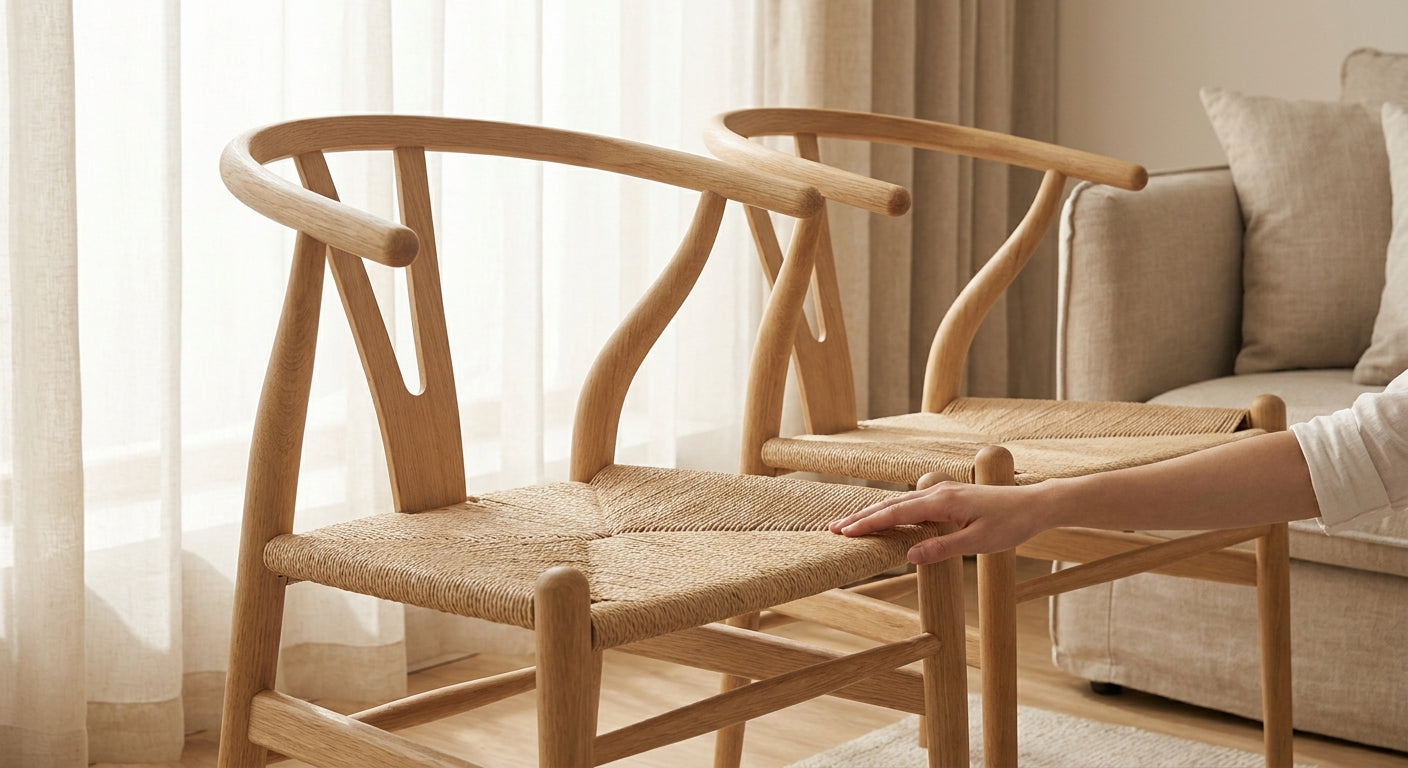
A well-made Wishbone chair replica matches Hans Wegner's original CH24 on the details that matter: a steam-bent beech frame, a hand-wrapped paper cord seat, and an oil finish that ages instead of flaking. This guide walks through exactly what to check before you pay for one in 2026, joint by joint.
- A well-made Wishbone chair replica uses steam-bent solid beech, not moulded plywood — check the arm joint first.
- Authentic-style seats use around 120 metres of hand-wrapped paper cord; machine-wrapped cord frays within a year.
- This wishbone chair replica quality guide flags oil finish over lacquer as the clearest tell of a serious remake.
- Expect £180-£350 for a solid beech replica in 2026 — under £120 usually means a moulded frame.
- Buy: mortise-and-tenon arm joints. Skip: glued dowel joints that flex within months.
Why this matters
The Wishbone chair replica market runs from £90 stacking-chair knockoffs to £400 solid oak remakes, and most listings use identical photos. You can't tell the difference from a product page alone — you have to know what a genuine steam-bent frame and a hand-woven cord seat actually look and feel like.
Get it wrong and the seat unravels inside a year, or the arm joint starts to creak within six months. Get it right and you've got a chair that holds its shape through daily dining-room use for a decade or more. Quell Workspaces covers a full wishbone chair replica roundup if you want specific models vetted against these same checks.
What you'll need
- A bright torch or phone light to inspect joints in low product photos or in person
- A tape measure (seat height should sit around 44-46cm)
- 10 minutes to sit, lean back, and test flex
- The listing's material spec — solid beech vs beech veneer vs plywood
- Reference knowledge of the original CH24 joinery, so you know what you're comparing against
The steps
1. Check the arm-to-leg joint construction
This is the single biggest tell on any Wishbone chair replica. Wegner's original uses a continuous steam-bent back-and-arm rail joined to the legs with visible mortise-and-tenon work — you should see the joint, not a smooth moulded curve that hides it.
Run a finger along the underside of the arm where it meets the front leg. A genuine joint has a slight seam and screws or dowels reinforcing it from below. A one-piece moulded arm with no visible joint at all is almost always plastic-composite or bent plywood dressed up as solid wood.
Common mistake: buyers assume a smooth, seamless curve means better craftsmanship. It's the opposite — it usually means the arm was moulded in one shot rather than steam-bent and joined.
2. Look for hand-wrapped paper cord, not a machine wrap
An authentic-style seat uses roughly 120 metres of unbleached paper cord, wrapped by hand in a herringbone pattern that takes an experienced weaver about three hours per chair. That labour shows in the price and in the weave.
Look closely at the pattern where strands cross at the seat rail corners. Hand-wrapped cord has slight, natural tension variation; machine-wrapped or synthetic cord (often polypropylene dressed to look like paper) has a perfectly uniform, almost printed look and feels slick rather than fibrous.
Verdict: hand-wrapped natural paper cord is a buy signal. Uniform synthetic cord that looks too clean is a skip.
3. Test whether the frame is steam-bent or moulded
Steam-bending the back rail into that continuous curve takes roughly 30 minutes per piece under an industrial steam press, and it's what gives solid wood the strength to flex slightly without cracking. Moulded plywood or bent MDF fakes the shape but not the grain structure.
Check the grain direction along the curved section. On a genuine steam-bent piece, the wood grain follows the curve continuously. On a moulded or laminated fake, you'll often spot visible layer lines at the edges, like plywood on a cut sheet.
4. Examine the finish: oil vs lacquer
Wegner-style replicas built to last use a Danish oil or soap finish that soaks into the beech and can be reapplied. Cheaper factories spray a thick lacquer instead, which looks glossy in photos but chips and yellows within 12-18 months.
Run a thumbnail lightly across an unseen edge if you're inspecting in person. Oil finish feels like wood with a slight sheen; lacquer feels like a hard plastic shell sitting on top.
Common mistake: assuming a glossier finish means higher quality. Glossy usually means lacquer, and lacquer is the cheaper, shorter-lived option.
5. Weigh the chair
A genuine CH24-style frame in oak or beech typically lands in the 3.5-4.5kg range. Anything noticeably lighter, especially under 3kg, usually means a hollow or composite frame rather than solid timber.
Most listings don't publish weight, so ask the seller directly. A vague or evasive answer on frame weight is itself a warning sign.
6. Check the underside joinery
Flip the chair over if you can, or ask for an underside photo. Genuine mortise-and-tenon or dowel-and-glue joints reinforced with corner blocks are visible and solid to the touch. Stapled or nailed corner brackets on their own, with no glued joint underneath, won't survive daily lean-back use.
7. Sit and flex-test the frame
Sit down, lean back fully, and shift your weight side to side. A well-built replica flexes slightly at the back rail (that's the steam-bent wood doing its job) without any creak at the leg joints.
Any squeak on the first sit usually means a joint gap that will only get worse. Skip any chair that creaks new — it won't quiet down with use.
Troubleshooting
- Seat cord starts fraying within months — the cord is synthetic or machine-wrapped under low tension. Contact the seller; a genuine hand-wrapped paper cord seat shouldn't show wear this fast.
- Frame wobbles at the leg joints — the joint is glued dowel rather than mortise-and-tenon. Tighten fixings if accessible, but treat this as a structural flaw, not routine maintenance.
- Chair squeaks when leaning back — a joint has separated slightly. On solid wood frames this can sometimes be re-glued; on moulded frames it usually can't be fixed.
- Finish is peeling or flaking — this is lacquer, not oil. An oil finish wears matte over time rather than chipping; a peeling glossy coat confirms a lower-grade replica.
- Listing price looks too good — under £120 for a solid-wood Wishbone chair replica in 2026 almost always means moulded plywood or composite construction, whatever the description claims.
Tools and resources
- How to spot a quality replica chair before you buy for the general checklist behind these same joinery and finish checks
- Hans Wegner GE290 Plank Chair replica to compare joinery style across Wegner's wider design lineage
- A torch, tape measure, and 10 minutes with the actual chair — no app or tool replaces sitting in it
What to do next
Once you've confirmed the joinery and cord quality, the remaining decision is finish. Natural oak reads warmer and shows grain more; black-stained beech hides minor colour variation between batches, which matters if you're buying multiple chairs for one table.
FAQ
What's the best way to tell a Wishbone chair replica is well made?
Check the arm-to-leg joint for visible mortise-and-tenon work and confirm the seat uses hand-wrapped paper cord rather than a uniform synthetic weave. A well-made wishbone chair replica also uses an oil finish, not glossy lacquer, and weighs 3.5-4.5kg in solid beech.
How much does a good Wishbone chair replica cost in 2026?
A solid beech Wishbone chair replica typically costs £180-£350 in the UK in 2026. Below £120, the frame is very likely moulded plywood or composite rather than solid wood.
Is steam-bent wood better than moulded plywood for this chair?
Yes — steam-bent solid wood follows continuous grain through the curve and flexes slightly under load without cracking. Moulded plywood fakes the shape but shows layer lines at the edges and cracks rather than flexes over time.
Why does the seat cord matter so much?
An authentic-style seat uses around 120 metres of hand-wrapped paper cord, which takes roughly three hours to weave and gives the seat its shape and give. Machine-wrapped or synthetic cord looks uniform and slick, and it frays within a year of daily use.
Should I buy a Wishbone chair replica with a lacquer finish?
No — lacquer chips and yellows within 12-18 months, while an oil or soap finish wears matte and can be reapplied. Glossy sheen in photos is usually a sign of lacquer, not higher quality.
Does the chair's weight tell you anything about quality?
Yes — a genuine solid beech or oak frame lands in the 3.5-4.5kg range. Anything under 3kg usually signals a hollow, composite, or lightweight moulded frame rather than solid timber.
What's a red flag when buying online without seeing the chair in person?
An unusually low price, no published weight, and stock photos with no underside joinery shot are the three biggest red flags. Ask the seller directly for frame weight and joint construction before you buy.
Can a squeaky new Wishbone chair replica be fixed?
Sometimes, if the joint is solid wood glued dowel or mortise-and-tenon that's simply loosened. If the squeak appears on the very first sit, treat it as a structural flaw and consider returning the chair rather than living with it.
One last thing
The detail that separates a genuine remake from a fake fastest isn't the wood grade — it's the cord weave. Herringbone paper cord wrapped by hand takes roughly three hours per chair, and that labour cost is baked into the price. Any Wishbone chair replica selling well below £150 skipped that step somewhere, whatever the listing photo shows.


