
23 July 2026 · Editorial Team
Camaleonda Replica Modular Configuration Guide 2026
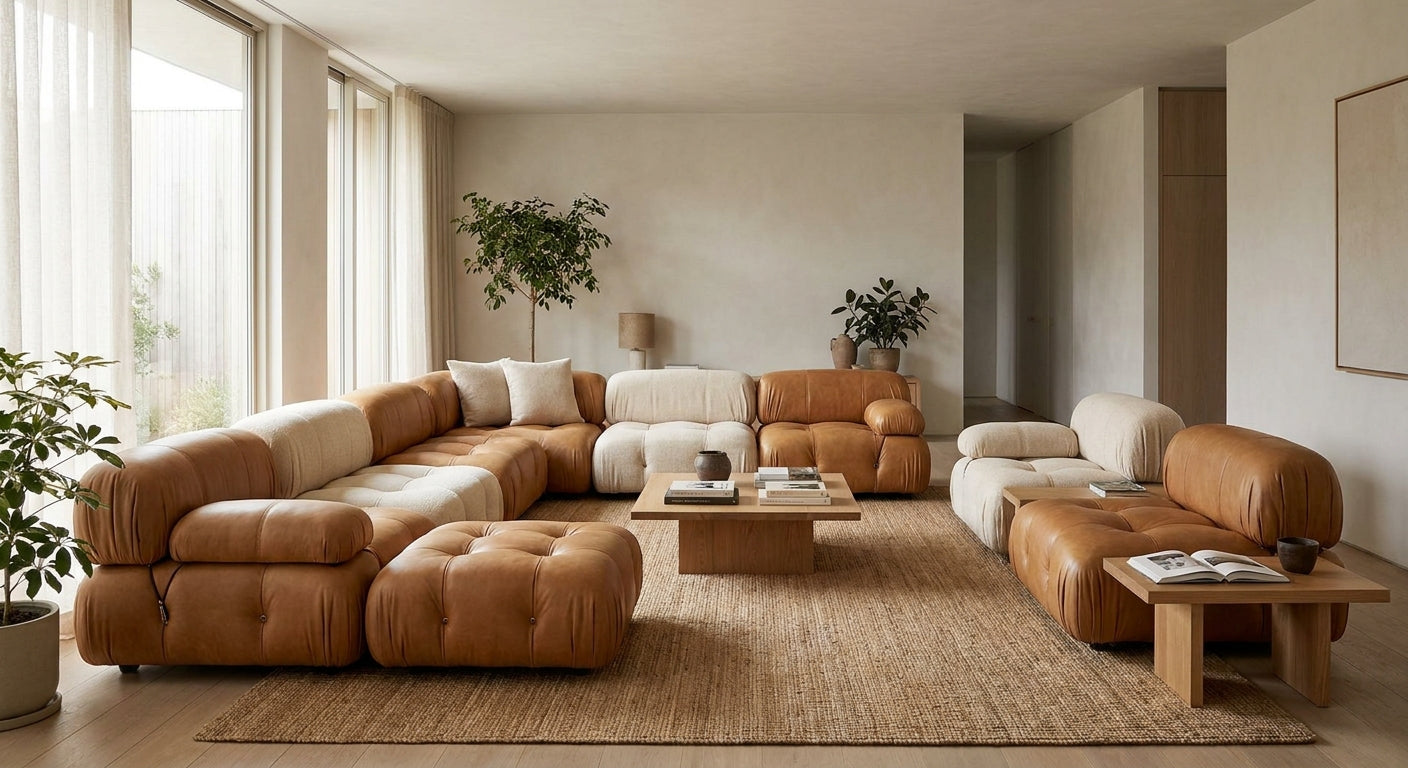
Configuring a Camaleonda replica sofa is a planning exercise before it is a furniture purchase — get the module count and connector logic right and the piece looks like an authentic Bellini design; get it wrong and you end up with gaps, sagging corners, or a shape that doesn't fit the room.
- Camaleonda replica modular configuration starts with module count, not fabric — measure the space first.
- Standard configurations use 3-7 modules; anything past 7 needs a floor plan sketch before ordering.
- Corner and wedge units cost more per module than straight seats — budget for them separately.
- Zip-together connectors fail first at high-traffic corners; check connector quality before the fabric swatch.
- Order fabric swatches before committing to a full Camaleonda replica order in 2026 — colour reads differently under office and living-room light.
Why this matters
A genuine Camaleonda from B&B Italia runs into five figures for a modest configuration, which is exactly why the replica market for this design has grown so fast through 2026. The modular system Mario Bellini designed in 1970 — foam-block seats, wedge corners, and metal zip connectors — is straightforward to reproduce, but the connector quality and foam density are where cheap replicas fall apart within a year. Quell Workspace's Camaleonda sofa replica buying guide covers sourcing in more depth; this guide focuses specifically on getting the modular configuration right before you place an order.
Most buyers get the fabric decision right and the configuration decision wrong. That's backwards — fabric is reversible in a way that a badly sized modular layout is not.
What you'll need
- Room measurements: wall-to-wall width, ceiling height near stairwells or doorways, and depth of the intended footprint
- A rough sketch of traffic flow — where people walk past the sofa, not just where it sits
- A tape measure and painter's tape to mock up the footprint on the floor
- Fabric or leather swatches from at least two suppliers before ordering
- A note of delivery access: staircases, lift dimensions, and door widths
- A decision on module count target (see Step 2) before contacting any seller
The steps
1. Measure the room and mark the footprint
This prevents the single most common mistake: ordering a configuration that's too wide for the intended wall. Tape out the footprint on the floor using painter's tape at the exact module dimensions — most Camaleonda replica modules run roughly 80cm to 90cm square per seat unit, though this varies by manufacturer.
Leave at least 90cm of clearance for walking paths on at least one open side. Expected outcome: a taped outline you can walk around for a few days before committing. Common mistake: measuring the wall length and forgetting to subtract radiator covers, skirting boards, or door swing.
2. Decide your module count and shape
A straight three-module bench works for a small reading corner; a five-to-seven module L-shape or U-shape suits an open-plan living room or reception area. Configurations above seven modules need a scale floor plan, not a tape outline, because corner units eat more floor space per seat than straight units.
Count your realistic regular occupancy, then add one or two modules for guests. Buy a 5-module L-shape if you seat 3-4 regularly with occasional guests; skip anything over 7 modules unless the room genuinely exceeds 25 square metres of open floor.
3. Choose arm units and corner or wedge pieces
Corner and wedge modules cost more per unit than straight seats because the foam blocks are cut at an angle and the connector hardware is reinforced differently. Skimping here is where budget replicas show their age fastest — a wedge unit under strain from repeated corner-sitting will sag within 12-18 months if the foam density is below commercial grade.
One arm unit at each open end is standard; armless ends work only if the sofa backs onto a wall on both sides. Verdict: Buy reinforced wedge units even at a premium; Skip flat-rate "any module, one price" listings where corner units cost the same as straight seats — that's a signal the foam spec doesn't vary either.
4. Pick the fabric or leather grade
Boucle and corduroy dominate 2026 Camaleonda replica listings because they match the original 1970s textile look, but they show wear at contact points faster than a tight-weave linen blend or top-grain leather. Quell Workspace's guide on fabric and colour options for Camaleonda replicas breaks down which weaves hold up under daily use.
Order physical swatches, not screen colour samples — boucle in particular reads three to four shades lighter under natural daylight than under a phone screen's white balance. Buy swatches from at least two suppliers before ordering the full configuration.
5. Confirm the connector and zip-together system
The zip connectors that let you rearrange modules are the mechanical heart of any Camaleonda replica modular configuration — cheap zips seize after repeated use, and cheap Velcro-style connectors let modules drift apart over months. Ask the seller directly what connector hardware they use before ordering; a reputable maker will name the mechanism, not just say "connects easily."
Expected outcome: modules that lock flush with no visible gap and separate cleanly when you want to reconfigure for a different room. Common mistake: assuming all connector systems are interchangeable between brands — they are not, and mixing modules from two different Camaleonda replica lines usually means the connectors don't match.
6. Check delivery access and assembly space
Modules typically ship flat-packed or semi-assembled, but full corner sections can be bulky. Measure your narrowest doorway, staircase turn, and lift interior before ordering — a module that's 85cm wide won't clear an 80cm doorway on the diagonal if the ceiling is also low.
Expected outcome: confirmation from the seller (in writing) that your access dimensions work before the order ships. Common mistake: measuring the front door and forgetting an internal doorway or landing turn further into the house.
7. Place a staged order if the configuration is large
For configurations of six modules or more, order in two batches where the seller allows it — verify fit, connector quality, and colour match on the first batch before committing to the rest. This costs a little more in shipping but avoids a full return on a five-figure order.
Verdict: Buy in stages above six modules; Buy in one order below four modules where fit risk is lower.
Troubleshooting
- Modules won't sit flush: check the connector alignment first — most gaps come from mismatched connector height, not floor unevenness.
- Corner unit sags within months: the foam density is below commercial grade; this is a sourcing issue, not a fixable one — budget for a replacement corner unit from a supplier that states foam density in kg/m³.
- Fabric colour looks different from the swatch: check under the room's actual lighting at both day and evening settings before finalising — LED daylight bulbs shift boucle and corduroy tones noticeably.
- Configuration feels too tight in the room: remove one module rather than rearranging the same footprint — a 5-module L often reads better as a 4-module L with a separate ottoman.
- Delivery team can't get a module through the door: ask about disassembly options for corner units before the delivery date, not on the day.
- Zip connectors feel stiff after a few months: a light silicone lubricant on the zip teeth resolves most cases; if it persists, the connector hardware is likely below spec.
Tools and resources
- How to spot low-quality replica leather — useful if you're weighing leather over fabric for your configuration
- How to care for replica leather furniture at home — relevant once the sofa is installed
- Painter's tape and a long tape measure for the floor mock-up in Step 1
- A written module diagram from the seller confirming connector compatibility across your chosen units
What to do next
Once the module count, arm units, and fabric are locked in, the next decision is sourcing — not every seller offering a Camaleonda replica in 2026 uses the same foam density or connector hardware, and that's the difference between a sofa that holds its shape for a decade and one that sags by year two. Read through the full configuration and sourcing detail before ordering.
FAQ
How many modules do I need for a Camaleonda replica configuration?
Most living rooms work well with 3 to 5 modules for a straight or L-shaped layout; open-plan spaces over 25 square metres can support 6 to 8 modules in a U-shape. Always tape out the footprint before ordering rather than relying on the seller's stock photo layout.
What's the difference between a wedge module and an arm module?
A wedge module fills an internal or external corner in an L or U configuration, while an arm module sits at an open end and provides a raised side. Wedge units generally cost more because the foam is cut at an angle and the connector hardware is reinforced.
Can I mix modules from two different Camaleonda replica sellers?
Usually not — connector systems vary between manufacturers, and a zip-together mechanism from one brand rarely locks with another. Confirm connector compatibility in writing before assuming modules are interchangeable.
Is boucle or leather better for a Camaleonda replica?
Boucle matches the original 1970s look more closely but shows wear at contact points faster than top-grain leather. Leather costs more upfront but typically outlasts fabric by several years under daily use.
How much does a Camaleonda replica modular configuration cost in 2026?
Pricing varies widely by module count, fabric grade, and seller, with small 3-module configurations at the low end and 7-plus module layouts with leather at the high end. Get a written quote broken down by module type rather than a single lump sum.
Do corner modules need extra floor space compared to straight modules?
Yes — a wedge or corner unit occupies more floor depth than a straight seat unit of the same width, so a 5-module L-shape needs more total floor area than a 5-module straight bench. Account for this in your Step 1 floor mock-up.
How do I know if the connector hardware is good quality before buying?
Ask the seller to name the specific mechanism (metal zip, locking bracket, or Velcro-style strap) rather than accepting a vague answer like connects easily. Metal zip connectors generally hold configuration shape longer than Velcro-style alternatives.
Should I order all modules at once or in stages?
For configurations of six modules or more, order in two batches where the seller allows it so you can verify fit, colour, and connector quality before committing to the full order. Smaller configurations under four modules carry less fit risk and can usually be ordered in one go.
One last thing
The detail most buyers skip is asking for the foam density spec in kg/m³ before ordering — sellers who publish it are almost always the ones whose corner units won't sag within the first year, and sellers who won't answer that question directly are telling you something too.


