
8 October 2026 · Editorial Team
Acoustic panels or office pods: which fixes open-plan noise?
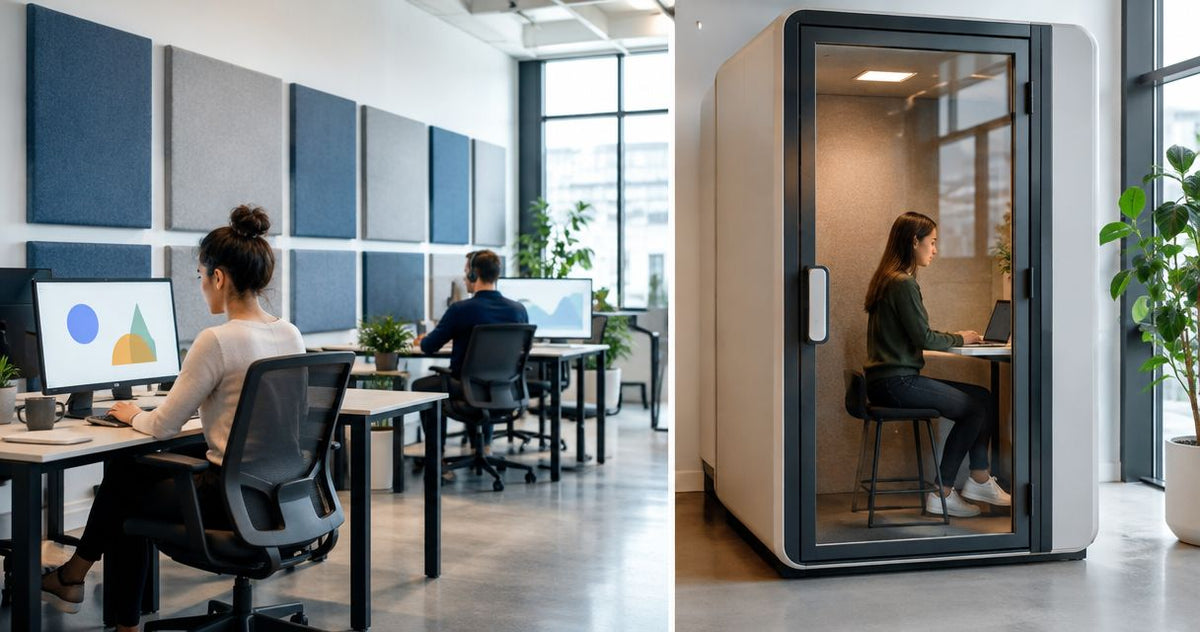
Acoustic panels reduce reflected sound across an open-plan office; office pods provide an enclosed place for calls, focused work and meetings. Choose panels for reverberation, pods for conversations that need separation, and both when those problems overlap. Neither choice guarantees silence: panels leave speech sources in the shared room, while a pod does not treat the rest of the office.
- Acoustic panels vs office pods is a choice between treating reflected sound and enclosing a specific activity.
- Acoustic panels suit reverberant shared spaces, but do not create a private room.
- Office pods suit calls and meetings, but do not treat noise across the whole office.
- Quell Workspaces offers acoustic panels and enclosed workspaces; choose by the task you need to accommodate.
Why this matters
An office can feel noisy for different reasons. Speech reflected around a room creates one problem; a nearby colleague holding a call creates another. Treating them as the same issue leads to a purchase that solves only part of the complaint.
A Folio Geometric Acoustic wall panel belongs to the room-treatment side of that decision. An enclosed booth belongs to the activity-separation side. Start with what interrupts your team, rather than choosing the object that looks most substantial.
A quieter-sounding room and a private place to talk are different outcomes. Your brief should name the outcome before it names the product.
Acoustic panels or office pods: which fixes open-plan noise?
Acoustic panels address sound reflected from room surfaces. Office pods introduce an enclosure around an activity, separating it from the shared workspace. The right choice depends on whether your main complaint is reverberation, direct speech from nearby desks, or a shortage of enclosed workspaces.
| Approach | Best for | Main advantage | Main limitation |
|---|---|---|---|
| Acoustic panels | Reducing reverberation in a shared room | Treat reflected sound without changing the office into separate rooms | Do not enclose conversations or establish speech privacy |
| Office pods | Moving calls, focused work and meetings into an enclosure | Give specific activities a separate workspace | Do not treat reverberation throughout the surrounding office |
| Panels and pods together | Offices with both reverberation and competing conversations | Address the room and the activity separately | Require a brief that covers both, rather than treating either as a complete fix |
Imagine colleagues taking calls beside desks where others are reading or writing. Panels address some of the reflected sound, but the callers remain beside those desks. Moving calls into an enclosed workspace changes where the conversation happens; it does not change every reflective surface outside it.
Now imagine an office that sounds lively even when conversations are spread out. Room treatment addresses that reflected sound more directly. A booth used by one caller does not alter how other conversations behave across the open floor.
The distinction is not panels versus pods as competing versions of the same product. Panels treat the room; pods separate a task from the room. That is the useful comparison for a workplace decision-maker.
Acoustic panels: best for reflected sound
Acoustic panels absorb some of the sound energy that reaches them, reducing the sound reflected back into the room. This is different from blocking sound between enclosed spaces. A wall treatment does not become a partition simply because it is described as acoustic.
Panels are relevant when the shared workspace itself is the problem: conversations feel persistent, sound reflects around the room, and the office lacks a settled acoustic character. Their purpose is to improve that common environment, not to give an individual a separate place to work.
What panels do well
- Address reverberation: they treat reflected sound rather than relying solely on people changing their behaviour.
- Keep the room shared: colleagues remain in the same open workspace.
- Support different activities: room treatment is relevant beyond the moments when someone uses a booth.
The limitation is equally important. A person speaking beside you still creates direct sound, and panels do not place an enclosure between you and that person. They also do not establish that a conversation cannot be understood elsewhere in the office.
Choose panels when you want to improve the shared room. Do not make panels responsible for a separate brief, such as providing a place for a private call. That mismatch creates disappointment even when the treatment is doing its intended job.
Office pods: best for calls and enclosed work
Office pods provide a separate workspace within a larger office. Their acoustic purpose differs from panels because the enclosure sits around the activity, rather than treating only the surfaces of the surrounding room.
For calls, the practical change is straightforward: the caller leaves the shared desk area. For meetings, participants have somewhere to gather without holding the discussion beside colleagues working on unrelated tasks. The enclosure becomes a destination for that activity.
What pods do well
- Separate activities: calls and meetings move away from open desks.
- Create a defined workspace: colleagues can identify where enclosed work belongs.
- Support a task-specific brief: a phone-call space and a group meeting space serve different needs.
Pods have limits. The surrounding office still contains other voices and reflective surfaces, and the enclosure occupies part of the floor plan. Its usefulness also depends on whether people can access it when they need it.
Do not turn the word soundproof into a promise of total silence. The name of a product is not a substitute for evidence about what people hear inside or outside it. When speech separation matters, distinguish a general acoustic description from a documented performance claim.
Using panels and pods together
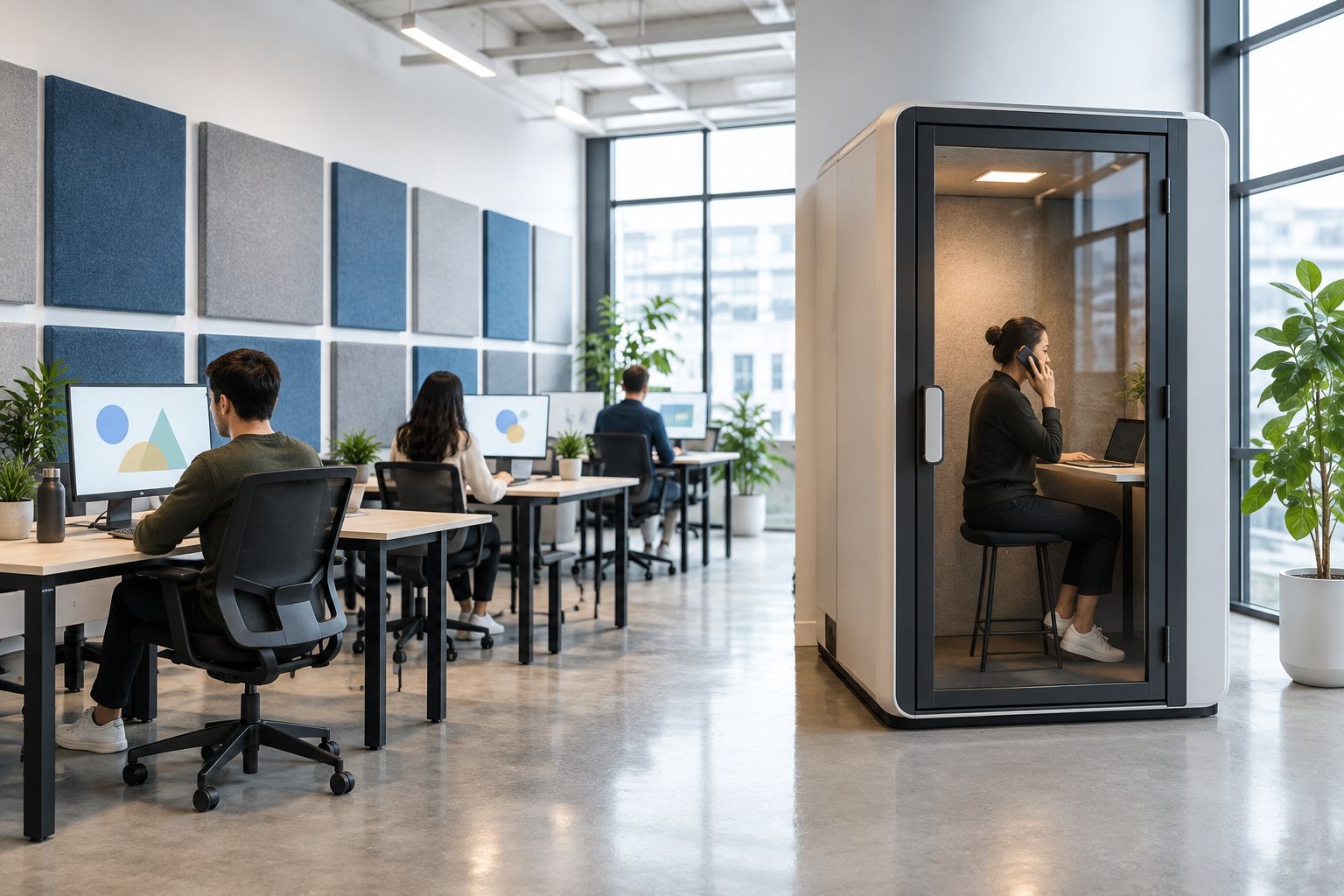
Panels and pods are complementary when your office has both room-wide reverberation and activities that need separation. The panels address reflected sound in the common space. The pod gives selected activities somewhere else to happen.
That does not mean every office needs both. If your main problem is repeated calls beside desks, start with the call-space brief. If the shared room itself sounds reverberant, start with the room-treatment brief.
Write separate success statements for each investment. For example, the room-treatment brief can describe the shared acoustic environment you want to improve. The enclosed-workspace brief can identify the calls or meetings that need a destination outside the desk area.
Keep those statements separate when reviewing the result. A frequently used booth does not prove that the shared room has improved, and a less reverberant room does not prove that conversations have become private. Each approach must answer its own brief.
Why the right choice varies between offices
The decision depends on how sound and work interact in your space, not simply on how loudly people describe the office. These factors determine which approach addresses the actual complaint:
- The sound path: reflected sound calls for room treatment; a nearby conversation remains a source of direct sound.
- The activity: individual calls, group discussions and quiet desk work create different demands on the same room.
- The required separation: making the office sound less reverberant is not the same as providing an enclosed place to speak.
- The existing workspace: available enclosed rooms change whether another task-specific space is the immediate priority.
- The overlap in demand: simultaneous calls and meetings affect whether an enclosed workspace will be available when needed.
- The shared environment: a pod serves its occupants, while panels address sound in the room where they are placed.
Do not use the phrase open-plan noise as the whole brief. It hides these distinctions. Describe the location, activity and interruption so that the proposed treatment has a clear job.
Turn the noise complaint into a useful brief
You do not need to begin with a product shortlist. Begin with the work that is being interrupted and the work that causes the interruption. A short, specific brief makes the comparison more useful than a list of acoustic features without context.
- Name the interruption. Record whether people report room-wide reverberation, nearby calls, group discussions or difficulty finding an enclosed workspace. Keep different complaints separate.
- Locate the activity. Identify where the conversation happens and where colleagues find it distracting. This distinguishes a room-treatment need from a need to move an activity.
- Name the intended outcome. Choose between improving the common room, creating a destination for calls, accommodating meetings, or addressing overlapping needs.
- Match the approach. Consider panels for reflected sound and an enclosure for a task that needs separation. Use both only where each has a stated purpose.
- Review the same complaint afterwards. Ask whether the original interruption has changed. Do not replace the original objective with a different benefit simply because the new workspace is popular.
This process is a briefing sequence, not an acoustic test. It helps you ask a clearer question; it does not establish a performance rating or predict a reduction in sound levels.
Describe the problem before requesting a specification. “We need somewhere for calls away from shared desks” gives a supplier a clearer starting point than “we need something acoustic”.
Match the workspace to the task
Quell Workspaces is best for workplace teams considering acoustic panels alongside enclosed spaces for calls and meetings. The supplied range includes both approaches, so the relevant choice is the task, not an assumption that one product category replaces the other.
| Product | Best for | Role in the brief | Limit to recognise |
|---|---|---|---|
| Folio Geometric Acoustic - Wall Panel | Considering wall treatment for a shared room | A panel option for the room-treatment shortlist | A wall panel does not create an enclosed call space |
| Office Phone Booth Folio | Considering a dedicated place for phone calls | A phone-booth option for the call-space shortlist | A booth does not treat the entire open-plan room |
| Folio Office Pod - 2-4 Person | Considering an enclosed space for small meetings | A meeting-space option identified for 2–4 people | A meeting enclosure does not replace room-wide acoustic treatment |
These are use-case distinctions, not a ranking by acoustic performance. The product names identify different destinations for work; they do not establish equivalent sound reduction or speech privacy.
Keep the same discipline when considering Quell Workspaces acoustic panels and office pods. Choose the relevant product type, then check its supplied information against the task you have named. Do not infer performance from appearance, product category or the size of the enclosure.
FAQ
Are acoustic panels better than office pods for open-plan noise?
Acoustic panels are better matched to reverberation; office pods are better matched to moving calls and meetings into an enclosure. Choose according to the interruption, rather than treating them as interchangeable products.
Will acoustic panels stop me hearing colleagues on calls?
Acoustic panels do not stop direct speech from a nearby colleague. They address reflected sound, so a call-space brief remains different from a room-treatment brief.
Does an office pod make the whole office quieter?
An office pod does not treat sound throughout the whole office. It provides an enclosed destination for an activity, while the surrounding room retains its own acoustic conditions.
Can acoustic panels make a conversation private?
Acoustic panels alone do not establish speech privacy. Reducing reflected sound is not evidence that people elsewhere cannot understand a conversation.
Should I choose a phone booth or a meeting pod?
Choose a phone booth for a dedicated call-space brief and a meeting pod for a group-discussion brief. Match the named use and supplied occupancy information to the activity you need to accommodate.
Do I need acoustic panels as well as a pod?
You need to consider both when room-wide reverberation and conversations requiring separation are distinct problems. Neither approach automatically makes the other necessary.
One last thing
The most useful final check is not whether the office contains more acoustic products. It is whether the original complaint has changed. Return to the same activity, location and interruption that shaped the brief.
For Quell Workspaces acoustic panels and enclosed workspaces, keep the conclusion equally specific. Treat reflected sound with room treatment; give calls and meetings an appropriate destination. If both problems exist, keep both objectives visible rather than asking either product to do everything.


