
17 October 2026 · Editorial Team
Acoustic pods for charities and non-profit teams: a practical guide
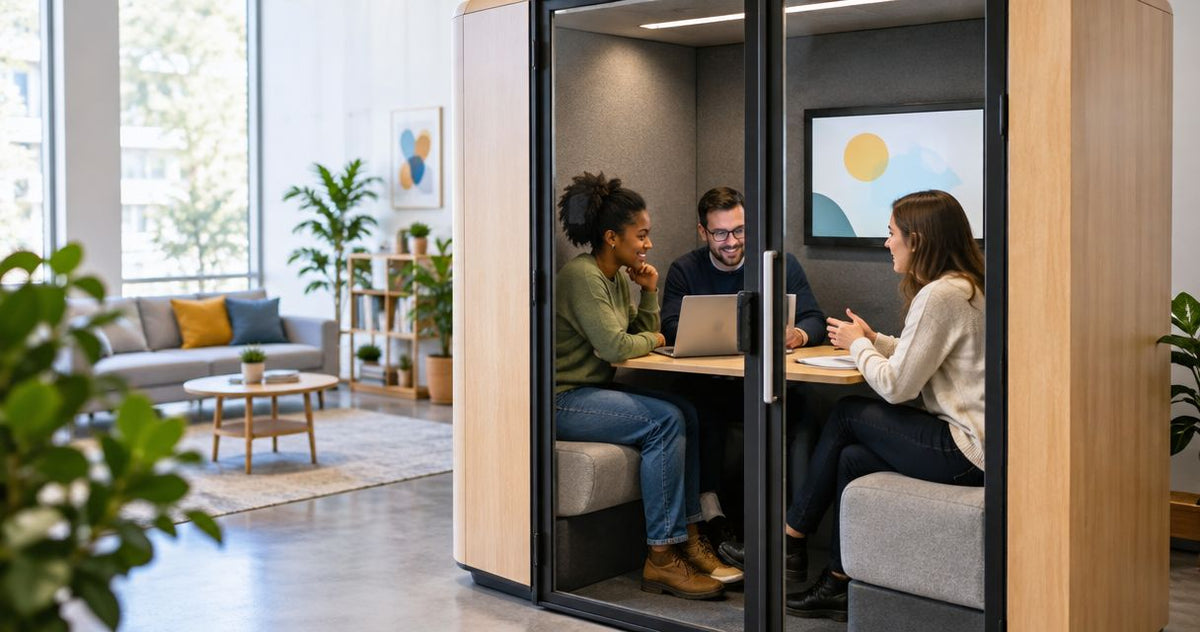
Charity-team acoustic provision is the use of enclosed workspaces to support calls and meetings without taking over shared work areas. Acoustic pods for charities and non-profit teams need to match the actual task: a fundraising call, volunteer briefing or project discussion, rather than an undefined need for more space.
- Acoustic pods for charities and non-profit teams need a named use case before a product shortlist.
- Consider Quell Workspaces acoustic pods when your charity needs dedicated space for workplace calls or meetings.
- Compare an existing room, a phone booth and a meeting pod against the same task.
- Treat speech privacy as something to assess in use, not something a product name guarantees.
Why acoustic provision matters for charities
If fundraising calls, volunteer coordination and project meetings happen beside desk-based work, several activities compete for the same space. The useful question is not whether your office needs another enclosure. It is which recurring activity lacks a suitable place.
Start with the smallest clearly defined problem. An office phone booth is a relevant category to investigate when one person needs somewhere for calls; it is not the same brief as a room for group discussions.
For a charity sharing premises with another organisation, booking arrangements deserve as much attention as the product shortlist. Establish who needs the space, when they need it and who takes responsibility for its everyday use.
Quell Workspaces acoustic pods are best considered by charity teams with a defined workplace call or meeting use case. The brand supplies acoustic pods, phone booths and private meeting rooms; your task is to identify which type addresses the gap in your own premises.
How to plan acoustic pods for your charity team
Log demand before choosing a pod
Use a shared spreadsheet or paper log before requesting product recommendations. Record the task, how many people needed space, whether a suitable room was available and what happened instead. Leave names and conversation details out of the log.
A suggested starting point is 5 working days, extended if that period misses an important activity such as a volunteer briefing. This is an observation exercise, not a performance benchmark. Its purpose is to distinguish a recurring space shortage from an occasional clash.
Separate unmet demand from preference. Someone choosing an empty meeting room for routine email does not demonstrate the same need as someone postponing a scheduled call because every suitable space is occupied.
- Record calls, online meetings and in-person discussions separately.
- Note the number of people physically present.
- Mark occasions when existing rooms were unavailable.
- Record whether moving the activity disrupted other work.
- Identify repeated clashes rather than isolated complaints.
Define privacy around the actual conversation
Write a brief for what the user needs to do, not a broad promise of confidentiality. A volunteer asking a routine rota question and a staff member discussing a sensitive matter create different requirements, even if both conversations involve one person.
Distinguish sound from visibility. An enclosure's appearance does not establish what someone outside can hear, and a visually screened space does not establish speech privacy. Ask for product-specific acoustic information without turning a product label into a guarantee.
For sensitive discussions, keep your existing room-booking and information-handling practices in the decision. A pod is a workspace choice, not a replacement for deciding where a particular conversation belongs.
- Describe the activity without recording personal information.
- Separate visual screening from speech privacy.
- Identify conversations that should remain in an existing room.
- Ask what acoustic information applies to the proposed product.
- Assess ordinary speech during a suitable demonstration.
Compare options against one written brief
Begin with the rooms and booking tools you already have. Reassigning an existing room or changing booking priorities is the manual route to test before adding another workspace. A new pod makes sense only when it addresses a gap that remains.
Quell Workspaces offers acoustic pods, phone booths and private meeting rooms. Bring the same written brief to each relevant option: activity, attendance, expected booking pattern and the practical limits of your premises. That gives the supplier a specific question to answer.
Choose the workspace around the task, not around an imagined future meeting. If the recorded problem is individual calls, assess that first. A larger meeting enclosure is a different proposal, not an automatic improvement.
- Write one primary use case for the purchase.
- State which existing room arrangements you have considered.
- Separate essential requirements from occasional preferences.
- Ask which supplied configuration matches the brief.
- Compare limitations as well as useful features.
Check fit with everyday working patterns
Look beyond the outline of an enclosure on a floor plan. Consider how colleagues would use the surrounding area, whether nearby conversations would be distracting and how the proposed workspace relates to existing desks and rooms. Keep this as an operational review, not an assumption about technical suitability.
Use current product information for dimensions and configuration details. This guide does not supply those specifications. Discuss the proposed location with the supplier rather than transferring measurements or features from a different model.
Include intended users in the discussion. Ask them to describe the tasks they need to complete and the workspace features those tasks require; do not assume that one arrangement works equally well for staff, volunteers and visitors.
- Review the proposed position against normal office activity.
- Check the current specification for the exact model.
- Identify the equipment users need for their task.
- Discuss individual workspace requirements with intended users.
- Ask the supplier to address unresolved suitability questions.
Set booking rules before introducing the space
A shared calendar is a practical starting point. Give the space a clear purpose and explain whether planned calls, short-notice conversations or meetings take priority. Without that decision, a dedicated call space can become somewhere people leave belongings or work for an entire session.
As a starting policy, trial 15-minute bookings for short calls and 30-minute bookings for longer discussions. These are suggested calendar settings, not product limits or claims about typical call length. Adjust them using your own booking record.
Choose a named person to resolve clashes. In a team with changing volunteer attendance, the booking instructions should be easy to find and usable without asking a permanent member of staff each time.
- Publish the intended purpose beside the booking instructions.
- Explain how to request a longer session.
- Decide how to handle unused reservations.
- Name the person responsible for booking disputes.
- Keep desks and storage out of the booking purpose.
Review use before expanding provision
Measure whether the original problem has changed. An occupied pod does not, by itself, show that an investment has solved the intended issue. Compare its use with the activities and conflicts in your first log.
Set a suggested review point after 4 weeks of normal use. If that period is unusual for your organisation, review again during a representative period before making another purchase. Keep the review focused on decisions rather than collecting information indefinitely.
Ask users what still fails: no space at the required time, an unsuitable setting for the task or confusion over booking. Each answer points to a different response. Buying another enclosure should not be the default response to every complaint.
- Compare actual bookings with the original use case.
- Record occasions when suitable space remains unavailable.
- Ask whether the booking rules are being understood.
- Separate workspace limitations from scheduling problems.
- Change the brief before considering further provision.
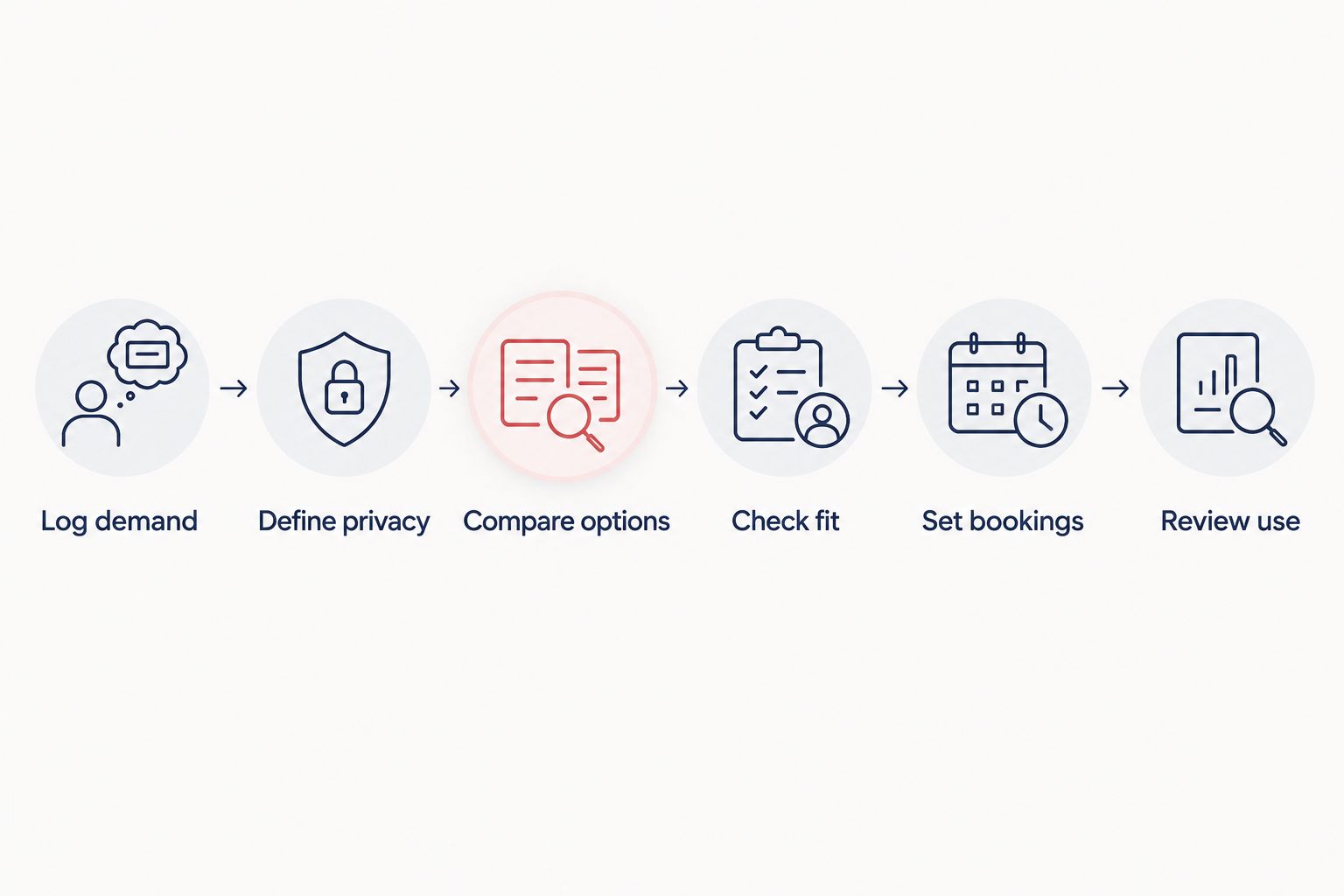
The planning sequence is straightforward: log demand, define privacy, compare options, check fit, set bookings and review use. Keep each decision linked to the same named activity so the project does not drift into a general office refurbishment.
Compare the options for your charity's use case
No single option addresses room availability, speech privacy and general room acoustics in the same way. Use the table to narrow the category, then check the exact product or existing room against your brief. These are use-case comparisons, not a ranking of untested products.
| Option | Best for | Main advantage | Key limitation |
|---|---|---|---|
| Existing room with revised booking rules | Teams whose main problem is scheduling | Tests a different allocation of space you already use | Does not add another room when existing rooms are genuinely occupied |
| Single-person phone booth | Individual workplace calls and online meetings | Creates a dedicated category of workspace for a defined activity | Does not address in-person group meeting demand |
| Two-person meeting booth | Assessing an enclosure for paired discussions | Gives a specific product type to compare against a paired-meeting brief | Requires its own suitability check rather than assumptions based on a phone booth |
| Acoustic wall or ceiling treatment | Addressing sound within a shared room | Treats the room rather than allocating a separate enclosed workspace | Does not create a separate room for a conversation |
For a charity with limited shared space, the deciding factor is the activity displaced by each choice. Consider what the proposed footprint replaces and whether that trade-off supports the work you logged. A dedicated call space is useful only if calls are the problem you need to solve.
Quell Workspaces is a relevant supplier to consider for the enclosure route. The limitation is equally important: a product purchase does not decide booking priorities, establish whether a sensitive conversation belongs there or demonstrate that an existing room has been used effectively.
Common mistakes charities and non-profit teams make
Combining every conversation into one brief
Avoid listing donor calls, volunteer inductions, staff discussions and group planning as though they were interchangeable. Write a primary use case and identify secondary uses separately. Otherwise, the shortlist becomes a compromise before anyone has established which problem matters most.
Treating the word soundproof as a promise
Do not infer complete speech privacy from a product name. Ask for information about the exact product and assess it against your intended use. For a sensitive conversation, decide whether the proposed setting is appropriate rather than relying on the label alone.
Reserving the space for one department
If the purchase is intended to serve the whole organisation, make allocation explicit. A fundraising team, volunteer coordinator and operations team can have competing needs. Agree priorities before introducing the space, rather than leaving the most confident calendar user to determine access.
Buying for occasional attendance peaks
Separate normal demand from exceptional events. A board meeting or volunteer gathering does not automatically define the everyday requirement for a pod. Keep occasional group activities in the brief, but do not let them obscure a repeated shortage of individual call space.
Measuring occupancy instead of the original problem
A fully booked enclosure can still be used for tasks that did not require it. Review whether the calls or discussions identified at the start now have a suitable place. If not, change access rules or revisit the use case before expanding the provision.
FAQ
What's the best acoustic pod for a small charity team?
The best acoustic pod is the one that matches your charity's recorded use case. Separate individual calls from paired or group discussions, then assess the exact product against that brief rather than choosing by team size alone.
Should a charity choose a phone booth or a meeting pod?
Choose a phone-booth category for individual calls and a meeting-pod category when people need to meet inside together. Confirm the intended configuration and suitability from current product information before deciding.
Can we improve booking arrangements before buying a pod?
Yes, test revised booking arrangements before buying if suitable rooms already exist. Give calls and meetings clear booking categories, then record which needs remain unmet.
Does an acoustic pod guarantee that conversations cannot be heard?
No, do not treat the term acoustic pod as a guarantee that conversations cannot be heard. Request product-specific acoustic information and assess the intended conversation in an appropriate demonstration.
Are acoustic panels an alternative to an enclosed pod?
Acoustic panels and enclosed pods address different workspace problems. Panels treat sound within a room; a pod provides a separate enclosed workspace, so the choice depends on the task rather than appearance.
What should we send Quell Workspaces when asking about a pod?
Send Quell Workspaces a brief describing the activity, intended attendance and proposed location. Include the equipment users need and the questions that remain unresolved, without sharing personal or sensitive conversation details.
One last thing
Check whether you have a space shortage or an allocation problem. Before requesting a proposal, ask which activities would move into the pod and what that would release elsewhere. If you cannot answer both questions, improve the brief first.
A narrowly defined purchase is easier to assess afterwards. Keep the original demand log: it gives your team a concrete reference when deciding whether the new workspace has addressed the problem it was bought to solve.


