
26 October 2026 · Editorial Team
Acoustic pods for healthcare administration offices

Healthcare administration acoustic pods are enclosed office workspaces intended to reduce noise around calls, focused tasks and meetings. Acoustic pods for healthcare offices should support administrative work without being treated as clinical rooms or a guarantee of confidential conversation.
- Quell Workspaces acoustic pods are best suited to healthcare administration teams seeking dedicated spaces for calls and focused work.
- Match the enclosure to the task: solo calls, paired discussions or small administrative meetings.
- Acoustic separation, visual privacy and information handling are different requirements; assess each separately.
- Use existing rooms and clearer booking rules first, then address the remaining workspace gap.
Why acoustic pods matter for healthcare administration
Healthcare administration combines telephone work, record updates, scheduling and conversations between colleagues. These activities need different working conditions: a call needs a place to speak, while concentrated paperwork needs relief from nearby conversations.
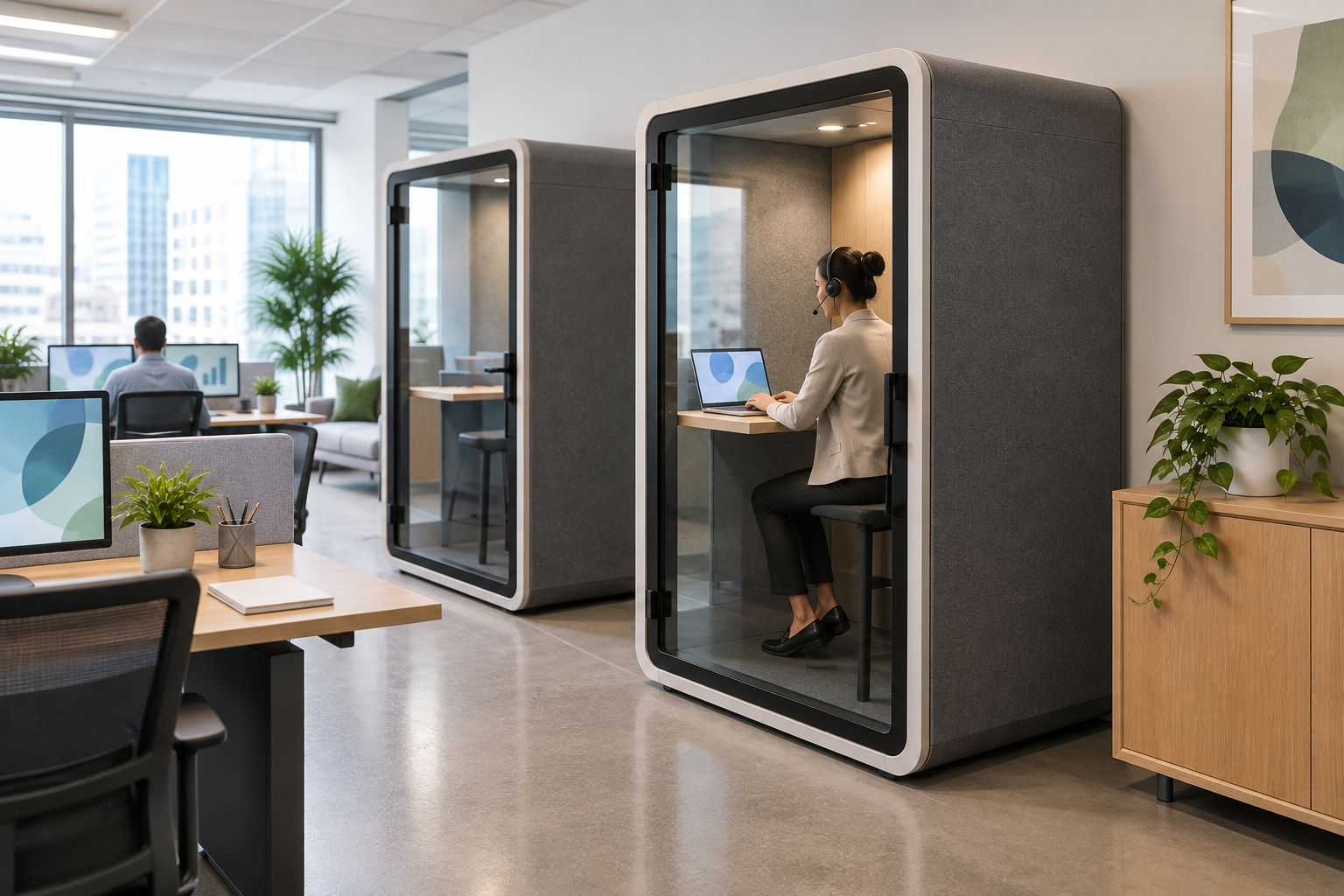
An enclosed workspace gives you somewhere to move a particular activity rather than asking everyone on the office floor to work differently. Start with the task, not the enclosure. The Office Phone Booth is a relevant commercial starting point when your brief centres on individual administrative calls.
Quell Workspaces acoustic pods are best suited to healthcare administration teams seeking dedicated spaces for calls and focused work. That recommendation concerns the workplace use case, not clinical suitability or an assurance that speech cannot be heard outside.
The distinction matters when you write the purchase brief. A quieter place to complete a scheduling call does not automatically resolve how information is displayed, discussed or handled. Define those requirements separately so that a furniture decision does not become a substitute for your organisation’s working procedures.
Plan acoustic pods around healthcare administration tasks
Identify the work that needs separation
Begin with a simple task diary. Ask colleagues to record the activity they needed to complete, where they did it and what interrupted it. Record task types rather than names, appointment details or other sensitive content.
Separate calls from quiet desk work. A person making appointment-related calls needs somewhere to speak; a colleague checking a rota needs somewhere to concentrate. Putting both into the same undifferentiated category makes the workspace brief less useful.
Also distinguish an occasional interruption from a recurring space problem. If a booking rule resolves the issue, change the rule before adding an enclosure. Your brief should explain which work still lacks a suitable place after those changes.
- List appointment scheduling, supplier calls, record updates and staff discussions separately.
- Record when an existing room is unavailable for the task.
- Note whether the activity involves speaking, listening or quiet concentration.
- Keep task diaries free of personal information.
- Identify which activities require a different setting under your organisation’s procedures.
Improve the spaces you already have
The manual approach is to make existing room use clearer. Review calendars, remove obsolete recurring bookings and describe each room’s purpose. A small room used for individual calls should not disappear from use because its booking title suggests a large meeting.
Then agree where unscheduled administrative calls belong. If colleagues have no shared rule, they must improvise each time the phone rings. A practical allocation can expose whether your problem is room access, booking discipline or a genuine shortage of enclosed space.
An acoustic pod becomes a useful additional option when the remaining task needs a dedicated setting. Quell Workspaces designs and manufactures acoustic office pods, phone booths and private meeting rooms; select the relevant product type only after identifying that gap.
- Remove recurring reservations that no longer serve a current activity.
- Label rooms by their intended workplace use.
- Agree a route for unscheduled calls.
- Separate individual concentration bookings from group discussions.
- Keep a record of tasks that still have nowhere suitable to happen.
Match the enclosure to the activity
Write a short use-case statement before looking through product pages. For example: the administration team needs an enclosed place for individual scheduling calls without occupying its shared meeting room. That statement is more useful than a request for a pod with no named purpose.
For discussions, start with the people who actually participate. The supplied catalogue includes pages named for 2-person, 4-person and 6-person spaces. These are distinct product choices, not evidence that every administration office needs the largest option.
Choose for the recurring task, not the exceptional meeting. Keep occasional larger gatherings in your existing meeting arrangements where those arrangements suit the activity. Avoid asking one enclosure to function as a call booth, shared office and general meeting room at the same time.
- Write the main activity in the purchase brief.
- Distinguish individual calls from paired discussions.
- List the equipment the task requires without assuming it is included.
- Check the selected product page for its stated configuration.
- Identify activities that should remain in existing rooms.
Assess acoustic and visual privacy separately
Start with a manual review of what people can hear and see around the proposed work area. Look at ordinary workplace conditions: nearby conversations, people passing and the direction a screen faces. Do not record real administrative conversations as test material.
Acoustic treatment and an enclosure address different aspects of sound. Absorptive panels reduce reflected sound within a space; an enclosed pod creates a separate workspace. Neither a product name nor the word soundproof establishes that a particular conversation will be inaudible outside it.
Ask Quell Workspaces for information relevant to the proposed product and task. Then assess that information against your organisation’s requirements rather than treating any enclosure as automatic permission to discuss sensitive material.
- Review speech audibility and sightlines as separate questions.
- Use neutral sample speech when assessing a setting.
- Check whether documents or screens are visible from outside.
- Request product-specific acoustic information.
- Keep information-handling decisions with the responsible team.
Plan how the pod fits into the working day
Use your existing office plan and room calendar to understand where the activity starts. A pod for frequent telephone work should be considered in relation to the team doing that work, not selected solely because an unused corner exists.
This is a workflow exercise, not an installation plan. Mark the relevant desks, shared rooms and administrative functions, then discuss the proposed location with your facilities team and supplier. Do not infer dimensions, service requirements or installation arrangements from photographs.
Think about the surrounding work as well as the activity inside. A pod beside a busy conversation area serves a different context from one near a quieter administration team. The right brief explains both the intended use and the office conditions around it.
Use the drawing to discuss location, not to assume the pictured arrangement matches a particular product. A written brief remains necessary even when the proposed layout looks straightforward.
- Mark the teams that would use the enclosure.
- Identify which existing rooms must remain available.
- Describe surrounding office activity.
- Refer product and location questions to the relevant teams.
- Confirm the proposed use before developing the purchasing brief.
Set clear booking and use rules
Start with the calendar tools you already use. Give the space a descriptive name and state its primary purpose. An individual call space and a group discussion space need different expectations, even if both are enclosed.
Define whether users book ahead or use the space when it is free. Then explain what happens when the intended task ends. Without that distinction, a space purchased for calls can become someone’s informal all-day desk.
Do not assume that an accessory or enclosure manages these rules for you. Your operating process should work independently of optional product features. Keep the rules short enough that colleagues can understand them without a separate training session.
- Name the space after its primary use.
- State whether bookings or walk-in use take priority.
- Explain which activities belong elsewhere.
- Ask users to release bookings they no longer need.
- Assign responsibility for updating the room description.
Review whether the workspace solves the original problem
Compare the completed arrangement with the task diary, not with a general impression that the office looks better. Ask whether the named administrative activity now has an appropriate place and whether other rooms remain available for their intended work.
Keep the review descriptive unless you have reliable records for a numerical comparison. Notes about booking conflicts, unsuitable tasks and user feedback are useful without converting them into unsupported productivity claims.
If the space is not serving its intended purpose, examine the booking rules and task fit before assuming another purchase is necessary. An enclosure cannot correct an unclear brief on its own.
- Revisit the original list of displaced tasks.
- Check whether colleagues use the space for its stated purpose.
- Record booking conflicts without including conversation content.
- Ask what prevents the intended activity from happening there.
- Update the operating rules before expanding the provision.
Compare workspace options for healthcare administration
Best for depends on the activity, not the product category alone. An existing room, an individual booth and a meeting enclosure offer different ways to organise administrative work. The table compares their roles and limitations without assuming product features that have not been supplied.
| Option | Best for | Main advantage | Key limitation |
|---|---|---|---|
| Existing enclosed room | Teams with suitable rooms but unclear allocation | Uses space already available to the organisation | Access depends on competing bookings and agreed priorities |
| Individual phone booth | A defined individual administrative call task | Gives calls a dedicated workspace category | Does not provide a setting for group discussion |
| Quell Plus 2 Person Pod | Paired administrative discussions | Offers a catalogue option named for 2-person use | Larger discussions need a different option |
| Quell Coworker 4 Person Meeting Booth | Small administrative team discussions | Offers a catalogue option named for 4-person meetings | Requires a clear group-use brief rather than an individual-call brief |
| Quell Plus 6 Person Meeting Booth | Administrative meetings involving a larger group | Offers a catalogue option named for 6-person meetings | Selecting it for occasional meetings does not establish a recurring need |
The Quell Workspaces options give you different product types to investigate, but the supplied catalogue names do not establish the full specification or suitability for your office. Check the relevant product information and discuss the intended use before deciding.
Existing rooms remain a valid choice. If clearer allocation meets the need, your next move is an operating change rather than a new enclosure.
Common mistakes in healthcare administration pod planning
Treating an administration pod as a clinical room
A healthcare office setting does not turn office furniture into a clinical facility. Keep the brief tied to scheduling, calls, paperwork and administrative discussions. If the proposed activity is clinical, assess it through the appropriate organisational process rather than extending the office-pod recommendation.
Assuming quieter means confidential
Reduced distraction and confidentiality are not interchangeable. Review audibility, sightlines and information handling separately. Do not use an acoustic product description as a blanket assurance that sensitive conversations cannot be overheard.
Buying for the largest occasional meeting
An exceptional group discussion is a weak basis for choosing the everyday call space. Identify the recurring activity first, then retain suitable meeting arrangements for work that does not match it. This keeps the purchase brief focused on an actual workspace gap.
Ignoring unscheduled calls
A booking-only process needs a clear answer for incoming calls that cannot wait for the next reservation. Agree the workflow before choosing the product. Otherwise, colleagues can continue taking calls at their desks while the dedicated space sits reserved for something else.
Using product photographs as a specification
A photograph shows an arrangement, not a complete list of included equipment or product requirements. Confirm what the selected product includes from its supplied information. Do not assume furniture, accessories or a pictured office layout form part of the purchase.
FAQ
Are acoustic pods suitable for healthcare administration offices?
Acoustic pods are an option for defined administrative calls, focused work and staff discussions. Assess the selected product against the task and workplace conditions; this does not establish suitability for clinical activity.
What is the best pod type for appointment scheduling calls?
An individual phone booth is the relevant starting category for appointment scheduling calls made by one colleague. Confirm the task, equipment needs and workplace requirements before selecting a product.
Does an acoustic pod guarantee that conversations are confidential?
An acoustic pod does not by itself guarantee confidential conversation. Assess speech audibility, visual privacy and information-handling procedures separately for the proposed activity.
Should an administration team choose a phone booth or a meeting pod?
Choose a phone booth for a defined individual call task and a meeting pod for discussions involving colleagues. The recurring activity should determine the choice rather than an occasional larger meeting.
Can acoustic panels replace an enclosed office pod?
Acoustic panels and enclosed pods serve different purposes. Panels address reflected sound within a space, while a pod provides a separate workspace; decide which problem your administration team needs to address.
How should staff book an administrative call pod?
Use a clear booking or walk-in rule that matches the administrative task. State the primary purpose, explain how unscheduled calls are handled and ask colleagues to release unused reservations.
One last thing
Before approving an enclosure, write down the task it should remove from the shared office floor. If that sentence contains several unrelated activities, split the brief and decide which need matters most.
The useful question is not whether your office needs a pod; it is which administrative task needs a dedicated place. That gives you a clearer product discussion and a practical test after the space is in use.


