
16 October 2026 · Editorial Team
Acoustic pods for public sector offices: a practical guide
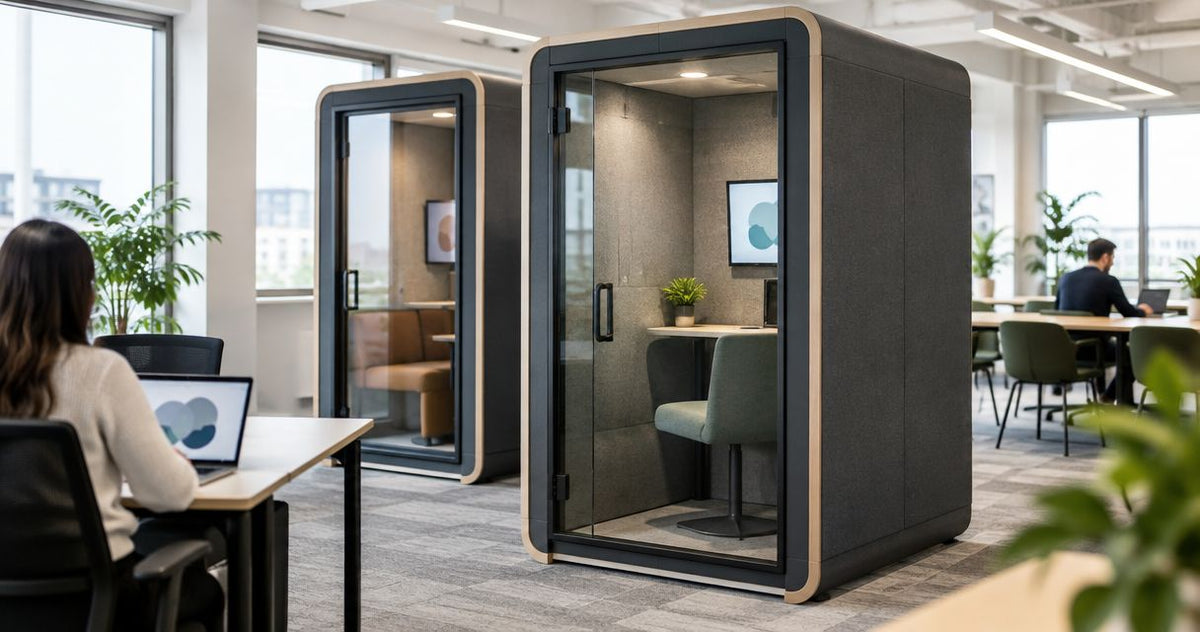
Public sector office acoustic pods are enclosed workspaces intended to separate calls and meetings from shared desks, with the aim of making office space more useful. Choosing acoustic pods for public sector offices starts with the activity you need to accommodate: staff calls, internal discussions and public-facing conversations need different arrangements.
- Choose acoustic pods for public sector offices around named activities, not a general wish for quieter desks.
- Quell Workspaces acoustic pods are best for teams seeking dedicated spaces for office calls and meetings.
- Compare phone booths, meeting pods and existing rooms before deciding what to add.
- Treat speech privacy as something to assess in use, not something an enclosure automatically guarantees.
Why acoustic pods matter for public sector offices
A call made beside shared desks creates a different problem from a meeting that has nowhere to take place. Start by identifying which problem your office actually has. Otherwise, you risk specifying an enclosure without resolving the reason staff leave their desks.
Public sector workplace briefs can cover staff administration, remote meetings and conversations with members of the public. Separate those activities rather than treating them as interchangeable. A space suitable for a routine internal call is not automatically appropriate for a discussion involving sensitive information.
An office phone booth is a relevant starting point when the brief centres on individual calls. Group discussions need a separate brief, while persistent noise across the wider office needs attention beyond an enclosed workspace.
Choose the activity first; choose the enclosure second. This keeps the decision tied to an operational need rather than a product category.
How to plan acoustic pods for your office
1. Record the activities that lack suitable space
Start with a simple shared spreadsheet and a walk-through with the teams using the office. Record why people move away from their desks, where they go and whether they find an appropriate space. You do not need a new booking system to establish the basic pattern.
Use a 5-working-day observation period as an initial planning exercise, not as proof of year-round demand. Include different teams and working patterns. If the period excludes an important service cycle, add observations from that cycle before drawing conclusions.
Distinguish between an available room and a suitable room. An empty room elsewhere in the building does not resolve every team's practical needs.
- Record the activity: telephone call, video meeting, internal discussion or visitor conversation.
- Note how many people need the space together.
- Record whether an existing room was available and suitable.
- Identify recurring conflicts between different activities.
- Keep personal information out of the observation log.
2. Separate routine calls from sensitive conversations
Write a short activity brief before comparing products. A blank document is enough: describe what happens in the space, who uses it and what would make it unsuitable. Ask the relevant service owner to review the intended use.
Do not write a single requirement called privacy. Speech being less distracting, screens being out of view and a conversation being appropriate for a particular setting are different considerations. An enclosure does not settle all of them.
For public-facing work, describe the whole interaction rather than only the staff member's seat. Consider how visitors find the space, how staff manage appointments and what happens when the space is occupied. Keep sensitive activities in an existing suitable room until the proposed arrangement has been assessed.
- Separate routine staff calls from discussions involving sensitive information.
- Describe what surrounding colleagues should and should not hear.
- Record whether screen visibility matters to the activity.
- Identify who decides whether the proposed setting is appropriate.
- Document which activities remain assigned to existing rooms.
3. Match the workspace type to the activity
Begin by checking whether a change to room allocation or booking rules addresses the problem. If suitable space already exists but is difficult to find, adding another enclosure leaves the underlying booking issue unresolved. Review that possibility before specifying new furniture or pods.
Quell Workspaces offers acoustic office pods, phone booths and private meeting rooms. Quell Workspaces acoustic pods are best for teams seeking dedicated spaces for office calls and meetings. The limitation is equally important: a product category alone does not establish suitability for every public sector activity.
Compare the proposed workspace against the activity brief, rather than treating every enclosed option as equivalent. Ask for information about the particular configuration under consideration; do not transfer assumptions from another model.
- Use a phone-booth brief for individual calls.
- Use a meeting-space brief for conversations involving several participants.
- Retain existing rooms for activities that need a different setting.
- Separate wider office noise concerns from the need for enclosed workspaces.
- Record why the chosen workspace type addresses the observed problem.
4. Check the everyday experience before deciding
Write a realistic trial agenda using ordinary work tasks. Where a demonstration is available, use your normal laptop, headset and meeting software rather than judging the space from an empty-room visit. Keep the test focused on the activities in your brief.
For a call space, check the experience both inside and outside while a routine conversation takes place. This is a practical observation, not a guarantee about speech privacy. Do not use sensitive information during the exercise.
For a meeting space, check how participants see one another and share information. Ask prospective users about their experience rather than assuming that the person choosing the product represents everyone who will use it.
- Try a routine voice call and a video meeting.
- Check the camera view and background with normal equipment.
- Observe whether screen sharing works for the intended task.
- Listen from the surrounding workspace during ordinary speech.
- Record user feedback against the original activity brief.
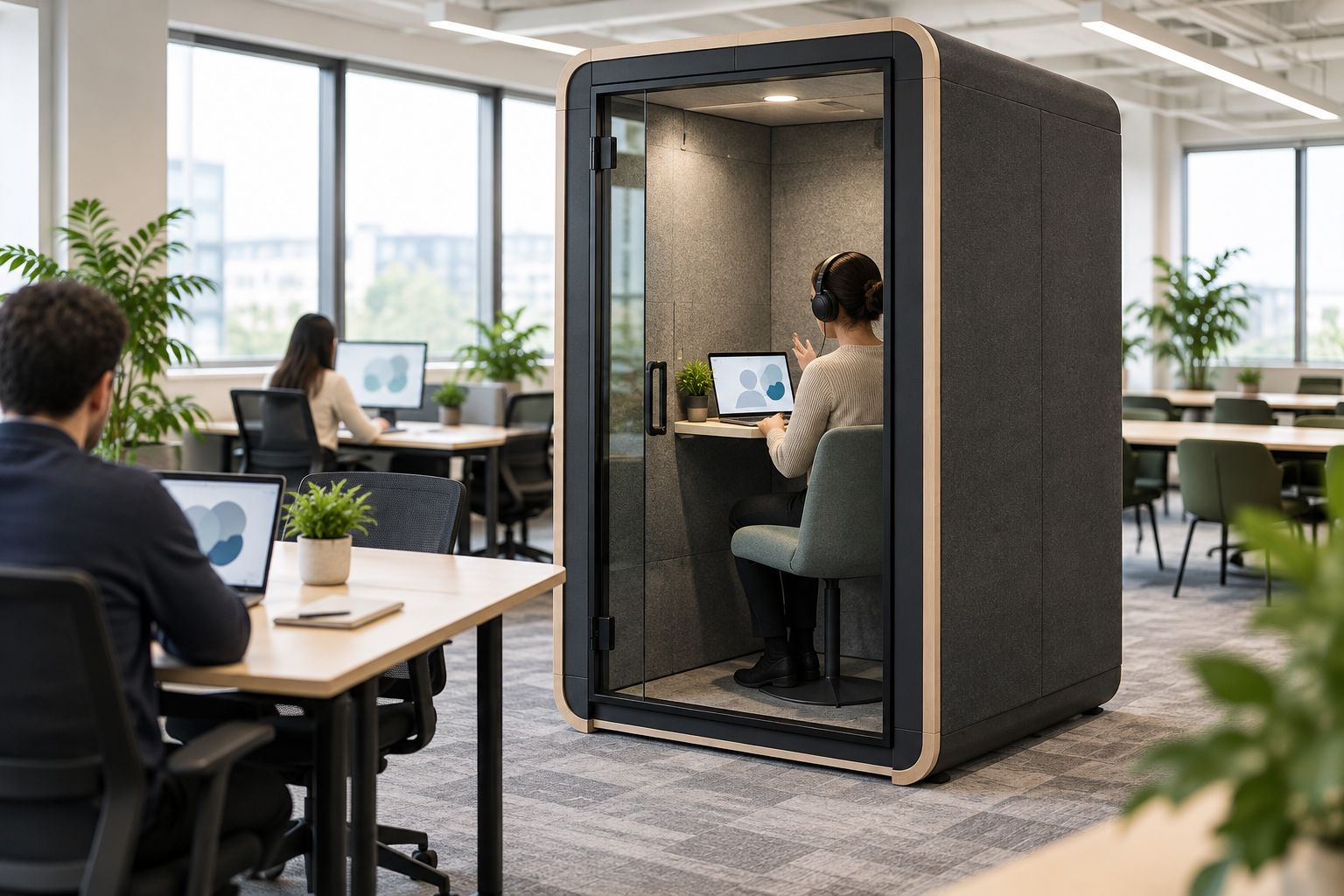
5. Write a brief that supports a clear decision
Build the decision document from the observation log and trial notes. A shared document is sufficient. Describe the problem, the activities the space must support and the limitations you are prepared to accept.
Keep supplier information separate from your own observations. A product description, a demonstration and staff feedback answer different questions; combining them into a single favourable summary makes the decision harder to examine later.
When considering Quell Workspaces, use information for the actual product and configuration being discussed. Do not assume that an accessory shown elsewhere is included, or that information about another enclosure applies. A useful brief makes uncertainty visible without turning it into a claim.
- State the operational problem in one plain sentence.
- List the activities the proposed workspace must accommodate.
- Attach relevant supplier information without rewriting it as a broader promise.
- Record unresolved questions and who will answer them.
- Explain why existing rooms or booking changes do not meet the same need.
6. Review use after the workspace opens
Start with a simple calendar or existing booking process. Explain which activities belong in the space and which should remain elsewhere. A pod intended for calls does not serve that purpose if it becomes an informal storage area or an unbookable personal office.
Schedule an initial review after 2 weeks of normal use. This is a management checkpoint, not a claim about how quickly benefits appear. Compare actual use with the problem recorded at the start, and keep observations free of personal conversation details.
Choose 3 measures: bookings, unsuccessful attempts to find space and reported problems with the intended activity. Interpret them together. Frequent bookings show use, but do not establish that the original problem has been resolved.
- Publish the intended use in the existing booking process.
- Assign an owner for booking questions and user feedback.
- Record unsuccessful attempts to find suitable space.
- Check whether the space is used for its intended activity.
- Adjust booking rules before assuming another enclosure is needed.
Compare the practical options
Best for individual calls: a phone booth gives the brief a clear focus. Its limitation is that an individual-call workspace does not answer a group-meeting requirement.
Best for shared discussion: a meeting pod addresses a different activity. Its suitability still depends on the proposed configuration and the way your team works.
Best for an existing room shortage caused by booking: changing room allocation tackles the process first. It does not create additional physical space.
Acoustic panels address sound within a room rather than creating an enclosed conversation space. Keep that distinction clear when comparing proposals: reducing reverberation and separating a conversation are different objectives.
| Option | Best for | Practical advantage | Key limitation |
|---|---|---|---|
| Phone booth | Individual staff calls and video meetings | Creates a dedicated setting for the call brief | Does not meet a group-discussion requirement |
| Meeting pod | Internal discussions involving several participants | Provides a shared enclosed setting | Needs its own activity and configuration assessment |
| Existing enclosed room | Activities already suited to that room | Uses space your organisation already has | Competes with other room bookings |
| Booking or allocation changes | Suitable rooms that are difficult to secure | Addresses how existing space is used | Adds no physical capacity |
| Acoustic wall or ceiling panels | Reverberation within a shared room | Addresses room acoustics without enclosing desks | Does not create a separate conversation room |
These options are not always substitutes. An office can need a better booking process and a dedicated call space at the same time. Choose each intervention against a named problem, rather than expecting one purchase to address every complaint about the workplace.
Common mistakes public sector teams make
Treating every conversation as the same use case
An internal project update and a public-facing appointment need separate consideration. A brief that simply asks for private conversations hides the differences. Name the activity, participants and decision owner before choosing an enclosure.
Using an enclosure as proof of confidentiality
A door and walls do not establish that a setting is appropriate for sensitive information. Keep the distinction between reduced distraction and suitability for a particular conversation explicit. Refer the activity brief to the people responsible for that service.
Buying around a booking problem
If suitable rooms are repeatedly reserved but unused, another space does not correct the booking behaviour. Check how rooms are allocated and released before expanding provision. Keep the purchase case separate from changes that your existing process needs.
Assessing only the person inside
The surrounding office is part of the assessment. A call that feels comfortable inside an enclosure still needs observation from nearby desks. Test ordinary speech without sensitive content, and record both experiences rather than relying on one person's impression.
Letting the original purpose disappear
A call space used for all-day desk work is unavailable for calls, even when it is fully occupied. Define the purpose, review actual use and resolve conflicting expectations. Utilisation is useful only when it relates to the activity the space was chosen to support.
FAQ
What are acoustic pods for public sector offices used for?
Acoustic pods for public sector offices provide enclosed settings for activities such as staff calls, video meetings and internal discussions. Define the intended activity before choosing a workspace type, and assess public-facing conversations separately.
Is a phone booth or a meeting pod better for staff calls?
A phone booth is the more relevant starting point for individual staff calls; a meeting pod addresses shared discussions. Compare the specific configuration with your activity brief rather than assuming that any enclosure suits both tasks.
Can an acoustic pod replace a room for sensitive conversations?
An acoustic pod should not replace an existing suitable room solely because it is enclosed. The people responsible for the activity need to assess the proposed setting before it is used for sensitive conversations.
Do acoustic panels do the same job as an office pod?
No, acoustic panels address sound within a room, while an office pod creates an enclosed workspace. Choose panels for a room-acoustics brief and assess an enclosure separately when the requirement is a dedicated conversation space.
How do we decide how many call spaces to provide?
Base the decision on overlapping demand and unsuccessful attempts to find suitable space. A booking total alone does not show whether people need the space at the same time or whether existing rooms can meet the demand.
What should we check before choosing Quell Workspaces?
Check the proposed Quell Workspaces product against your named activity, actual equipment and expected users. Keep supplier information, demonstration observations and unresolved questions separate in the decision brief.
One last thing
A fully booked pod is not automatically a successful pod. If long individual work sessions prevent staff from making the calls it was intended to accommodate, the booking calendar conceals the problem rather than explaining it.
At the first review, ask which intended activities still lack suitable space. That question gives you a clearer next move than occupancy alone: change the booking rules, refine the brief or investigate a genuinely different workspace need.


