
13 October 2026 · Editorial Team
Best breakout furniture for co-working spaces

Best overall for a social breakout area: Bugsy Lounge Chair. Best for seated work away from the main desk area: Billy Office Chair. Best for informal perch seating: Joy Stool. Best for furnishing a dedicated group pod: Furniture for 4-Person Office Pods. Choose breakout furniture for co-working spaces by the activity you need to support, rather than giving every shared area the same seating.
- Bugsy Lounge Chair leads this breakout furniture for co-working spaces shortlist for informal social seating.
- Billy Office Chair is the choice for a breakout workstation, not a lounge setting.
- Joy Stool serves a different role from lounge seating: an informal place to perch.
- Furniture for 4-Person Office Pods belongs on the shortlist for a dedicated group pod.
- Quell Workspaces breakout furniture should be selected by activity; furniture alone does not create speech privacy.
Why this matters
A co-working breakout area has to serve people with different intentions. Someone taking a break needs a different setting from someone answering emails or discussing a project. The best furniture choice starts with a clear purpose for the space.
Quell Workspaces offers seating and pod-furniture options, but those categories are not interchangeable. A lounge chair belongs in a different brief from furniture intended for a group pod. You can start with the Bugsy Lounge Chair when the brief is informal seating rather than another workstation.
Avoid asking a single breakout corner to be a social lounge, a quiet work area and a meeting space at the same time. Write down its main job first. That decision makes the shortlist clearer and helps members understand how to use the finished area.
What makes the best breakout furniture for co-working spaces?
Use these criteria to decide which furniture category belongs in your space. They concern the role of the furniture, not unverified claims about materials, comfort or performance.
- Activity fit: distinguish between taking a break, working at a surface, perching and holding a group discussion.
- A clear seating role: choose lounge seating for a lounge brief and office seating for a workstation brief.
- Useful variety: add a different kind of setting, rather than duplicating what the main desk area already provides.
- A defined relationship with tables: decide whether the seat is for conversation or work at a surface before choosing accompanying furniture.
- A clear privacy boundary: separate the furniture decision from any need for an enclosed conversation space.
- An understandable layout: make the intended use apparent through the furniture arrangement and the way you describe the area to members.
These criteria prevent a common planning mistake: choosing attractive furniture before deciding what people should do there. A chair can suit its own category and still be the wrong choice for your brief.
Breakout furniture at a glance
The shortlist ranks products by distinct uses. It does not rank acoustic performance, upholstery quality or comfort, and it does not treat pod furniture as a substitute for open lounge seating.
| Rank and item | Best for | Defining role | Key limitation |
|---|---|---|---|
| 1. Bugsy Lounge Chair | Informal social seating | Lounge-chair option for a break area | Lounge seating does not create an enclosed conversation space |
| 2. Billy Office Chair | A breakout workstation | Office-chair option for seated work | It serves a workstation brief rather than a distinct lounge brief |
| 3. Joy Stool | Informal perch seating | Stool option within a mixed seating plan | A stool should not be treated as interchangeable with a lounge chair |
| 4. Furniture for 4-Person Office Pods | Furnishing a dedicated group pod | Furniture listed for a four-person office-pod setting | It is a pod-specific choice, not the default for an open breakout area |
1. Bugsy Lounge Chair: best for informal social seating
Bugsy Lounge Chair is the clearest starting point when you want a breakout area to feel functionally different from the desk area. Its role in this shortlist is lounge seating. Choose it for a space whose main purpose is a break or an informal conversation, rather than work at a desk.
The useful distinction is not a claimed comfort score. It is the type of setting you are creating. If your shared workplace already has desk seating, a lounge-chair brief gives you a reason to add something different.
Bugsy Lounge Chair pros:
- Matches a lounge-seating brief directly.
- Gives the breakout plan a seating category distinct from office chairs.
- Provides a clear starting point for an informal conversation area.
Bugsy Lounge Chair cons:
- A lounge chair alone does not address a requirement for enclosed conversations.
- It is not the default choice when the main activity is work at a desk or table.
Best for: a social breakout area where members pause work or have an informal conversation.
Keep the brief focused. Decide whether the area is primarily for breaks or discussion before choosing any accompanying surface. Adding a work surface changes what the setting invites people to do, so that decision should be deliberate.
Verdict: Choose Bugsy Lounge Chair as the default for a lounge-led breakout area.
2. Billy Office Chair: best for a breakout workstation
Billy Office Chair belongs on the shortlist when your breakout area includes seated work at a surface. It is an office-chair option, not a lounge-chair alternative. The relevant question is whether you need another place to work or a place to step away from work.
A secondary workstation has a different purpose from a social corner. It can form part of a mixed breakout area, but you should identify it as a work setting rather than presenting all seating as interchangeable.
Billy Office Chair pros:
- Matches an office-seating brief.
- Gives a breakout workstation a distinct furniture choice from the lounge area.
- Lets you plan seated work separately from informal social seating.
Billy Office Chair cons:
- Another office chair does not, by itself, create a different kind of break area.
- The surrounding work surface remains a separate selection decision.
Best for: a breakout workstation intended for seated desk or table work.
Avoid choosing Billy Office Chair simply because members already use office chairs elsewhere. Familiarity does not establish the purpose of a new area. If the brief says “somewhere to take a break”, start with lounge seating; if it says “another place to work”, office seating belongs in the discussion.
Quell Workspaces breakout furniture should give each setting a clear role. Billy Office Chair serves the work setting in this shortlist, while Bugsy Lounge Chair serves the lounge setting.
Verdict: Choose Billy Office Chair for a breakout workstation; skip it as the default for a social lounge.
3. Joy Stool: best for informal perch seating
Joy Stool adds a stool option to the shortlist. Its role is informal perch seating, distinct from both a lounge chair and an office chair. Use that distinction to decide whether it fills a genuine gap in your furniture plan.
A mixed seating plan does not need every furniture category. It needs categories that serve different activities. Include a stool because you want a perch setting, not simply because the lounge and workstation choices are already covered.
Joy Stool pros:
- Adds a seating category different from the chairs in this shortlist.
- Matches an informal perch-seating brief.
- Can be considered as one part of a varied breakout plan rather than its only seating choice.
Joy Stool cons:
- A stool is not a direct substitute for a lounge chair or office chair.
- Any intended pairing with a table or counter needs to be checked against the actual products selected.
Best for: an informal perch setting within a broader breakout area.
Define the intended activity before selecting accompanying furniture. A place to pause and chat has a different brief from a place to open a laptop. Do not infer that the same combination of stool and surface will serve both equally well.
Keep another seating category in the plan if the area also needs to function as a lounge or workstation. The reason to shortlist Joy Stool is variety of use, not a claim that stools are the best seating for everyone.
Verdict: Choose Joy Stool for a defined perch setting; skip an all-stool plan for a mixed-use breakout area.
4. Furniture for 4-Person Office Pods: best for a group-pod brief
Furniture for 4-Person Office Pods is a different kind of recommendation from the individual seating options. The destination identifies furniture for a four-person office-pod setting. Shortlist it when you are furnishing that setting, rather than treating it as an open-lounge furniture collection.
The important distinction is scope. Furnishing an existing or planned pod is a specific task; choosing furniture for an open social area is another. Confirm the intended pod and the contents of the furniture selection before making the final choice.
Furniture for 4-Person Office Pods pros:
- Directly addresses a four-person office-pod furniture brief.
- Gives group-pod furnishing its own place in the decision process.
- Keeps pod furniture separate from the individual lounge, office-chair and stool choices.
Furniture for 4-Person Office Pods cons:
- It is not the default recommendation for an open breakout lounge.
- The furniture choice does not establish the pod’s acoustic performance or suitability for a particular conversation.
Best for: a dedicated group pod that needs furniture selected for its intended setting.
Do not assume that a pod-furniture listing supplies every element of the meeting space. Keep the furniture selection and the enclosure selection as separate decisions. Neither should stand in for checking the other.
For a Quell Workspaces group-pod project, begin with the exact pod you intend to furnish. Then confirm the furniture choice against that project, rather than selecting it solely because the group size sounds right.
Verdict: Choose Furniture for 4-Person Office Pods for a matching group-pod brief; skip it for a general open-lounge brief.
How the shortlist is ranked
The order follows the purpose of a typical breakout brief: a setting away from the main desk area. Bugsy Lounge Chair leads because it addresses lounge seating; Billy Office Chair, Joy Stool and Furniture for 4-Person Office Pods each address a different, narrower use.
This is a use-case shortlist, not a product-testing league table. The supplied product destinations identify the furniture categories. The recommendations explain where those categories belong without assigning unsupported performance scores.
Turn the shortlist into a furniture brief
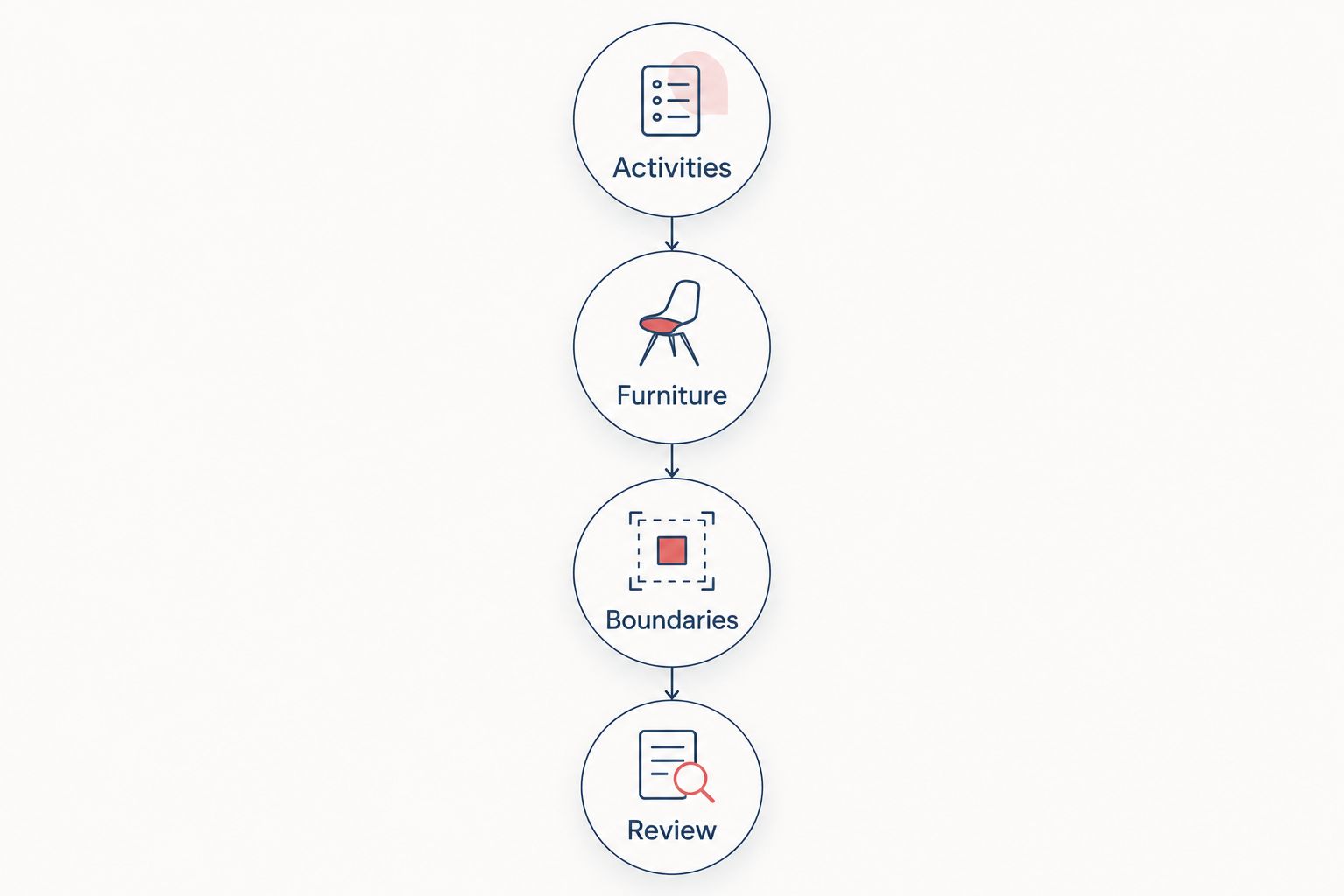
A useful brief should explain what members will do, which furniture category supports it and what remains a separate decision. Use the following sequence before selecting individual items.
Activities
Write the intended activities in plain language: taking a break, informal conversation, seated work or group discussion. Give the area a main purpose. If every activity receives equal priority, divide the brief into separate settings instead of asking one furniture arrangement to do everything.
Furniture
Match the main activity to its furniture category. Lounge seating, office seating, stools and pod furniture each have a place in this shortlist, but none is the universal answer. Select the category first, then assess the actual product for your project.
Boundaries
State what the furniture is not expected to solve. An open social setting is not an enclosed conversation space. A workstation is not automatically a break area. A furniture selection for a pod does not establish the performance of the enclosure around it.
Review
Read the brief as if you were a member using the space for the first time. Can you tell whether it is for work, breaks or discussion? If the answer depends on a long explanation, simplify the intended use before adding more furniture.
Do not turn the shortlist into a requirement to buy every category. A focused lounge area can have a lounge brief; a secondary work area can have a workstation brief. Variety is useful only when it serves a different activity.
Which breakout furniture should you choose?
Bugsy Lounge Chair is the default choice in this shortlist for an informal co-working breakout lounge. Start there when the purpose is to give members a setting away from desk work.
Choose Billy Office Chair when the brief is specifically a secondary workstation. Choose Joy Stool when you have identified a separate perch setting. Choose Furniture for 4-Person Office Pods when you are furnishing a dedicated group pod rather than an open lounge.
Quell Workspaces breakout furniture is best selected as a set of different functional choices, not a single category with a universal winner. Keep the lounge, work and pod briefs separate until you know which ones the space actually needs.
FAQ
What's the best breakout furniture for co-working spaces?
Bugsy Lounge Chair is the default in this shortlist for an informal lounge area. Choose Billy Office Chair for a breakout workstation, Joy Stool for a perch setting, or Furniture for 4-Person Office Pods for a dedicated group-pod brief.
Should a co-working breakout area use lounge chairs or office chairs?
Use lounge chairs for a lounge brief and office chairs for a workstation brief. The intended activity should determine the category, rather than treating both types of seating as interchangeable.
Is Joy Stool a replacement for a lounge chair?
Joy Stool serves a different seating role from a lounge chair. Shortlist it for an informal perch setting, not as an automatic replacement for lounge seating throughout the area.
Which furniture should I shortlist for a four-person office pod?
Furniture for 4-Person Office Pods is the relevant option in this shortlist. Confirm the intended pod and the contents of the furniture selection before deciding.
Does breakout furniture make conversations private?
Furniture alone does not create an enclosed conversation space. Treat any requirement for speech privacy as a separate decision from selecting chairs, stools or pod furniture.
How do I avoid choosing the wrong breakout furniture?
Define the area's main activity before choosing a product. Match that activity to lounge seating, office seating, a perch setting or a dedicated pod-furniture brief, then check the actual selection against your project.
One last thing
The most useful final check is to remove the product names from your brief. If the description still clearly explains what members will do in the area, you have a basis for choosing furniture. If it only describes a collection of chairs, revisit the purpose before making the selection.
Choose the activity first. Let the furniture follow.


