
13 October 2026 · Editorial Team
Best desk privacy screens for open-plan offices

Best overall for sightlines at a single desk: a desk-mounted privacy screen. Best for room noise: acoustic wall panels. Best for confidential calls: an acoustic phone booth. No single product fixes all three, so pick by the problem you actually have.
- Desk privacy screens for open-plan offices block sightlines, not speech. Buy one only if visual distraction is the complaint.
- Acoustic wall panels and ceiling panels reduce room noise. They do not give anyone privacy.
- An acoustic phone booth is the right fix for confidential calls. It takes floor space, so size the order to your team.
- Match the product to the complaint: sightlines, noise or calls. Buying all three at once rarely pays off.
Why desk privacy screens are only part of the answer
Open-plan complaints fall into three groups: people can see your screen, people can hear your conversation, and people can hear everyone else's. A desk screen deals with the first. It does very little about the second and third, because speech travels over and around a screen.
If noise is the main complaint, start with the acoustic wall panels guide for open-plan offices. If you are unsure whether panels or enclosed spaces fit your layout, acoustic panels or office pods compares the two directly.
What makes a good privacy fix for an open-plan office
Use these criteria to judge any option before you buy:
- Problem it solves: sightlines, room noise or private calls. Be specific about which.
- Footprint: how much desk or floor space it takes from the team.
- Effect on collaboration: whether it cuts people off from each other or only from the aisle.
- Shared or individual: one desk, a row of desks or the whole floor.
- Flexibility: how easily it adapts when the layout changes.
Desk privacy screens at a glance
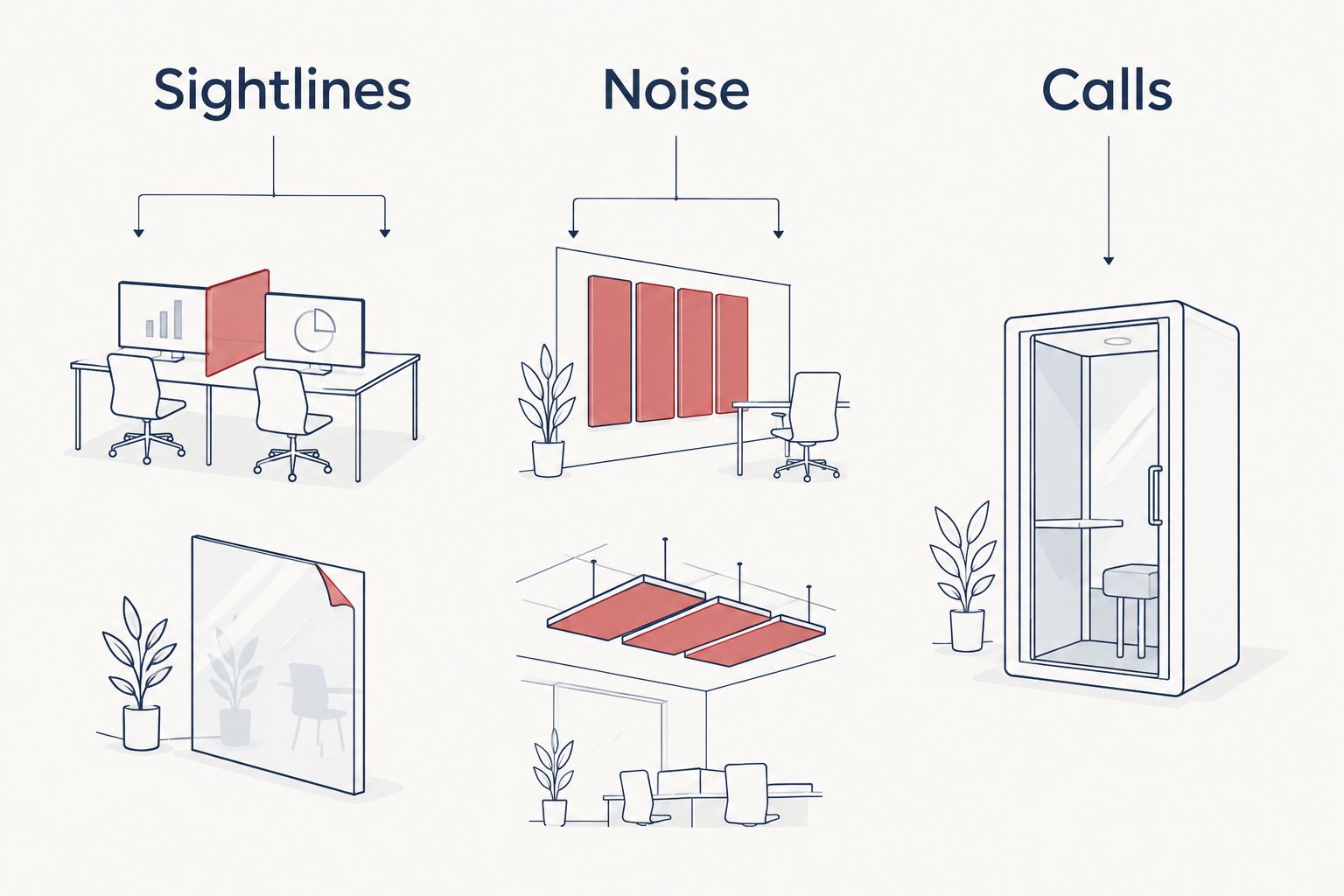
The options sit in different columns because they solve different problems. Two of them compete for the same job only when you ignore what staff are actually complaining about.
| Option | Best for | Standout feature | Key limitation |
|---|---|---|---|
| Desk-mounted privacy screen | Blocking sightlines at a desk | Targets one workstation | Little effect on speech |
| Acoustic wall panels | Reducing room echo | Treats the shared space | No visual privacy |
| Ceiling panels | Rooms with limited wall space | Uses overhead surface | No visual privacy |
| Acoustic phone booth | Confidential calls | Fully enclosed space | Needs floor space |
| Privacy film | Adding privacy to Quell pods | Optional pod addition | Only for Quell Workspaces pods |
1. Desk-mounted privacy screens: best for sightline control
A desk screen sits at the edge of a workstation and blocks the view from the aisle or the neighbouring desk. It is the lowest-disruption change on this list because it leaves the room layout alone.
Desk screen pros:
- Targets the individual desk where the complaint comes from
- No change to the room layout
- Works for desks that people use in rotation
Desk screen cons:
- Speech passes over and around it, so noise complaints remain
- Can make a team feel divided if every desk gets one
- Adds clutter next to monitors
Best for: teams handling sensitive screens, such as finance or HR. Verdict: Buy, but only where sightlines are the real issue.
2. Acoustic wall panels: best for echo and general noise
Wall panels absorb sound in the shared room, which softens the background hum of conversation. Quell Workspaces lists the Folio geometric acoustic wall panel among its acoustic products.
Wall panel pros:
- Treat the whole room rather than one desk
- Work alongside desk screens without competing with them
- Fixed to a wall, so they take no desk or floor space
Wall panel cons:
- Give nobody visual privacy
- Need free wall area close to where the noise is
- Reduce echo but do not stop a nearby conversation being heard
Best for: open rooms where the complaint is a general din. Verdict: Buy, paired with a screen where sightlines also matter.
3. Ceiling panels: best when walls are unavailable
Glazed or fully used walls leave panels with nowhere to go. Ceiling panels use the overhead surface instead. The guide to ceiling rafts for open-plan noise route is worth considering when the walls are already taken.
Ceiling panel pros:
- Free up wall space for screens, whiteboards or storage
- Treat the room without touching desks
Ceiling panel cons:
- No visual privacy
- Less targeted than panels placed near the noise source
Best for: glass-walled or heavily furnished rooms. Verdict: Wait until you have confirmed that wall panels are not an option.
4. Acoustic phone booths: best for confidential calls
A screen cannot make a call private. An enclosed booth can. The acoustic phone booth gives one person a closed space for calls, so the open floor stays quiet and the caller is not overheard.
Phone booth pros:
- Removes calls from the open floor entirely
- Serves a whole team, not one desk
- Gives video calls a dedicated space
Phone booth cons:
- Takes real floor space
- Several people may want it at the same time in a larger team
Best for: teams with frequent calls or video meetings. Verdict: Buy when calls are the main source of disturbance.
5. Privacy film: best for adding privacy to an existing Quell pod
Quell Workspaces describes its privacy film as an optional addition created exclusively for its own pods. It adds privacy for more confidential meetings.
Privacy film pros:
- Adds visual privacy to a pod without changing the pod
- Optional, so you choose per pod
Privacy film cons:
- Only relevant if you already own or plan to buy a Quell Workspaces pod
- Does nothing for open desks
Best for: owners of a Quell pod who use it for sensitive meetings. Verdict: Skip unless you have a pod.
How the options were ranked
Each option was matched to the criteria above: the problem it solves, space cost, effect on collaboration and flexibility. Nothing here is ranked by price, because price changes. Check current pricing on each product page.
Which option should you choose?
If people can see each other's screens, buy desk screens for the affected desks only. If the floor is loud, add acoustic wall panels. If calls are the issue, add a phone booth. Most offices need one of these, not all three.
Default pick for the undecided: start with whichever complaint your team raises most often, fix that first, and review again after a few weeks.
FAQ
Do desk privacy screens stop noise in an open-plan office?
No. Desk screens block sightlines, and speech still carries over and around them. Add acoustic panels or a phone booth for noise.
What is the best fix for confidential calls?
An enclosed acoustic phone booth. It takes calls off the open floor, which a desk screen cannot do.
Can acoustic wall panels replace desk privacy screens?
Not for visual privacy. Wall panels reduce room noise but do not block anyone's view of your screen.
Should every desk get a privacy screen?
No. Fit them where sensitive work happens. Screens on every desk can make a team feel divided.
When are ceiling panels better than wall panels?
When walls are glazed or fully used. Ceiling panels use the overhead surface instead.
Is privacy film suitable for open desks?
No. Quell Workspaces describes its privacy film as an optional addition for its own pods.
One last thing
Write down what staff actually complain about before you buy anything. A short list of "can see my screen", "hear calls" and "too much background noise" tells you which column of the table to shop from.


