
15 October 2026 · Editorial Team
Best lounge chairs for executive offices

Best for an executive-office conversation area: the Bugsy lounge chair. Best desk-first alternative: the Billy office chair. When choosing lounge chairs for executive offices, start with the activity you want to move away from the desk: informal meetings, reading or a separate seat for visitors.
- Quell Workspaces’ Bugsy lounge chair is the lounge-specific shortlist choice for executive-office conversations.
- The Billy office chair is a desk-seating alternative, not a like-for-like lounge chair.
- Choose lounge chairs for executive offices around conversation, reading or visitor seating—not appearance alone.
- Check the chair, supporting furniture and intended activity together before ordering.
Why this matters
An executive office often needs to support different activities in the same room. Desk work, a visitor conversation and reading a document do not necessarily belong in the same seating arrangement.
A lounge chair gives you a way to define a separate activity area. But adding one without deciding its role can leave you with an attractive seat that nobody chooses. Buy for a named use, then decide how the chair belongs in the room.
This guide separates a lounge-chair choice from a desk-chair alternative. The distinction matters more than creating a long ranking of products intended for different jobs.
What makes the best lounge chairs for executive offices?
Use these criteria to keep the decision focused on daily work rather than a furniture photograph:
- A clear purpose: Decide whether the chair is for visitors, informal conversations or reading. Give it a primary role.
- A workable posture: Consider what someone will do while seated, including looking at another person, holding a document or reaching a table.
- Useful supporting furniture: Judge the chair alongside the surface needed for drinks, papers or a notebook.
- A distinct place in the room: The lounge area should have an understandable purpose separate from the main desk.
- An appropriate appearance: Choose a visual relationship with the existing office rather than treating the chair as an isolated statement piece.
These are questions about the room and its use, not claims that a particular model has been tested for every activity. A product photograph helps you assess appearance; it does not replace trying the intended activity in the seat.
Executive-office seating at a glance
| Item | Best for | Relevant distinction | Key limitation |
|---|---|---|---|
| Bugsy lounge chair | A separate conversation or reading area | A lounge-chair option within the Quell Workspaces range | A lounge-chair designation alone does not establish suitability for desk work |
| Billy office chair | A desk-first seating requirement | An office-chair alternative when the desk remains the main workstation | It is not a like-for-like lounge-chair choice |
The default lounge shortlist is Bugsy. Billy belongs in the decision only when your actual requirement is office seating at a desk, rather than a separate lounge area. Neither category label proves how an individual user will experience the chair.
1. Bugsy lounge chair: best for a separate conversation area
The Bugsy lounge chair is the lounge-specific product in this shortlist. For an executive office, its relevant role is a separate seat for informal conversation, reading or a visitor—not an assumed replacement for the main working chair.
Quell Workspaces’ Bugsy lounge chair is the clearest shortlist choice for an executive-office lounge area. That recommendation follows the product category and intended room use, rather than an unsupported claim about comfort or performance.
Where Bugsy belongs in the decision
Start with the conversation you want the room to support. If visitors currently sit across the working desk for every discussion, consider whether a separate seating area would better suit informal exchanges.
For reading, look beyond the chair itself. You need somewhere to put the document when you finish and a lighting arrangement that suits the task. Assess those elements together rather than expecting the chair to solve the whole setting.
Bugsy lounge chair pros:
- A lounge-chair option that directly matches the requested furniture category.
- A relevant candidate for a seating area separate from the executive desk.
- A focused starting point when informal conversation is the primary use.
Bugsy lounge chair cons:
- Its category does not establish whether it suits sustained keyboard work.
- Individual comfort needs a first-hand assessment rather than a conclusion from appearance.
- Its usefulness depends on the surrounding arrangement, not the chair alone.
Best for: An executive office that needs a distinct place for informal conversation or reading.
Verdict: Shortlist Bugsy for the lounge area; assess the intended activity before committing.
2. Billy office chair: best for a desk-first alternative
The Billy office chair is an office-seating option rather than a lounge chair. It belongs here as an alternative route when the phrase “executive seating” describes the main desk chair, not a separate visitor or reading seat.
Do not compare Billy and Bugsy as though they answer the same brief. First decide whether you need to furnish the workstation or create a different place to sit within the office.
When the desk should remain the priority
If the new chair will spend its working life at a desk, assess it in that setting. Consider the desk, keyboard, screen and tasks together; a product’s appearance cannot establish whether that combination works for you.
A lounge-chair purchase should not become a substitute for resolving an unsuitable workstation. Keep those decisions separate, even when you intend to update both areas of the room.
Billy office chair pros:
- An office-chair option for a desk-first purchasing brief.
- A useful alternative when a separate lounge area is not the real requirement.
- Keeps the workstation decision distinct from visitor-seating choices.
Billy office chair cons:
- It is not a like-for-like lounge-chair recommendation.
- An office-chair label does not establish individual comfort or fit.
- Choosing desk seating does not create a separate informal meeting area.
Best for: A buyer whose primary requirement is seating at the executive desk.
Verdict: Assess Billy for the workstation; leave it out of a lounge-only shortlist.
Match the chair to the conversation
A separate seating area needs a reason to exist. Before choosing furniture, write a sentence describing what happens there: “Visitors sit here for informal discussions” is more useful than “This corner needs a chair”.
For conversations, consider where each person looks and where shared material goes. If someone must repeatedly turn towards the desk to see a document, the arrangement is still centred on the desk, regardless of the lounge furniture.
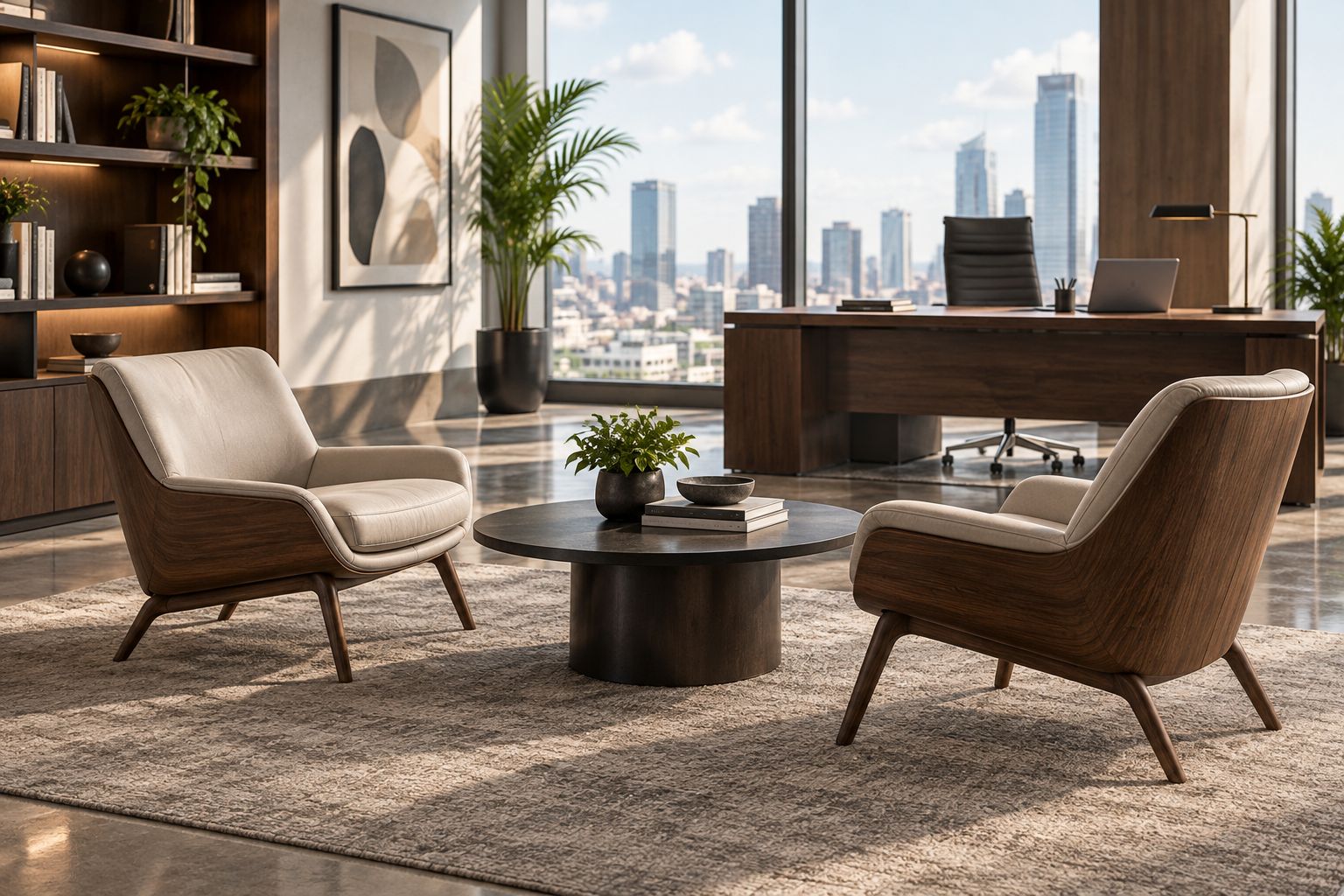
For document-heavy discussions, think about how papers will be handled. A chair can be suitable for talking yet leave people without a practical place to review material. Choose the setting around the discussion, not the other way round.
For reading, consider the whole routine: sitting down, holding the material, making notes and setting it aside. This gives you a more useful assessment than briefly sitting in a chair without doing anything.
Decide what the lounge area will not do
A clear boundary prevents a lounge purchase from carrying unrealistic expectations. You do not need every seat in an executive office to support every task.
Conversation seating is not automatically workstation seating. If you expect regular laptop work, assess that activity explicitly rather than assuming a lounge chair and low table will provide the arrangement you need.
Likewise, furniture placement is not evidence of speech privacy. A seating area away from the desk changes where a conversation happens; it does not establish who can hear it. Keep furniture selection and privacy requirements as separate decisions.
Use this distinction in the purchasing brief:
- Conversation: Prioritise how people face each other and share the space.
- Reading: Assess the seated activity, lighting and place for materials.
- Desk work: Review the chair together with the workstation.
- Visitor seating: Consider what the visitor needs to do during the meeting.
A brief that names the activity makes it easier to reject an unsuitable option without debating whether it looks sufficiently “executive”.
How to assess a chair before ordering
Use a repeatable process so that appearance does not dominate the decision. The aim is to check the intended use, not to create a technical specification that has no relationship to your office.
Write the use case
Describe the primary user and activity in plain language. For example, specify visitor conversations away from the desk rather than asking for a premium-looking occasional chair.
Include any secondary activity only if it genuinely matters. A chair selected mainly for conversation should not quietly acquire an expectation of full-time workstation use later in the purchase process.
Review the complete setting
Consider the chair with the table, lighting and other seating it will accompany. Look at how a person will use the setting, not just how the objects appear together.
Keep temporary items in mind as well. Bags, documents and drinks need somewhere to go during a meeting; deciding this early helps you judge whether the arrangement is practical.
Try the intended activity
If you can assess a sample, recreate the task. Hold a document, speak to someone in the adjacent seat or use the surface that would accompany the chair.
Ask the people involved to describe specific issues rather than simply rating comfort. “I cannot put my papers down conveniently” gives you an actionable observation; “it feels executive” does not.
Confirm the product details
Check the current product information for the exact option you intend to order. Do not transfer details from a photograph, a similar model or another item in the range.
Record the product selected and any questions resolved before ordering. This keeps the decision tied to the actual chair rather than an evolving collection of assumptions.
How the shortlist is ordered
The order follows category fit: a lounge chair comes first for a lounge-chair brief, while an office chair appears as a desk-first alternative. It is not a comfort score, a durability ranking or a report of comparative product testing.
The criteria are purpose, posture, supporting furniture, position in the room and appearance. Quell Workspaces lounge chairs for executive offices should be considered against the intended activity, not an assumed definition of executive style.
Which executive-office chair should you choose?
Choose the Bugsy lounge chair as your starting point when you are creating a separate conversation or reading area. Assess it with the supporting furniture and the people who will use that setting.
Choose the Billy office chair route when the actual problem is seating at the desk. Do not buy a lounge chair merely because the office belongs to an executive; the activity still determines the appropriate category.
If both areas need attention, write separate briefs. That keeps a lounge-chair preference from deciding the workstation purchase, or a workstation requirement from ruling out useful visitor seating.
FAQ
What is the best lounge chair for an executive office?
The Bugsy lounge chair is the lounge-specific shortlist choice in this guide. Assess it for the activity you intend, such as informal conversation or reading, rather than assuming it replaces a desk chair.
Is the Billy office chair a lounge-chair alternative?
The Billy office chair is an alternative only when your requirement is desk seating. It is not a like-for-like lounge chair, so separate the workstation brief from the conversation-area brief.
Can I use a lounge chair for laptop work?
Assess laptop work explicitly before choosing a lounge chair for that purpose. Consider the chair and working surface together rather than treating occasional seating as an automatic workstation replacement.
How should I arrange lounge seating in an executive office?
Arrange lounge seating around its primary activity. For conversations, consider how people face each other and where shared documents or drinks will go.
Should executive-office lounge chairs match the desk?
Choose a deliberate visual relationship rather than requiring an exact match. Judge the chair alongside the existing furniture, but keep the intended activity ahead of appearance.
What should I check before ordering an executive-office lounge chair?
Confirm the intended activity, assess the complete seating arrangement and check the current details for the exact product. Where possible, try the chair while doing the task it will support.
One last thing
Test the meeting, not just the chair. Recreate a typical conversation with the documents, notebook and drinks that accompany it. The awkward moment when someone has nowhere to put something often tells you more about the seating arrangement than a photograph does.


