
10 October 2026 · Editorial Team
Best office storage cabinets for open-plan offices
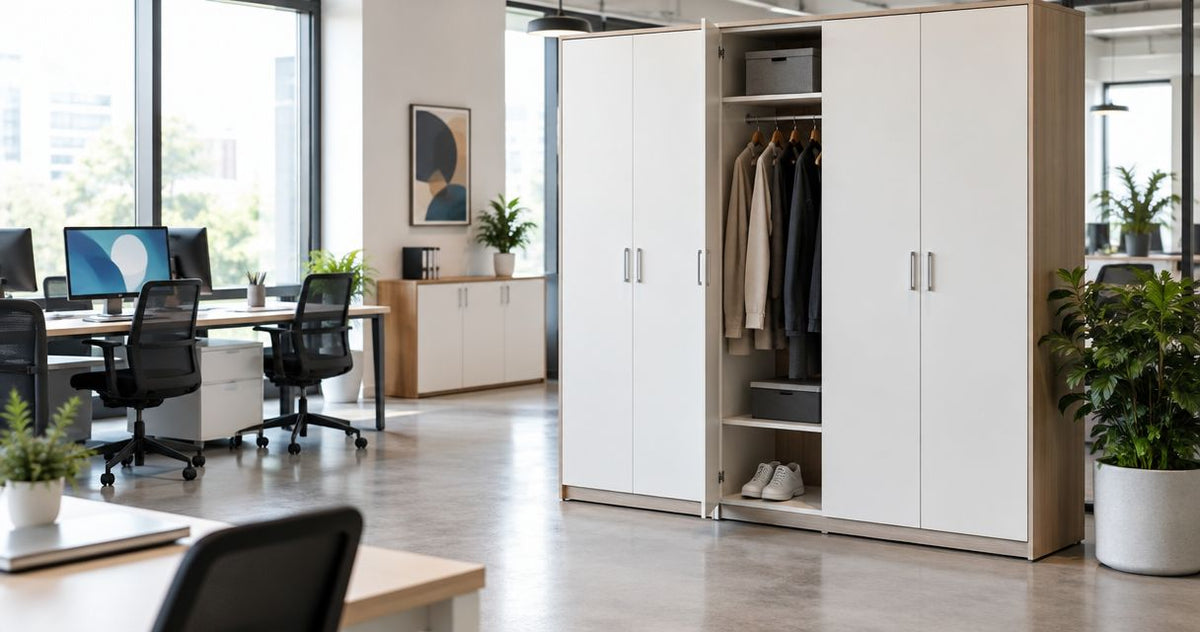
Best overall: personal lockers for hot-desking teams. Best for coats and bags: a tall closed cabinet by the entrance. Best for fixed desks: an under-desk pedestal. An office wardrobe in an open-plan office is a storage decision first and a noise and sightline decision second.
- Lockers are the best office wardrobe for hot-desking teams: personal, lockable and tidy.
- A tall closed cabinet by the entrance is the best way to clear coats and bags off desks.
- Open shelving suits shared reference material only. Keep confidential papers behind doors.
- Wall panels with built-in shelving store small items and cut noise in the same footprint.
Why this matters
In an open-plan office, storage is visible to everyone. A stack of bags by a desk or a row of open boxes makes the whole floor look unmanaged, and every hard storage surface you add changes how sound travels.
The fix is to choose storage by what it holds and who uses it, not by what fits the gap. Coats, laptops, client papers and shared supplies each need a different answer.
If noise is the bigger complaint, read the guide to acoustic wall panels for open-plan offices alongside this one. Storage and acoustics compete for the same wall space.
What makes the best office storage
Judge each option against these criteria before you buy:
- Security: can the contents be locked, and is the lock per person or per unit?
- Footprint: does it fit along a wall or a column without narrowing a walkway?
- Visual calm: closed fronts hide clutter. Open fronts show it.
- Fit to the work pattern: fixed desks, hot desks and mixed teams need different storage.
- Sound behaviour: large flat hard surfaces reflect noise. Soft or perforated surfaces do not.
- Ease of reconfiguring: can it move when the layout changes?
Office storage at a glance
| Storage type | Best for | Standout feature | Key limitation |
|---|---|---|---|
| Personal lockers | Hot-desking teams | Lockable, one per person | Needs a dedicated wall run |
| Tall closed cabinet (office wardrobe) | Coats, bags, spare equipment | Hides clutter completely | Takes up floor and wall space |
| Under-desk pedestal | Fixed desks | Storage stays at the desk | Not suited to hot-desking |
| Low credenza | Zoning a floor | Doubles as a divider | Little capacity for coats |
| Open shelving | Shared reference material | Easy access | Shows everything, no security |
| Wall panels with built-in shelving | Small items plus noise control | Storage and acoustics in one | Not for bulky or confidential items |
1. Personal lockers: best office wardrobe for hot-desking teams
Lockers give every person a secure place for a coat, a bag and a laptop. That removes the personal belongings from the desk surface, which is what makes hot-desking workable.
Lockers pros:
- Each person has a private, lockable space.
- Desks can be cleared at the end of the day.
- A single run of units along a wall reads as one tidy element.
Lockers cons:
- They need a dedicated wall or a clear zone.
- Someone has to manage allocation and lost keys or codes.
Lockers best for: teams where nobody owns a desk. Verdict: Buy.
2. Tall closed cabinet: best office wardrobe for coats and bags
A tall closed cabinet near the entrance is the closest thing to a true office wardrobe. Coats, umbrellas, bags and spare equipment disappear behind doors, and the floor looks calm from every angle.
Tall cabinet pros:
- Closed doors hide clutter from the whole floor.
- One unit serves a group, so it suits teams with fixed desks.
- It can sit against a wall away from the main walkway.
Tall cabinet cons:
- It is shared, so security depends on the lock and the habits of the team.
- A tall flat front is a hard surface that reflects sound.
Tall cabinet best for: reception areas and team zones that need coat storage. Verdict: Buy.
3. Under-desk pedestal: best storage for fixed desks
A pedestal keeps files, chargers and personal items at the desk where they are used. It adds no floor footprint beyond the desk itself.
Pedestal pros:
- Storage is within reach, so nothing migrates onto the desk.
- It needs no extra floor space.
- Each person controls their own contents.
Pedestal cons:
- It only works where people keep the same desk.
- It holds small items, not coats or bags.
Pedestal best for: fixed-desk teams with paper or personal items to store. Verdict: Buy, but pair it with a cabinet for coats.
4. Low credenza: best storage for zoning an open floor
A low credenza stores supplies and doubles as a divider between teams. It breaks up a long floor without building a wall.
Credenza pros:
- It separates zones while keeping the room open.
- Closed doors hide supplies.
- The top surface can hold printers or shared equipment.
Credenza cons:
- It does not give private coat or bag storage.
- It offers little sound or privacy benefit at seated head height.
Credenza best for: office managers who need a divider and shared supply storage in one piece. Verdict: Hold. Buy it only if you need the dividing function.
5. Open shelving: best for shared reference material
Open shelving suits items the whole team uses and nobody needs to protect: manuals, samples, binders, display pieces.
Open shelving pros:
- Everything is visible and quick to reach.
- It is easy to rearrange as needs change.
Open shelving cons:
- There is no security and no way to hide clutter.
- It makes a busy floor look busier.
Open shelving best for: shared reference material in a team area. Verdict: Skip for coats, bags or anything confidential.
6. Wall panels with built-in shelving: best for small items and noise together
This is the option for offices where the wall space is limited and noise is already a complaint. Acoustic wall panels with integrated shelving put small items on the wall and absorb sound in the same footprint. See the guide to acoustic wall panels with built-in shelving for how they compare.
Panels with shelving pros:
- One wall serves two jobs, storage and acoustics.
- It frees floor space that a cabinet would take.
Panels with shelving cons:
- It suits small, light items, not coats or bulky equipment.
- It is not a place for confidential papers.
Panels with shelving best for: noisy open-plan floors with little floor space to spare. Verdict: Buy if noise is the problem you also need to solve. Check the specification of any product you shortlist.
How these were ranked
The order follows the criteria above, weighted for open-plan use: security first, then footprint and visual calm. Lockers lead because they solve the hardest open-plan problem, personal belongings on shared desks. Open shelving ranks lowest because it fails on security and visual calm.
Which storage should you choose?
Start with who uses the desks. Hot-desking teams should buy lockers. Fixed-desk teams should buy a tall closed cabinet for coats and a pedestal for each desk. Add a credenza only when you need a divider.
If you still cannot work in the space after the storage is sorted, the problem is probably noise, not clutter. A soundproof office phone booth or a 2-4 person Folio office pod gives calls and meetings their own enclosed space, so the open floor can be used for focused work.
FAQ
What is an office wardrobe?
An office wardrobe is a tall closed cabinet or locker unit for coats, bags and spare items. It keeps personal belongings off desks and out of sight on an open floor.
What is the best storage for a hot-desking office?
Personal lockers are the best fit. Each person gets a lockable space, so desks can be cleared and reused by anyone.
Where should coat storage go in an open-plan office?
Place it near the entrance, against a wall and away from the main walkway. That keeps coats out of work areas and stops queues forming at the desks.
Is open shelving a good idea in an open-plan office?
Open shelving works for shared reference material only. It offers no security and shows clutter, so keep coats, bags and confidential papers behind doors.
Can storage help with open-plan noise?
Hard flat storage fronts reflect sound. Wall panels with built-in shelving combine storage with sound absorption, so they suit offices where noise is a complaint.
Do I need a cabinet if I already have lockers?
Not usually. Lockers cover coats, bags and personal items. Add a cabinet or credenza only for shared supplies and equipment.
One last thing
Most storage problems in open-plan offices are really layout problems. If belongings keep ending up on desks, add storage near the entrance first, because people drop things where they walk in.


