
23 October 2026 · Editorial Team
Can an office pod be used as a prayer or quiet room?
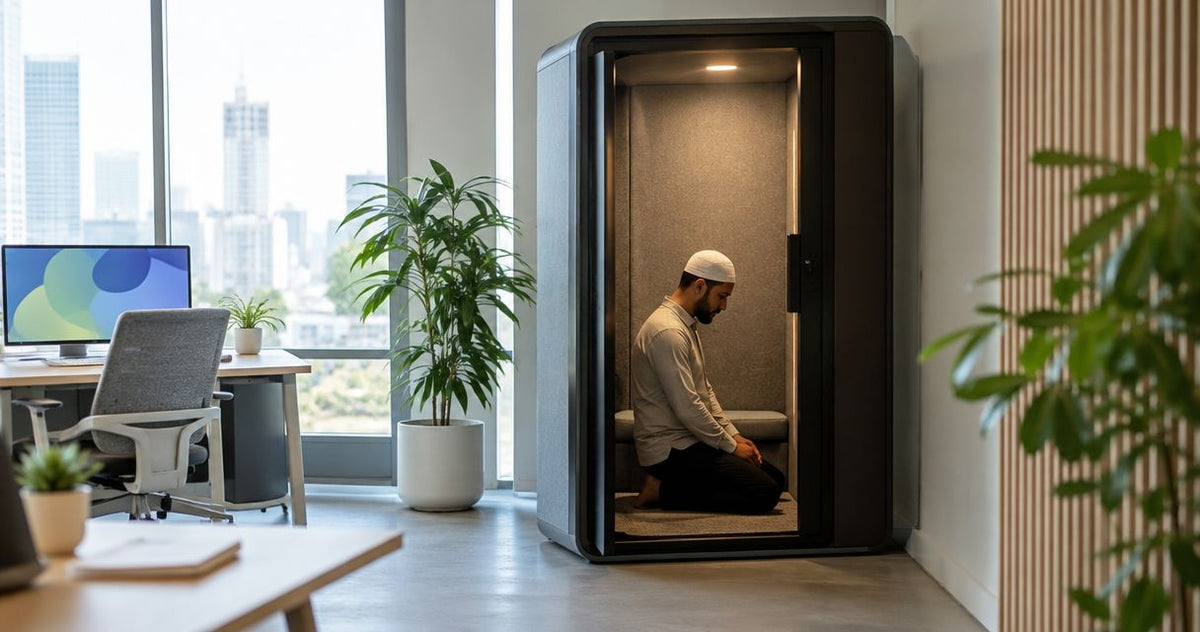
Yes, an office pod can serve as a prayer or quiet room when its interior supports the intended activity and its use is protected from calls, meetings and interruptions. A booth arranged for desk work is not automatically suitable for prayer: you need to consider usable floor space, visual privacy and how people will share it. Choose the space around the activity, not the seating capacity in the product name.
- An office pod for a prayer room needs an activity-led layout, visual privacy and clear shared-use rules.
- Quell Workspaces offers a prayer booth specifically described for worship; check its configuration against your users’ needs.
- A shared quiet room needs protected time without calls, meetings or interruptions.
- Ask intended users what they need before deciding on furniture or a booking process.
Can an office pod be used as a prayer or quiet room?
An office pod is an option for either use, but prayer and quiet breaks need different arrangements from a workstation. Quell Workspaces lists a Prayer Booth, and the supplied Soundproof Prayer Booth description identifies worship as its intended use. That makes the prayer-focused option a relevant starting point, not proof that every configuration will meet every user’s needs.
Start by deciding whether you want a dedicated prayer space or a room shared between prayer and quiet breaks. Both approaches need a clear purpose. Neither works as intended if colleagues treat the space as an overflow meeting room.
| Arrangement | Best for | Main advantage | Main limitation |
|---|---|---|---|
| Dedicated prayer space | Workplaces reserving a room for prayer | The room’s purpose stays clear throughout the day | It cannot also serve as general meeting capacity without changing that purpose |
| Shared prayer and quiet room | Workplaces accommodating prayer and silent breaks in the same space | Different activities can use one room at separate times | Booking, furniture and reset arrangements need agreement |
| Quiet-break space | Workplaces providing somewhere to sit without calls or conversation | The brief can centre on a quiet seated break | A seated layout does not establish suitability for floor-based prayer |
A room’s everyday use matters as much as its product description. Decide what happens inside before you choose the interior.
Why this matters
A room labelled “quiet” still needs rules about noise and interruptions. If video calls, informal meetings and quiet breaks all compete for it without any priority, users cannot rely on it for prayer or silence.
Privacy also needs a precise brief. Reducing surrounding sound and preventing people from looking into a room are separate requirements; do not use one as evidence of the other. Tell the supplier which matters for the activities you intend to support.
For workplace decision-makers, the task is to turn a broad request for “somewhere quiet” into an agreed use. That gives you a clearer basis for reviewing products and explaining the room to colleagues.
A dedicated prayer space
Best for: workplaces that want prayer to remain the room’s primary purpose. A dedicated arrangement avoids having to reset a workstation before each use. It also lets you write a brief around prayer rather than around a desk and chair.
Ask intended users whether they need floor-based space, seating, somewhere for personal belongings or a particular orientation within the room. Do not assume everyone practises in the same way. Record the requirements people actually identify, rather than supplying a standard list on their behalf.
The limitation is the commitment of space. A dedicated prayer room is not spare meeting capacity simply because it is temporarily unoccupied. Agree that distinction with whoever manages workplace bookings before introducing it.
A shared prayer and quiet room
Best for: workplaces that want prayer and silent breaks to share a room at different times. The advantage is a shared purpose centred on quiet use, rather than on general office activity. The difficulty is agreeing how each person leaves the room for the next.
Keep calls and meetings outside this arrangement if silence is the aim. A room cannot provide a predictable quiet break while also accepting spoken calls without some separation in its booking rules.
Decide how people reserve time, what happens when someone arrives without a booking and who handles a clash. Keep these arrangements easy to understand. Users should not have to negotiate the room’s purpose each time they need it.
A quiet-break space
Best for: workplaces whose brief is a quiet seated break rather than prayer. This is a different use case, even if the room looks similar from outside. Its furniture can centre on sitting quietly, provided that matches the agreed purpose.
The limitation is transferability. A comfortable chair does not establish that the same interior works for prayer, and an enclosed booth does not establish that it meets every individual preference for a quiet space.
If you intend to add prayer later, revisit the brief rather than changing the sign. Check the layout and shared-use arrangements with the people who will use it.
Why suitability varies
The right office pod for a prayer room depends on the activity and the way the workplace manages the space. Use these factors to frame the discussion, without treating them as specifications for any particular product:
- Intended activity: distinguish prayer, silent reflection and quiet seated breaks from calls or meetings.
- Interior arrangement: identify which furniture supports the activity and which items occupy space needed for it.
- Visual privacy: establish whether users need screening from passing colleagues, separately from acoustic requirements.
- Pattern of use: decide whether the room has a dedicated purpose or changes use between bookings.
- Personal belongings: agree how users manage items they bring into the room and what they leave behind.
- Room ownership: name the person or team responsible for bookings, supplies and resolving conflicting uses.
These factors belong in your brief. They are not reasons to assume that a larger meeting booth, a smaller phone booth or a product labelled “soundproof” automatically provides the right arrangement.
Write the brief before choosing furniture
Begin with a short description of what the room must enable. “A place for private prayer without calls or meetings” is more useful than “a pod with a chair”. It states the purpose without prescribing an interior before users have explained their needs.
Use a straightforward sequence:
- Agree the activities. Record whether the space is dedicated to prayer or shared with silent breaks. State which activities fall outside the brief.
- Ask intended users. Discuss floor-based and seated use, personal belongings, visual privacy and any orientation requirements they identify.
- Review the interior. Ask for the proposed furnished arrangement, not just an exterior image or an occupancy label.
- Set the operating rules. Decide how people book, indicate occupancy and leave the room ready for someone else.
- Confirm the proposal. Ask the supplier to explain how the proposed configuration addresses the written brief, without treating the product name as the answer.
Keep the brief focused. You do not need to collect personal explanations of why someone wants quiet time in order to specify a room. Ask about the space and activity, and keep individual booking details private within your chosen process.
For a wider fit-out brief, the guide to writing an office pod brief for your fit-out contractor provides a related planning topic. Keep the prayer-room requirements explicit rather than letting them disappear inside a general meeting-space request.
Separate visual privacy from quiet
Write separate requirements for what users hear and what passing colleagues can see. An acoustic enclosure and a screened interior address different concerns. Neither label establishes the other.
For visual privacy, discuss the view into the proposed room from its intended surroundings. Ask the supplier what the proposed configuration includes, rather than assuming that glazing, screening or an accessory is standard.
For quiet use, describe the surrounding activity and the intended activity inside. Request the relevant product information and review it against that brief. Do not promise complete silence or inaudibility on the strength of a product name.
Quell Workspaces’ prayer booth description establishes its intended worship use, but the supplied description does not specify a particular visual-privacy arrangement. Confirm that detail as part of the proposal instead of filling the gap with an assumption.
Keep the interior tied to the activity
Furniture should earn its place in the room. If the brief includes floor-based prayer, review the usable area with the proposed furniture in position. If the brief centres on seated reflection, discuss the seating arrangement with the intended users.
A useful review starts with the activity, then considers furniture and personal items. It does not start with a meeting-room layout and ask users to work around it. Avoid adding a desk simply because the enclosure is an office product.
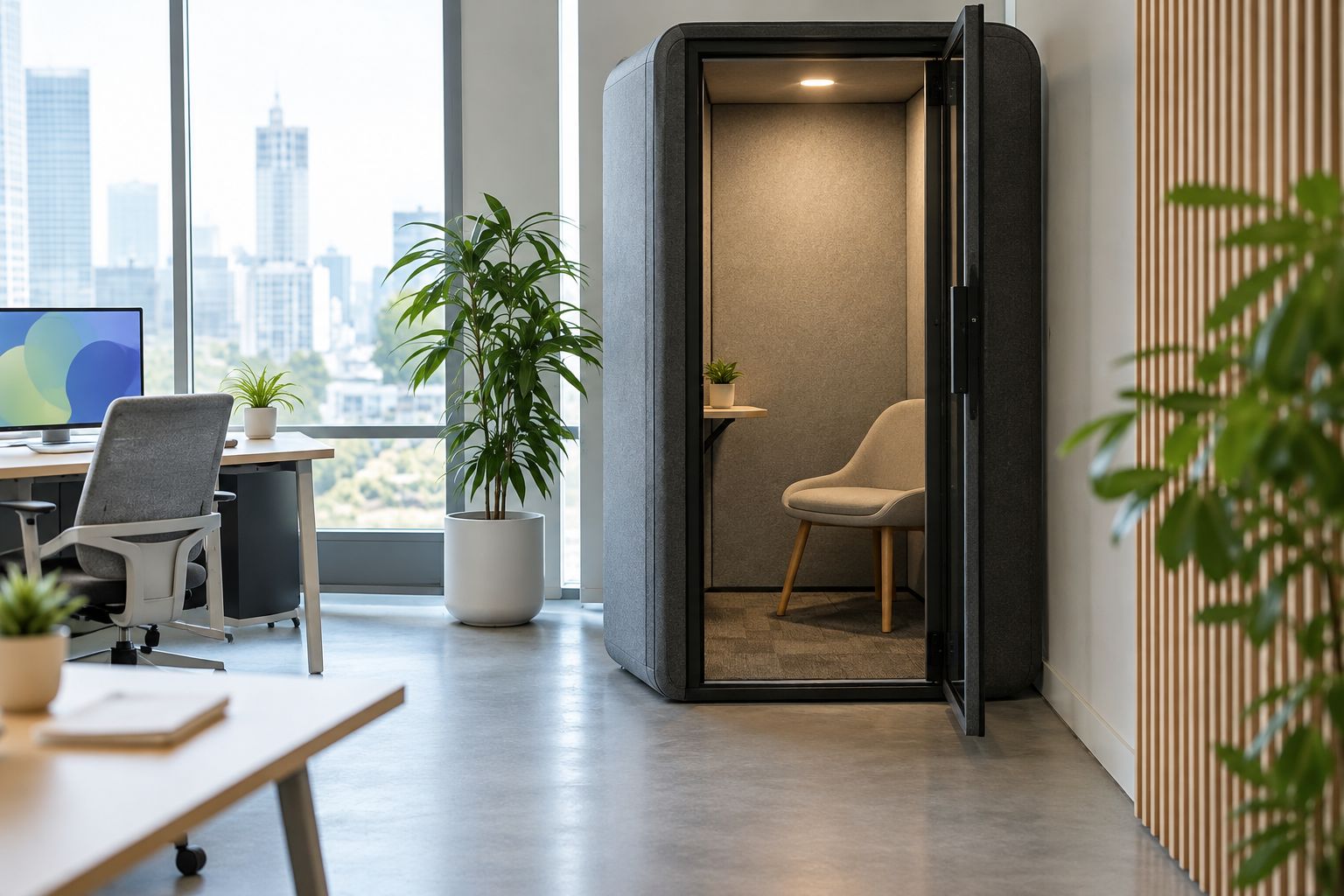
Treat images as illustrations, not evidence of a supplied configuration. Ask to review the actual proposed interior before making a decision. A product photograph cannot answer every question about how the room will be used.
Make shared use predictable
A shared room needs a short operating agreement. State its purpose, how people reserve time, whether walk-in use is permitted and how users show that it is occupied. Keep the instructions separate from personal information about a booking.
Set a clear boundary around interruptions. Colleagues should not interrupt an occupied prayer or quiet room merely because they want somewhere to take a call. Give them another route for finding meeting or call space.
Agree a neutral reset routine as well. Users should know what to take away, what remains in the room and whom to tell if something needs attention. The workplace team should retain ownership of the room rather than leaving every issue to its next user.
FAQ
Can I use an office phone booth as a prayer room?
An office phone booth is an option only if its actual interior supports the intended prayer activity. Check the furnished arrangement, visual privacy and shared-use rules rather than relying on the phone-booth label.
Does a prayer pod need to be completely silent?
Specify the acoustic conditions users need rather than promising complete silence. Review the relevant product information against the surrounding workplace activity and the intended use inside.
Can prayer and quiet breaks share the same office pod?
Prayer and quiet breaks can share a pod at separate times when users agree on the layout and booking rules. Keep calls and meetings outside that arrangement if the room is intended for quiet use.
What furniture should I put in a workplace prayer room?
Choose furniture after intended users have explained their needs. Review seated and floor-based activities before deciding which items belong in the room.
Should people have to explain why they are booking the quiet room?
Keep the booking process focused on reserving the room, not on collecting personal explanations. Use a neutral occupancy label and agree how booking details are handled.
Does Quell Workspaces offer a booth intended for prayer?
Quell Workspaces lists a Soundproof Prayer Booth whose supplied description identifies worship as its intended use. Confirm the proposed interior and privacy arrangement against your users’ brief before choosing it.
One last thing
Review the room as an activity space, not as a seat count. A product’s meeting capacity does not tell you how well its furnished interior supports prayer or a quiet break.
Before choosing a pod, ask intended users to review the proposed arrangement against the written brief. Resolve any mismatch there, rather than expecting people to adapt their use after the room is in place.


