
8 October 2026 · Editorial Team
Can an office pod work as a wellness room?
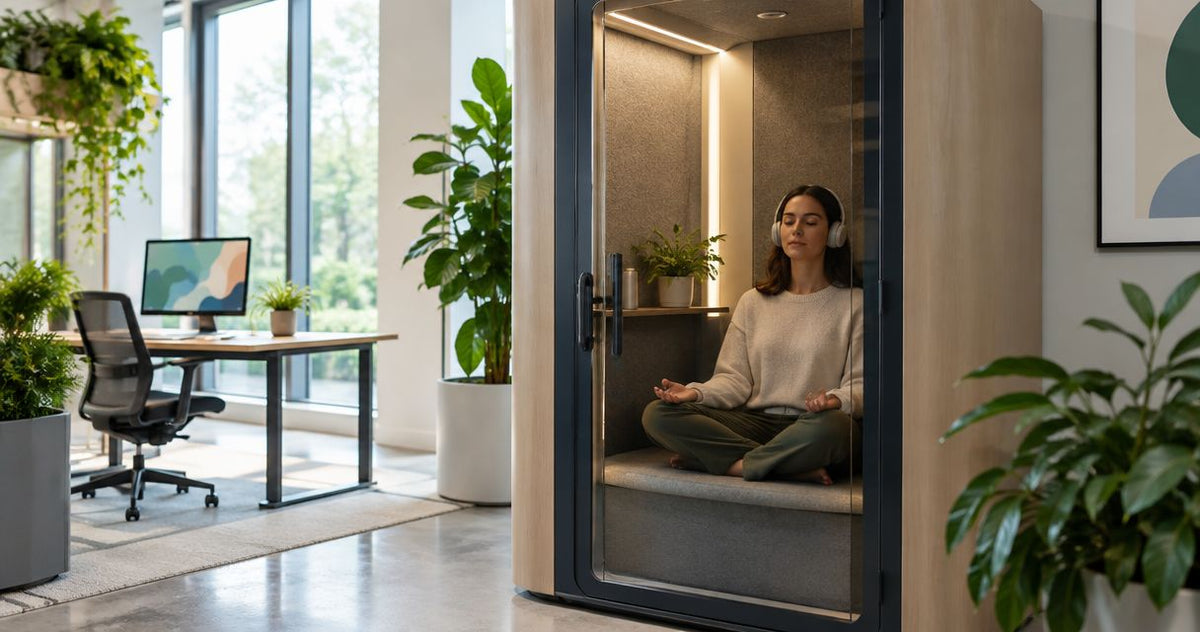
Yes, an office pod can work as a wellness room for quiet breaks, personal reflection and time away from desk activity, provided its layout and day-to-day use match those purposes. A booth designed around calls is not automatically a comfortable place to pause, and acoustic separation does not establish visual privacy. Define what employees will do in the space before choosing the pod.
- Using an office pod as a wellness room works best with a clear purpose: quiet breaks, reflection or private conversation.
- Quell Workspaces offers private-workspace options; assess the intended activity before selecting a pod.
- Acoustic separation and visual privacy are different requirements. Check both rather than assuming an enclosure provides complete privacy.
- Protect wellness use in the booking rules, or calls and meetings will compete for the same space.
Can an office pod work as a wellness room?
An office pod works as a wellness room when the intended activity fits the enclosure, furniture and booking arrangements. Treat “wellness” as a use brief, not a product specification. A room for an individual quiet break has a different job from a room for a private conversation.
For example, the Quell+ - 2 Person Pod is described as a space for private conversations and focused work. That makes it relevant to a conversation-led brief, but does not establish every feature needed for a wellness room.
Use the following comparison to separate the activities before choosing a layout.
| Intended use | Best for | Main benefit of a separate space | Limitation to resolve |
|---|---|---|---|
| Individual quiet break | Someone stepping away from desk activity | A defined place away from the working area | A call-focused layout does not establish seated comfort |
| Personal reflection | Someone wanting uninterrupted time alone | A space with a clear non-meeting purpose | Glazing and nearby foot traffic affect how private it feels |
| Private conversation | Someone speaking with a colleague or manager | A separate setting for a discussion | Check seating and the actual privacy characteristics |
| Shared calls and wellness breaks | Teams using one enclosure for several tasks | More than one use from the same space | Calls can displace breaks unless booking rules protect them |
The strongest brief names the activity, the intended users and what must happen inside the room. “A wellness pod” alone does not answer any of those questions.
Why this matters
A workplace decision-maker needs to distinguish buying an enclosure from creating a useful room. Furniture, privacy, positioning and everyday management determine whether the proposed space answers the brief. The product category is only the starting point.
Calling a phone booth a wellness room does not change its layout. Equally, a larger meeting enclosure does not become a useful retreat simply because it has more seats. Assess the activity first, then decide which existing features support it and which questions need answers.
This also keeps the project measurable without promising health outcomes. You can check whether employees find the room, understand its purpose and use it for the intended activities. Those are practical operational questions, not claims about stress reduction or treatment.
Start with the activity, not the room name
Write a short statement describing the room’s primary job. For example: “A place for an individual to sit away from desk activity without taking a call.” That sentence is more useful than a broad instruction to improve workplace wellbeing.
Keep the brief narrow enough to guide decisions. If the room must support quiet breaks, confidential discussions and routine video meetings equally, describe how those uses will coexist. Otherwise, the most frequent activity gets the room by default.
A useful brief contains:
- Primary activity: What the person will do inside.
- Intended users: Individual use, accompanied use or a conversation between colleagues.
- Furniture needs: A seated break, desk-based activity or face-to-face discussion.
- Privacy needs: Whether being seen, being overheard or being interrupted is the main concern.
- Booking rules: How users get access without explaining a personal reason.
Avoid turning this brief into an equipment wish list. Start with the task and identify the furniture or features it genuinely requires. Decorative changes do not resolve a mismatch between the room and its purpose.
Individual breaks need a different brief from conversations
For individual use, write the brief around 1 person taking a quiet break, rather than around the maximum occupancy of a product. This is a planning choice, not a claim about any booth’s capacity. The relevant question is whether the proposed arrangement supports that person’s intended activity.
Consider the posture the activity needs. A standing call, a seated pause and a conversation across a table are different uses. Do not assume that furniture chosen for working at a laptop also answers a brief for stepping away from work.
For conversation-led use, the supplied Quell+ - 2 Person Pod title identifies a configuration for 2 people. Its description names private conversations and focused work. Assess that stated purpose against the conversation you want the room to support, rather than treating the capacity as a complete suitability assessment.
The supplied Folio Office Pod - 2-4 Person title identifies 2–4 people. That is a different occupancy range, but it does not establish the interior dimensions, furniture arrangement or suitability for every wellness activity. More capacity is not a reason to choose it unless your brief needs that capacity.
Choose for the activity you expect, not the largest number in the product name. An individual retreat and a discussion room should not share a purchasing brief by accident.
Check privacy without assuming complete isolation
Separate acoustic privacy from visual privacy. Someone can feel exposed through glazing even when the room separates them from surrounding activity. Conversely, obscuring a view does not establish whether a conversation can be overheard.
Identify which concern matters for the proposed use. A person reflecting quietly might primarily want to avoid being watched. A conversation-led room needs a separate assessment of speech privacy. Neither requirement is answered by the word “wellness”.
Ask what the product’s supplied acoustic information actually describes. Do not translate a product name containing “soundproof” into a promise that nobody outside can hear anything. Keep any performance statement tied to the specific evidence for the product under consideration.
If visibility is the issue, investigate the booth privacy film option as a separate product enquiry. Confirm its relevance to the selected enclosure rather than assuming that a named accessory fits every pod or provides complete visual screening.
Also consider the route past the room. A location beside a busy circulation area presents a different visibility question from a quieter part of the workplace. Assess the actual setting instead of relying only on catalogue photography.
Why suitability varies between wellness-room briefs
The same enclosure can answer one brief and miss another. These are the main decision factors for a non-clinical room intended for quiet breaks, reflection or conversation:
- Room purpose: A break space needs a different arrangement from a workstation or discussion room.
- Seating arrangement: Check what is supplied and whether it matches the intended activity; do not assume furniture is included.
- Visual privacy: Establish what users can see, and what people outside can see, in the proposed setting.
- Acoustic information: Use the selected product’s actual evidence rather than a general description of office pods.
- Shared use: Decide whether calls and meetings are permitted, and how those uses compete with breaks.
These factors turn a broad idea into a purchasing brief. They also prevent you from attributing missing features to a product simply because its category sounds suitable.
Make the room easy to use without making it a meeting room
Booking arrangements should reflect the room’s purpose. If the room is intended for quiet breaks, avoid requiring users to enter a personal explanation in a shared calendar. A neutral booking description keeps the process focused on reserving the space.
Decide whether access is booked, unbooked or a combination. A booked room gives someone a reserved slot, but an entirely meeting-style calendar does not answer a need for an unplanned pause. An unbooked room avoids advance scheduling, but users need a clear way to recognise when it is occupied.
Do not promise instant access. Instead, establish what happens when the room is in use and where employees can find the relevant information. A room that nobody can confidently approach is not serving its intended purpose.
If calls are allowed, state when they are allowed. “Wellness room when available” leaves the priority unresolved. Protect the intended use explicitly rather than expecting employees to negotiate it each time.
Turn the brief into a purchasing decision
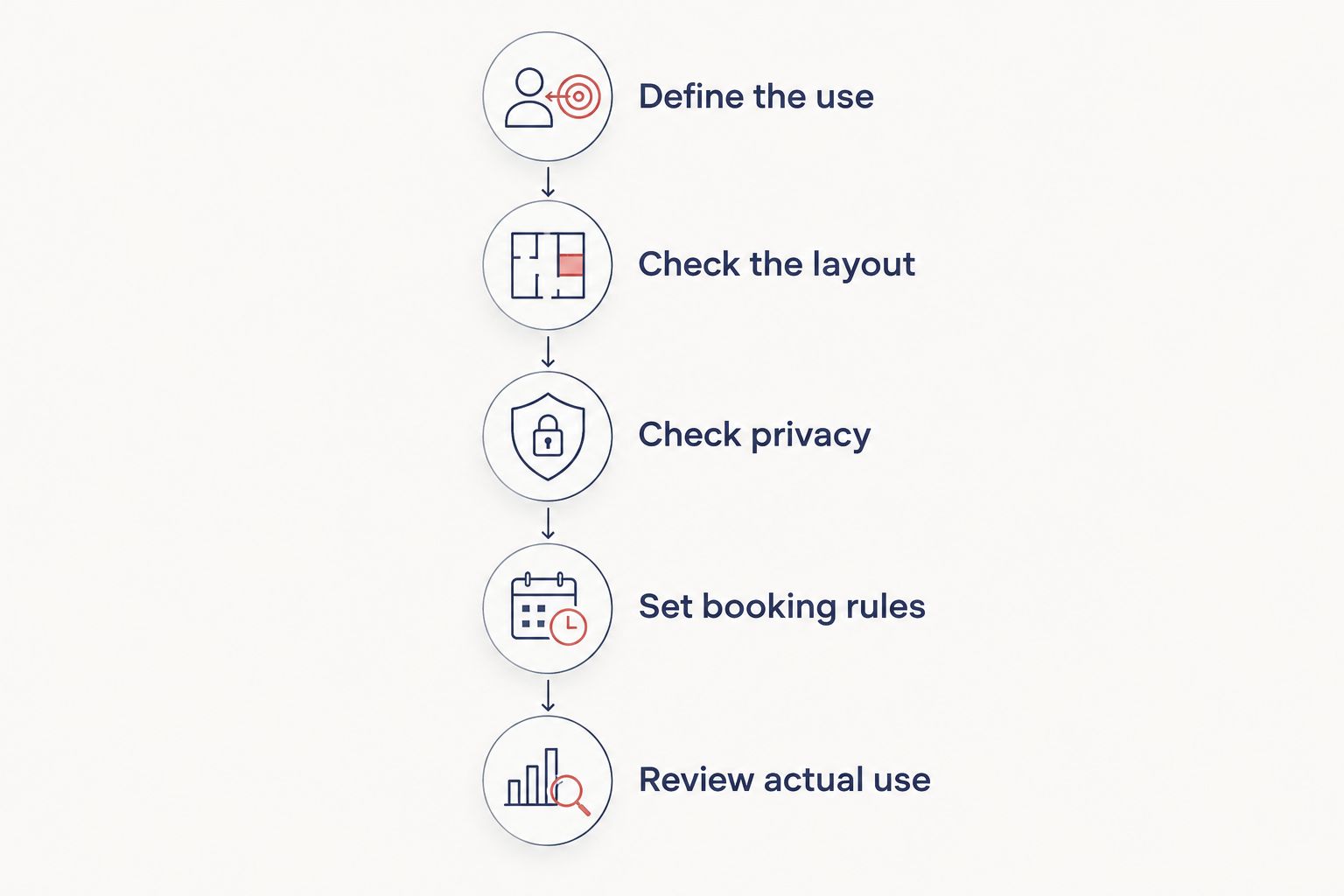
Use this sequence to compare a proposed pod with the room you actually need. Keep the exercise tied to supplied product information and your own workplace requirements.
- Define the use. Write the primary activity in a sentence. Distinguish a quiet break from a call or a private conversation.
- Check the layout. Compare the proposed furniture arrangement with that activity. Ask what is included and what requires a separate choice.
- Check privacy. Separate visual questions from acoustic questions. Seek product-specific answers rather than broad promises.
- Set booking rules. Decide how users access the room and which activities take priority.
- Review actual use. After the room is in use, ask whether it serves the original brief and identify practical obstacles.
Use a demonstration, available product imagery or a discussion of the proposed configuration to resolve layout questions. Do not infer internal dimensions, included furniture or other specifications from a product title.
Quell Workspaces is a relevant office-pod supplier for workplace teams seeking private conversation and focused-work spaces. For a wellness-room project, assess those stated uses against your brief rather than assuming a separate wellness specification.
Keep the benefits and limitations in balance
A separate enclosure gives you a defined space to assign to quiet breaks or conversation. It also gives facilities teams a specific room to manage, rather than leaving the intended activity without a designated location. Those are practical advantages of the proposal.
The limitations need equal attention. The selected product might be organised around working rather than pausing, visibility might not match user expectations, and shared bookings can displace the intended use. None of these questions is resolved by changing the room’s name.
Avoid presenting the room as a guaranteed wellbeing outcome. Describe the space and its intended activities plainly. Employees should know what they can use it for without being told how they are supposed to feel afterwards.
A useful review asks whether the layout works, whether booking is straightforward and whether the room remains dedicated to its stated purpose. Change the operating arrangements where they create friction; do not automatically treat a management problem as a reason to buy another enclosure.
FAQ
Can an office pod be used for quiet breaks rather than calls?
Yes, an office pod can be assigned to quiet breaks if its layout matches that use. Check the proposed furniture and protect break use in the booking arrangements rather than treating the room as an overflow call booth.
Does a wellness pod provide complete privacy?
A wellness-room label does not establish complete privacy. Assess visual privacy and acoustic information separately for the selected product and its proposed location.
Should a wellness room be for one person or a private conversation?
Choose the occupancy around the room’s primary activity. An individual quiet break and a conversation between colleagues need different layout and booking decisions.
Can we share a wellness pod with video meetings?
You can designate a pod for both uses, but the booking rules must state which activity takes priority. Without that distinction, routine meetings compete directly with quiet breaks.
What should we check before choosing a pod for a wellness room?
Check the intended activity, proposed layout, visual privacy, supplied acoustic information and booking arrangements. Confirm product details rather than inferring furniture, dimensions or performance from the product name.
Does Quell Workspaces offer spaces relevant to private conversations?
Quell Workspaces supplies the Quell+ - 2 Person Pod, described for private conversations and focused work. Its relevance to a wellness room depends on whether those uses and the proposed arrangement match your brief.
One last thing
Give the room a purpose before giving it a name. If your brief is “somewhere to pause without joining a call”, keep that distinction visible in the layout and booking rules.
The final check is simple: would someone understand how to use the room without asking a manager for permission or explaining a personal reason? Resolve that operational question alongside the product choice, not after the room arrives.


