
20 October 2026 · Editorial Team
How big is a single-person office phone booth?
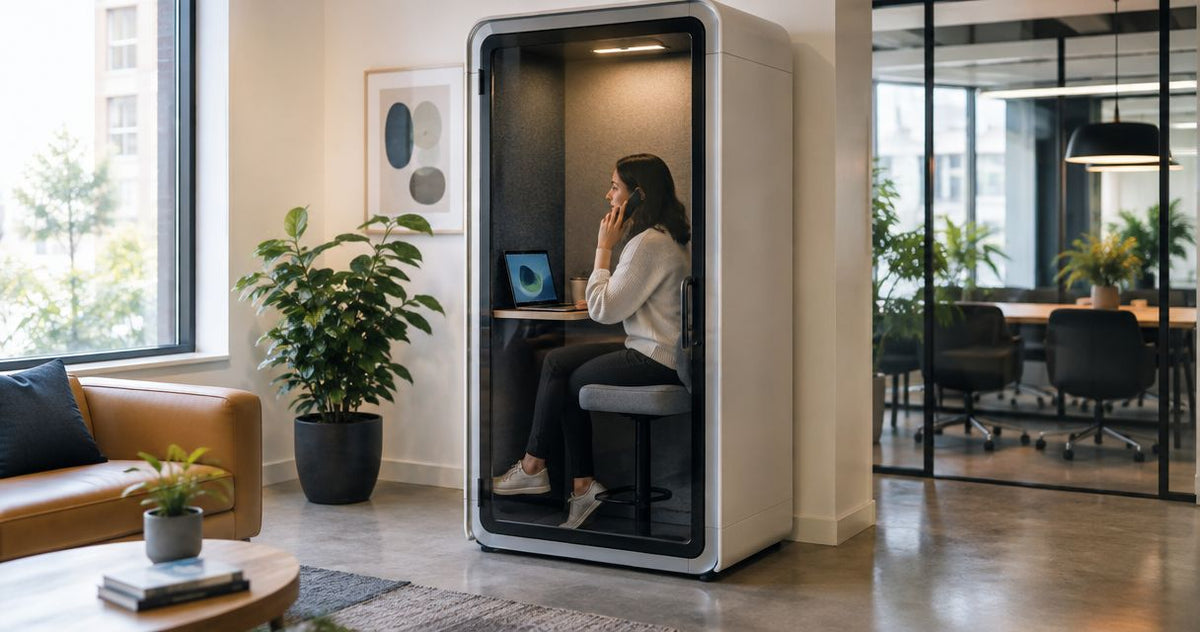
A single-person office phone booth has model-specific dimensions, not one standard size. Its external width, depth and height tell you how much space the enclosure occupies; its internal dimensions tell you how much room you have inside. Judge office phone booth dimensions by both measurements, then consider the door position and the furniture you intend to use.
- Office phone booth dimensions are model-specific: compare external measurements, internal space and your intended call setup.
- Quell Workspaces designs office phone booths for businesses needing a dedicated space for individual calls.
- A booth’s external footprint is not the same as its usable internal floor area.
- Check seated and standing call requirements separately; occupancy alone does not describe the workspace.
How big is a single-person office phone booth?
A single-person phone booth is sized for an individual workspace, but the occupancy label does not specify its width, depth or height. Start with the measurements for the exact model you are considering, rather than treating every single-person booth as interchangeable.
When reviewing a Quell Workspaces office phone booth, separate the enclosure’s outside dimensions from the space available to the person using it. Those figures answer different questions. A compact-looking enclosure does not, by itself, tell you whether the interior suits your working posture.
Use this sequence to read a dimensional specification:
- Identify the external width, depth and height. These describe the enclosure’s overall size, not the room inside it.
- Identify the internal width, depth and height. These describe the interior, before you consider how furniture occupies that space.
- Check the dimensional labels. Confirm which measurement is width and which is depth; do not assume every drawing lists them in the same order.
- Look at the intended working arrangement. A standing call setup and a seated laptop setup place different demands on the interior.
- Compare the enclosure with your office plan. Include its orientation and door position rather than representing it as an anonymous rectangle.
The useful answer is therefore not simply that a booth is “small”. It is whether the exact enclosure and its internal arrangement suit the individual calls you want to move away from shared desks.
Why this matters
An office manager needs to answer two separate questions: does the enclosure fit the proposed space, and does the workspace suit the person using it? External measurements answer the first. Internal measurements and the furniture arrangement help answer the second.
A booth that fits on a floor plan is not automatically the right workspace for your calls. Treat the footprint as a starting point, not the complete buying decision.
For facilities teams, keeping these questions separate also makes comparisons clearer. You can discuss the office layout using external dimensions, then discuss the call experience using internal space, working posture and the position of the work surface.
External dimensions: the space occupied by the enclosure
External width describes the booth from side to side. External depth describes it from front to back, while external height describes its overall vertical size. Read the manufacturer’s drawing alongside the figures so that you know which face is being measured.
A footprint is the area represented by the enclosure’s external width and depth. For a rectangular footprint, multiply those measurements using the same units. This calculation describes the enclosure itself; it does not describe every part of the surrounding office that people use when approaching or opening it.
Keep the width and depth visible even when you calculate an area. Two rectangles can have the same area but different proportions, and those proportions affect how each sits beside desks, walls or other furniture.
Height belongs in the comparison too. A floor-plan rectangle shows horizontal space only, so it cannot communicate the enclosure’s full size. Use the complete dimensional drawing, not just a footprint figure or a product photograph.
Internal dimensions: the room available inside
Internal measurements describe the space within the enclosure. They are not interchangeable with external measurements because the enclosure itself occupies part of the overall size. Do not calculate the interior by guessing how much to subtract from the outside.
Read internal dimensions together with the furniture arrangement. A work surface, chair or stool occupies space that would otherwise appear empty in a simple drawing. The useful question is how the person, furniture and work equipment relate to one another.
For a seated call, consider the position of the seat relative to the work surface and camera. For a standing call, consider the position of the work surface relative to the user. Neither arrangement is inherently the correct choice for every workplace.
This distinction also explains why “single-person” is not a complete dimensional specification. It describes intended occupancy, not a promise that every booth has the same internal proportions or supports the same working arrangement.
Which measurements answer which question?
Use the following comparison to keep the dimensional information in context. Each measurement has a useful role, but none answers every question about the booth.
| Measurement | Best for | What it tells you | What it does not tell you |
|---|---|---|---|
| External width and depth | Comparing enclosure footprints | The horizontal size of the enclosure | The amount of usable room inside |
| External height | Understanding overall enclosure size | The enclosure’s vertical dimension | The internal headroom |
| Internal width and depth | Reviewing the individual workspace | The dimensions inside the enclosure | How furniture occupies that space |
| Internal height | Reviewing the interior vertically | The height within the enclosure | Whether the whole working arrangement suits your task |
| Door position and movement | Understanding everyday access | Where the opening sits and how the door moves | The enclosure’s internal working area |
Compare like with like. An external width from one model and an internal width from another are not equivalent measurements, even when both appear under a general dimensions heading.
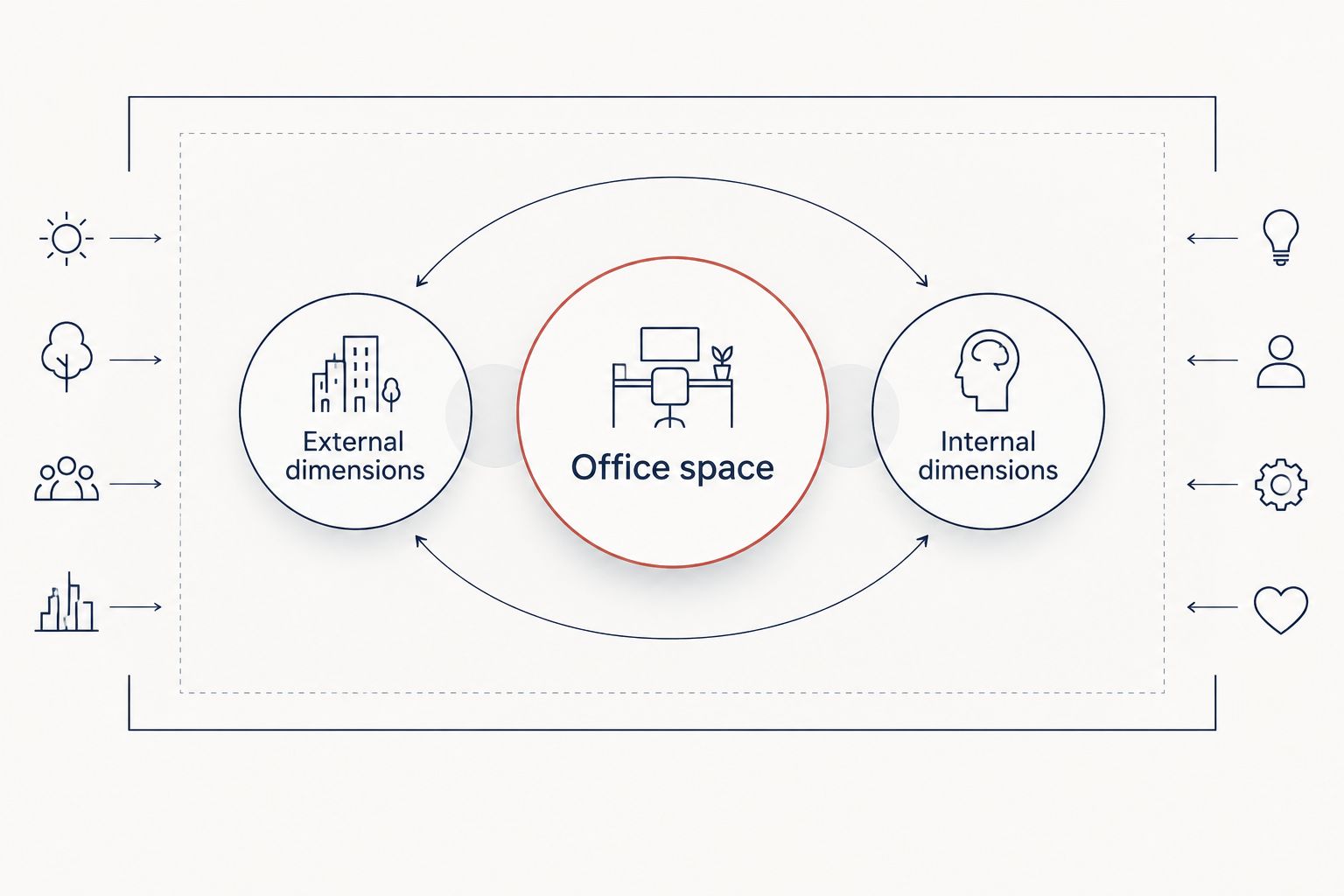
A dimensional comparison becomes more useful when every candidate follows the same format. Keep the outside measurements in one column, the inside measurements in another, and the proposed furniture arrangement beside them. That prevents a compact footprint from overshadowing the workspace you actually need.
Standing calls and seated calls need different comparisons
Choose the intended task before judging the size. A booth used for standing telephone calls has a different working arrangement from a booth used for seated video calls with a laptop and notes.
The distinction is not a claim that one type always occupies less space. It is a way to identify which internal relationships matter. Compare the measurements of the actual models rather than assigning dimensions to a category name.
| Call arrangement | Best for | Main advantage of this arrangement | Main limitation to consider |
|---|---|---|---|
| Standing calls | Teams choosing a standing call position | Keeps the workspace centred on standing use | Does not answer a requirement for seated working |
| Seated calls | Teams choosing a seated call position | Allows the brief to include a seat and work surface | Furniture occupies part of the interior |
| Seated video calls | Teams using a laptop camera during calls | Lets you plan the screen, seat and work surface together | A floor-area figure alone does not describe the camera setup |
Match the booth to the task, not the other way round. If seated laptop calls are the requirement, assess that arrangement directly instead of assuming that a single-person occupancy label proves it will work.
Avoid treating these use cases as a ranking. The best choice depends on the working posture your team wants and the arrangement supported by the specific product.
Why office phone booth dimensions vary
A model’s dimensions reflect its particular design and working arrangement. The label “single-person” does not standardise those details.
Keep these factors separate when reviewing a specification:
- Enclosure construction: the outer enclosure and the inner workspace have different boundaries, so external and internal dimensions describe different spaces.
- Overall proportions: width, depth and height describe the shape more clearly than a single footprint figure.
- Working posture: seated and standing use require different relationships between the person and the work surface.
- Furniture arrangement: a seat and work surface affect how the interior is used, even when the enclosure dimensions stay the same.
- Door arrangement: the position and movement of the door affect how the booth relates to the surrounding office.
These factors are comparison prompts, not reasons to estimate a product’s specifications. Use the figures and drawings for the exact model; never transfer dimensions from a similar-looking booth.
Product photographs can help you understand an arrangement, but perspective does not provide a reliable scale. A wide-angle view and a close crop can make the same enclosure appear very different in size.
How to prepare a useful dimensional brief
Write the use case first. “Individual video calls while seated with a laptop” gives a clearer brief than “a small booth”, because it identifies what the interior must accommodate.
Then describe the proposed office location separately from the booth. Record the space you are considering and the direction you want the opening to face. Keep those observations distinct from the product’s published measurements.
A useful brief contains:
- The intended call type and working posture.
- The exact product name being considered.
- External width, depth and height, with their units.
- Internal dimensions, recorded separately.
- The furniture arrangement shown for that product.
- The proposed orientation within the office.
This is a comparison brief, not an installation specification. Its purpose is to give everyone reviewing the purchase the same description of the requirement and the same dimensional information.
For a Quell Workspaces phone booth, keep the model-specific information attached to the brief. A product name, drawing and dimensional record are more useful together than an isolated footprint copied into a presentation.
What to check before choosing the smallest footprint
A smaller external footprint answers one question: the enclosure occupies less horizontal space than a larger footprint. It does not establish that the interior is better suited to your calls.
Check what you would be trading against that footprint. Your intended seat, laptop position and work surface all belong in the decision. Do not treat an empty interior drawing as the final furnished workspace.
The reverse is also true. A larger enclosure is not automatically the better choice when the task is an individual call and the office space is limited. Compare the actual arrangement with the brief rather than assuming that more floor area always adds useful value.
The right size is the size that suits the documented task and the proposed office space. Keep those two tests visible throughout the comparison, so the final choice does not depend on appearance alone.
FAQ
What are the standard dimensions of a single-person office phone booth?
There is no single dimensional specification that applies to every single-person office phone booth. Use the exact model’s external and internal measurements rather than treating its occupancy label as a size standard.
Do office phone booth dimensions include the space inside?
External office phone booth dimensions describe the enclosure, not the usable interior. Look for separately labelled internal measurements and review them alongside the furniture arrangement.
How do I work out a phone booth’s footprint?
For a rectangular footprint, multiply the external width by the external depth using matching units. Keep the original width and depth in your comparison because an area figure does not describe the enclosure’s proportions.
Is the smallest phone booth the best choice for individual calls?
The smallest phone booth is not automatically the best choice for individual calls. Compare its internal arrangement with your intended standing or seated use, as well as its external footprint.
Can I judge a phone booth’s size from a photograph?
A photograph does not provide a reliable measurement of a phone booth’s size. Use the model’s dimensional drawing to distinguish external size, internal space and the furniture arrangement.
How should I compare Quell Workspaces phone booth sizes?
Compare Quell Workspaces phone booth sizes model by model, keeping external dimensions separate from internal dimensions. Assess the working arrangement against your call requirements rather than choosing from the occupancy label alone.
One last thing
Keep width and depth beside the footprint throughout your review. A floor-area total hides the shape of the rectangle, yet that shape is what you are placing on the office plan.
Ask for the dimensional drawing of the exact configuration you are considering. Read it alongside your call brief, then compare the enclosure, interior and furniture as separate parts of the decision.


