
27 October 2026 · Editorial Team
How many phone booths do you need per employee?

Instead of manually resolving clashes over private call space, calculate how many phone booths per employee you need from simultaneous individual calls, then use a shared booking record to check the result. Size your booth provision around people who need a private space at the same time, not total company headcount.
- Quell Workspaces phone booths suit workplace teams creating dedicated spaces for individual calls.
- Calculate how many phone booths per employee you need from peak concurrent demand, not payroll headcount.
- Include unsuccessful booking requests: occupied booths alone do not reveal the full demand.
- Separate individual calls from group meetings before calculating phone booth requirements.
Why this matters
An employee-to-booth ratio describes your provision; it does not explain whether that provision works. The same headcount can produce different demand depending on attendance, call schedules and access to other private spaces.
Start with the activity you need to accommodate. If your requirement is individual calls, the office phone booth is a relevant commercial category to review once you have established demand. Keep product selection separate from the calculation: choosing a booth does not tell you how many people will need one simultaneously.
Quell Workspaces phone booths suit workplace teams creating dedicated spaces for individual calls. The limitation is equally important: individual call provision does not replace space for group meetings. Record those requirements separately rather than counting every request for a quiet room as phone booth demand.
Your planning question is therefore not simply how many employees you have. It is how many individual calls need dedicated space during your busiest observed periods, after accounting for other suitable spaces.
Before you start
Gather the following before building your calculation:
- An attendance record: use employees actually present in the workplace, with dates and working periods. Payroll headcount alone is not the relevant denominator.
- A shared spreadsheet and booking access: collect requested call times, actual booth use and the other private spaces employees can use. Assign someone to maintain the record.
- Unsuccessful requests as well as bookings: a full booking calendar hides calls that could not secure a space. Record rejected requests and calls moved elsewhere, without recording their content.
The non-obvious problem is measuring supply instead of demand. If every existing booth is occupied, occupancy shows that provision is full; it does not show how many additional employees wanted a booth.
Tell employees what to record before starting. Use call timing and space requirements, not client names, conversation details or reasons for confidential discussions. A capacity worksheet needs a clear demand record, not a copy of everyone’s working diary.
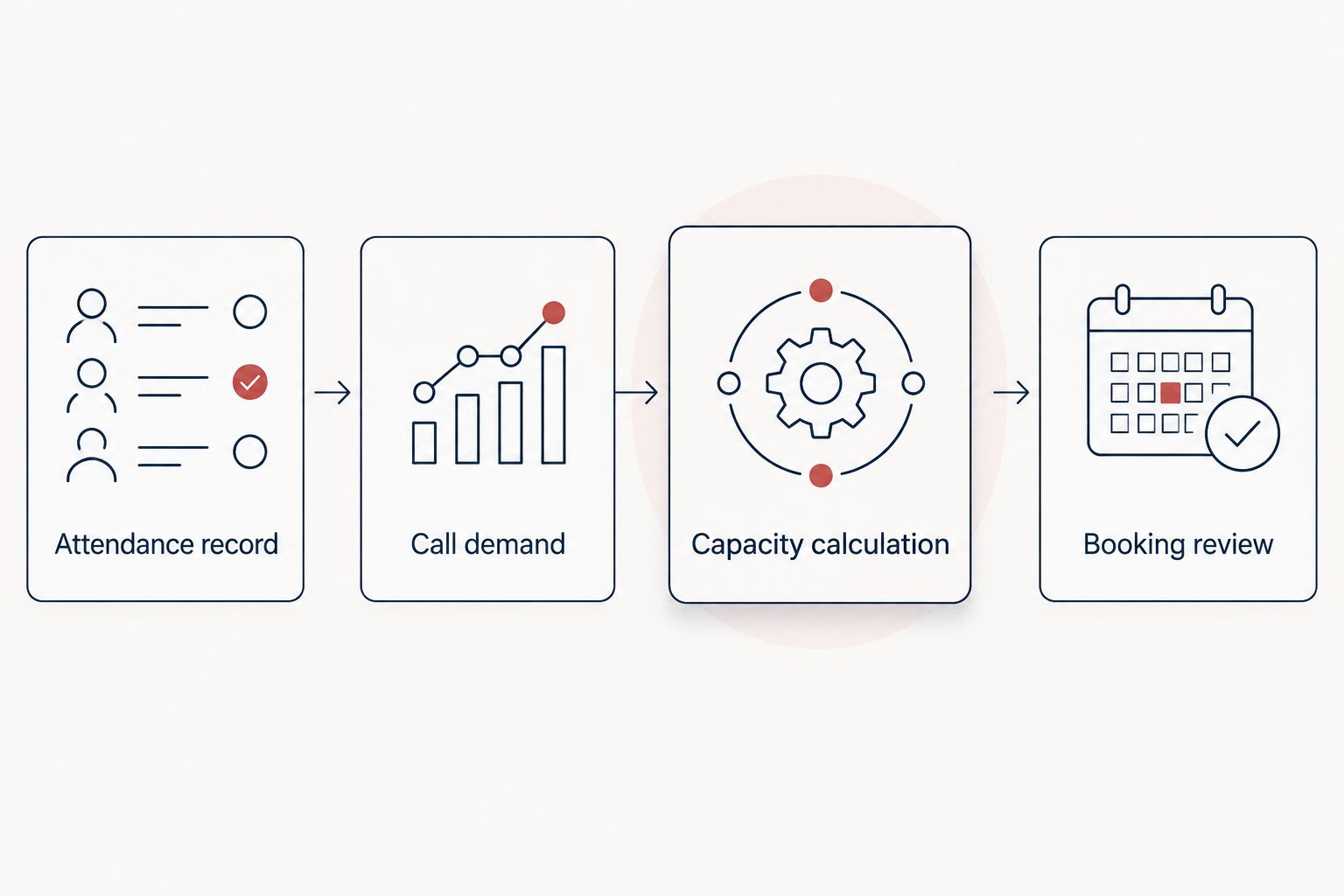
Attendance record
Build the worksheet around people on site
- Create a worksheet with column headings named Date, Work period, Employees present, Individual call requests and Other suitable spaces. These are headings you create, not settings in a particular booking platform.
- Enter actual attendance for each recorded period. Separate periods with materially different attendance rather than blending them into a single daily figure.
- Note which other private spaces are genuinely available for individual calls during that period. Do not count a meeting room that is already booked or reserved for another activity.
- Mark whether the period represents normal working patterns, a known busy period or an exceptional event. Keep exceptional events visible without treating them as routine demand.
Expected result: you can connect call demand to the employees actually present and the alternative spaces actually available.
Attendance matters because an organisation-wide ratio can conceal differences between working days. A booth calculation based on everyone employed gives the same denominator whether the workplace is lightly occupied or busy.
Keep the attendance record aligned with the call record. Comparing a morning call peak with an all-day attendance average mixes different periods and produces a ratio that is difficult to interpret.
Also keep locations separate when employees cannot realistically share the same booths. A company-wide total does not describe the provision available to someone working in a different office.
Call demand
Record the calls that need a booth
- Create a second worksheet with Date, Requested start, Requested finish, Individual call, Space required, Space used and Request outcome.
- Record the requested start and finish of each call needing a private space. Scheduled meeting times alone are insufficient if employees need the booth before or after the meeting itself.
- Distinguish individual calls from discussions attended by colleagues together. Route group meetings into a separate record rather than including them in the phone booth total.
- Use consistent entries in Request outcome, such as booked, moved to another suitable space, rescheduled or unable to find space. Record each request once, even if the employee tried several booths.
Expected result: the worksheet shows overlapping demand, including requests that did not become successful bookings.
A calendar entry is not automatically a booth requirement. Ask whether the employee needs a dedicated private space for that call and whether an alternative space meets that need.
Avoid counting both the original request and its replacement booking as separate demand. Link the outcome to the original request so that rescheduling does not inflate your calculation.
Equally, do not delete a request because the employee eventually managed without a booth. Its outcome explains how the workplace handled the demand. You can then decide whether that outcome is acceptable rather than silently treating it as evidence that no space was needed.
Capacity calculation
Turn overlapping requests into a booth requirement
- Sort the call record by date and requested start time. Compare each requested time window with the others to identify simultaneous individual calls needing dedicated space.
- For each overlapping period, count the requests and subtract only the alternative private spaces available and suitable at that same time. The remainder is demand for phone booths.
- Identify the highest remaining demand in the periods you recorded. Keep its date, attendance level and request outcomes alongside it so the result remains traceable.
- Divide that booth requirement by the employees present during the same period if you need a booths-per-employee figure. Label it as your workplace’s observed planning ratio, not a universal benchmark.
Expected result: you have a booth count tied to a documented demand peak and an employee ratio that explains the context.
Use this relationship:
Observed booth requirement = simultaneous individual calls needing private space − suitable alternative spaces available at that time.
If suitable alternatives cover all the requests, that period has no remaining booth demand. Do not carry a negative result into the provision calculation.
The employee ratio is a reporting step, not the starting point. If you report employees per booth instead, reverse the division and label it clearly. These measures are reciprocals, so confusing them changes the meaning of your result.
Which calculation should you use?
Use observed concurrent demand to establish provision, then use the employee ratio to communicate it. Each approach answers a different question.
| Approach | Best for | Advantage | Limitation |
|---|---|---|---|
| Concurrent-demand calculation | Deciding how many individual call spaces are needed | Connects provision to overlapping requests and available alternatives | Requires a complete record, including unsuccessful requests |
| Employee-to-booth ratio | Summarising provision after the demand calculation | Gives stakeholders a straightforward reporting measure | Does not account for call overlap, attendance patterns or alternative spaces by itself |
Do not multiply headcount by an unsupported ratio and call it a capacity assessment. That approach creates a precise-looking number without establishing whether calls overlap.
Your observed peak also has a boundary: it describes the periods you recorded. Keep checking the result when working patterns change. A calculation based on a quiet period is not evidence about an unobserved busy period.
Booking review
Check whether the proposed provision meets demand
- Compare the calculated booth requirement with the booths currently available for the recorded periods. Mark where demand exceeds provision and inspect the associated outcomes.
- Separate unavailable space from unused reservations. A reserved but empty booth creates a booking problem; it does not prove that another occupied booth is needed.
- Establish a shared booking convention covering when reservations start, when they finish and how employees release bookings they no longer need. Choose rules that reflect your recorded use rather than imposing an arbitrary duration.
- Repeat the demand check after changing booking practices or provision. Keep the earlier record so you can compare equivalent working periods.
Expected result: you can distinguish a genuine shortage from a booking problem and explain what change the evidence supports.
Adding capacity and improving access are different interventions. If unsuccessful requests coincide with occupied booths, review capacity. If they coincide with unused reservations, review how reservations are maintained and released.
Make the booking record available to the person responsible for workplace provision. That person needs to see missed requests as well as completed bookings; otherwise, a tidy calendar can hide an unresolved shortage.
When reviewing Quell Workspaces phone booths, use the demand record to define the intended use first. Check the supplied product information separately rather than assuming that every booth configuration meets the same requirements.
Recalculate whenever attendance patterns change
A second workflow uses the same worksheets to review provision after a change in workplace attendance or team activity. Keep the original calculation as a reference, then record demand under the changed working pattern.
Repeat the workflow when:
- More employees start attending on the same days.
- A team’s work changes to include more individual calls.
- Another private space becomes unavailable for call use.
- Employees report missed bookings despite apparently adequate provision.
Recalculate concurrent demand before changing the ratio. If attendance increases without overlapping call demand increasing, headcount alone does not demonstrate a need for additional booths.
The reverse also matters. Unchanged attendance can still produce a different requirement if employees begin taking calls at the same time. Keep the calculation focused on the activity you are accommodating.
Troubleshooting
The booths look empty, but employees cannot book them
Compare reservations with actual use during the same periods. Ask employees to release unused reservations and record whether access improves before interpreting booking failures as a capacity shortage.
Average usage is low, but busy periods cause clashes
Inspect overlapping call windows rather than averaging occupancy across the day. Low use outside the peak does not provide another space during the peak itself.
Your calculated demand is higher than the booking total
Check for unsuccessful requests and calls moved elsewhere. Those are legitimate demand records, but remove duplicate entries where the same request appears as both an attempted booking and a replacement booking.
The employee ratio changes sharply between days
Check the denominator and the time period. Use employees present during the relevant demand window, not payroll headcount on one day and attendance on another.
Group meetings keep appearing in the booth calculation
Separate individual calls from meetings attended together. A request for shared meeting space should not become several individual booth requests merely because several employees are involved.
Customise your workflow
Expand the record by team or working area when a single total hides differences in access. Keep the fields consistent so you can compare patterns without creating incompatible worksheets.
You can also distinguish scheduled calls from unplanned calls. That helps explain whether the booking process supports the work taking place; it does not justify inventing a spare-capacity percentage.
Before selecting Quell Workspaces provision, write a short brief covering the named use case, observed concurrent demand, available alternatives and unresolved booking problems. This gives the purchasing decision a practical basis without adding unsupported product requirements.
Keep individual-call planning separate from shared meeting-space planning. Review each against its own demand record, then check the relevant product information.
FAQ
How many phone booths per employee do we need?
Calculate the number from simultaneous individual calls needing private space, then divide by employees present during that period. Headcount alone does not establish demand because attendance, call overlap and alternative spaces differ.
Should we use total headcount or office attendance?
Use employees present during the period you are assessing. Total headcount describes the organisation, not the people competing for booths in that workplace at that time.
How do we calculate demand if we already have phone booths?
Record overlapping requests alongside actual booth use and unsuccessful bookings. Occupancy alone cannot reveal demand beyond the booths already available.
Do video calls count as phone booth demand?
Include an individual video call when the employee needs a dedicated private space. Record colleagues attending together as group meeting demand rather than individual booth demand.
Should we add booths when people complain about bookings?
Check whether the failed requests coincide with occupied booths or unused reservations. Occupied booths point to a capacity issue; unused reservations point to an access problem that needs a booking review.
When should we review our phone booth provision?
Review provision when attendance, call patterns or access to alternative spaces changes. Compare equivalent working periods and retain unsuccessful requests so the calculation includes unmet demand.
One last thing
The most useful entry in your planning record can be the call that never received a booking. Completed bookings show how your current provision was used; unsuccessful requests show where it stopped meeting demand.
Keep both. That makes your next decision about Quell Workspaces phone booths a response to a documented workplace requirement rather than an employee ratio copied from elsewhere.


