
20 October 2026 · Editorial Team
How much sound reduction should an office phone booth give?
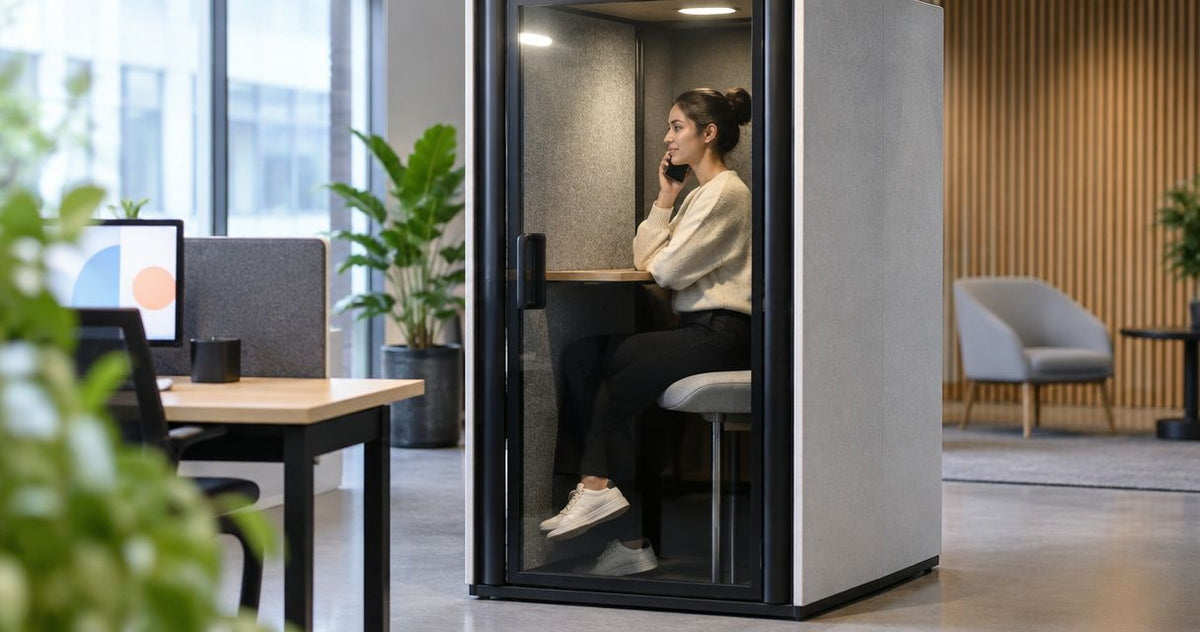
An office phone booth should reduce speech escaping into the workspace enough for your intended calls, but there is no single decibel target that guarantees privacy in every office. Judge office phone booth sound reduction by a measured result for the complete booth, then check whether nearby listeners can understand an ordinary conversation. A quieter voice outside the booth is not the same as an unintelligible conversation.
- Office phone booth sound reduction needs a measured speech result, not a soundproof label alone.
- Speech privacy depends on whether nearby colleagues understand words, not simply whether they hear a voice.
- Compare complete-booth results using the same measurement method and operating conditions.
- Quell Workspaces offers office phone booths; match the product evidence to your workplace call requirements.
Why this matters
A booth has two distinct jobs: limiting the disturbance from your calls and separating those calls from surrounding office activity. Your purchase decision needs to identify which problem matters most. A booth chosen for everyday video calls should not automatically become the designated space for sensitive conversations.
Quell Workspaces is a relevant starting point for businesses comparing office phone booths for workplace calls. The Office Phone Booth Folio is one named option; assess its acoustic evidence against your use case rather than treating the product name as a performance result.
Start with the conversation, not the catalogue wording. Someone making routine project calls has a different privacy requirement from someone discussing personnel matters, even when both use the same workspace.
How much sound reduction should an office phone booth give?
Enough to make the intended conversation suitably separate from the surrounding office, supported by a clearly identified whole-booth measurement. A universal target would hide the differences between a busy workspace, a quiet office and the listening positions around the booth.
The useful question is not simply how many decibels a booth reduces. It is what the reported figure measures, how it was obtained and whether it describes speech travelling through the complete enclosure. Without that context, two headline figures do not establish which booth better suits your calls.
| What you are assessing | What it tells you | What it does not establish | Best for |
|---|---|---|---|
| Sound reduction through the complete booth | How much sound is reduced under the stated measurement conditions | Guaranteed privacy at every desk in your office | Comparing acoustic evidence |
| Sound absorption inside the booth | How internal surfaces manage reflected sound | How much speech escapes through the enclosure | Understanding the internal acoustic environment |
| Speech intelligibility outside the booth | Whether a listener can make out spoken words at a particular position | A repeatable technical rating for every workplace | Checking your actual conversation requirement |
These are complementary checks, not interchangeable labels. Internal absorption helps address reflections within a space; sound isolation concerns transmission between spaces. Speech intelligibility brings the discussion back to the outcome your colleagues experience.
A sensible brief therefore combines evidence with a use case. Ask for the complete-booth acoustic result, identify the call type, and assess the listener positions that matter in your workplace. Do not convert a general acoustic description into a promise of confidential speech.
What should a useful acoustic figure describe?
A useful figure identifies the measured quantity rather than presenting an unexplained decibel value. Decibels express a level or a difference in level; the accompanying description tells you which one you are reading. That distinction matters when you compare products.
Look for evidence associated with the complete booth and its stated configuration. A result for a wall panel or another individual component is not automatically a result for the finished enclosure. Sound transmission involves the enclosure as a whole, not just the material highlighted in a product description.
Keep the evidence attached to the product it actually describes. If the report refers to a different model or configuration, ask how it relates to the booth under consideration. Do not assume that visually similar booths share the same acoustic performance.
Use these questions to clarify a reported result:
- What acoustic quantity does the figure describe?
- Does the result cover the complete booth or an individual component?
- Which model and configuration were assessed?
- What measurement method and operating conditions accompanied the result?
- Does the evidence address speech leaving the booth, noise entering it, or another acoustic property?
Compare like-for-like evidence before comparing headline numbers. A larger number is not a useful buying advantage when it describes a different measurement.
Why office phone booth sound reduction varies in practice
A measured acoustic result and a workplace listening experience answer different questions. The measured result describes performance under specified conditions; the listening experience includes the office around the booth and the conversation inside it.
The main acoustic factors are:
- Speaking level. Raised speech creates a different listening situation from an ordinary conversational voice. Your assessment should reflect how people actually use the booth.
- Background sound. Speech that blends into a busy office can become more noticeable when surrounding activity stops. Assess the quieter periods as well as the busiest ones.
- Listener position. A colleague close to the enclosure experiences a different sound field from someone farther away. Check the positions relevant to your workspace.
- Complete-enclosure transmission. Walls, doors and openings contribute to how sound travels between spaces. A component description does not describe every transmission path.
- Room reflections. Sound outside the booth interacts with the surrounding room. The office itself remains part of the listening environment.
These factors explain why a product figure cannot describe every conversation in every office. They are not reasons to disregard measured evidence; they are reasons to use that evidence alongside a clearly defined requirement.
For routine calls, your priority might be reducing distraction at neighbouring desks. For sensitive conversations, your priority is whether someone outside can understand the words. Keep those outcomes separate when you write the brief.
How should you assess a booth for your calls?
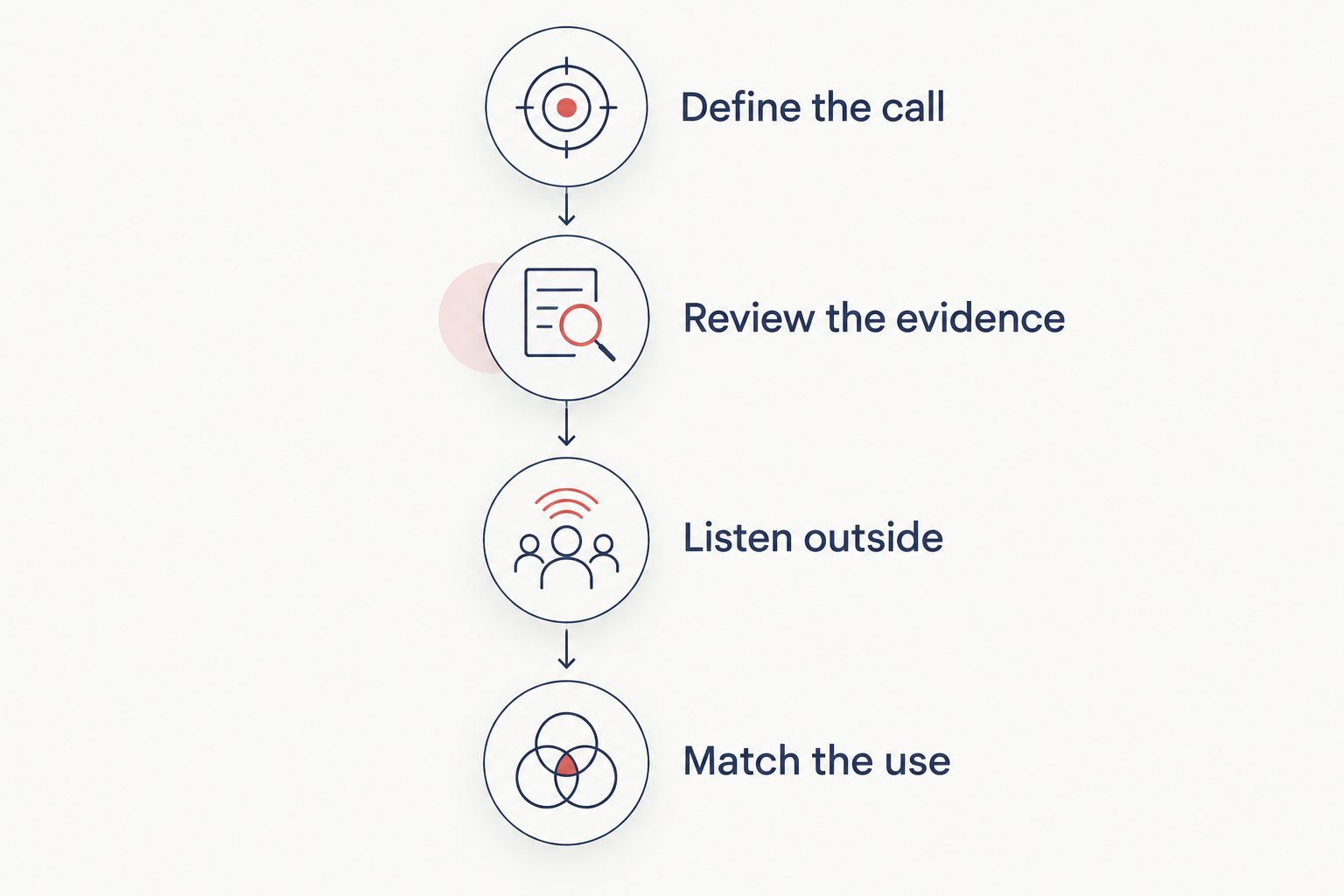
Use a straightforward sequence that connects the conversation requirement to the acoustic evidence. This is a decision process, not a substitute for a technical measurement or a guarantee of privacy.
Define the call
Describe the calls the booth is intended to support. Include whether they are routine conversations, video meetings or discussions containing sensitive information. Specify the outcome you need rather than using quiet as a catch-all requirement.
A useful brief says that nearby colleagues should not be distracted by routine calls, or that speech should not be intelligible at the relevant listening positions. Those are different objectives. Naming the objective makes the later evaluation more meaningful.
Review the evidence
Read the product-specific acoustic information and the description of the reported measurement. Keep the model name, configuration and result together in your comparison notes. Ask for clarification when the acoustic terminology does not identify what was measured.
Quell Workspaces office phone booths should be considered through the same evidence-led process as any workplace enclosure. A product description establishes what is being offered; it does not replace a product-specific acoustic result.
Listen outside
During a demonstration, use ordinary speech and listen from positions that represent nearby colleagues. Focus on whether you can follow the conversation, not simply whether some sound reaches you. Avoid using confidential information as demonstration material.
A demonstration answers a practical question about that setting. It is useful supporting evidence, but it is not a controlled comparison unless the conditions are genuinely comparable. Record the circumstances rather than turning an impression into a technical claim.
Match the use
Compare what you heard with the call requirement you defined. A booth that reduces general disturbance has not necessarily met a requirement for sensitive speech. If the evidence does not establish the intended outcome, keep that use case separate rather than assuming it is covered.
What matters for routine calls?
For routine calls, assess distraction as well as speech privacy. A nearby colleague might hear a voice without being able to follow the words, yet still find repeated speech distracting. Conversely, a barely noticeable conversation can remain intelligible in a quiet office.
Keep the caller's experience in view too. Noise entering the booth and speech leaving it are related acoustic concerns, but a claim about one should not automatically be read as a quantified claim about the other. Ask which direction and acoustic property the evidence addresses.
The practical advantage of an enclosed call space is its separation from the shared workspace. Its limitation is that enclosure alone does not establish a particular reduction figure. Your decision still needs evidence for the actual product.
Recommend a booth for routine calls only when its documented performance and demonstrated behaviour match that use. Do not add a confidentiality promise merely because the routine-call assessment was satisfactory.
What matters for sensitive conversations?
For sensitive conversations, focus on intelligibility outside the booth. Hearing that someone is speaking is different from understanding names, decisions or the substance of a discussion. A reduction figure helps inform the assessment, but it does not guarantee that words become unintelligible at every listening position.
Consider the quietest normal conditions in your workspace. A conversation assessed against busy office activity has not necessarily been assessed against a nearly silent room. Keep that distinction in the decision record.
Do not use a phone booth as the default answer to every confidential conversation. Where speech privacy is essential, make the intended use explicit and seek a product-specific acoustic assessment relevant to that requirement. Treat an inconclusive result as inconclusive, not as permission to make a stronger claim.
This is the central trade-off: a convenient place for calls is not automatically a verified setting for every type of discussion. Choose the conversation setting according to the evidence, rather than stretching the evidence to justify the setting.
Which descriptions should you read carefully?
Words such as acoustic, quiet and soundproof do not provide a numerical performance result on their own. They describe an intended characteristic or product category, but you still need to establish the measured property and its scope.
Likewise, visual privacy and acoustic privacy answer different questions. Preventing someone from seeing a caller does not establish whether that person can understand the conversation. Keep appearance and speech transmission separate in your assessment.
A helpful comparison records what each statement actually supports:
- An absorption statement supports a discussion of reflected sound, not a whole-booth isolation figure.
- A component result describes that component under the stated conditions, not necessarily the finished booth.
- A whole-booth result supports comparison within the scope of its measurement method.
- A workplace demonstration supports an observation about that conversation in that setting.
These distinctions prevent overclaiming without making the buying process unnecessarily technical. You do not need to become an acoustician; you need to keep each piece of evidence attached to the question it answers.
FAQ
What is a good sound reduction figure for an office phone booth?
A good sound reduction figure is a clearly described, complete-booth result that supports your intended calls. There is no single decibel target that guarantees speech privacy across every office and listening position.
Does soundproof mean nobody outside can hear me?
No. Soundproof wording alone does not establish that nobody outside can hear or understand you. Assess the measured acoustic result and speech intelligibility at the relevant listening positions.
Is sound absorption the same as sound reduction?
No. Sound absorption concerns reflected sound within a space, while sound reduction concerns sound transmitted between spaces. An absorption claim does not establish how much speech escapes a complete booth.
How can I check whether a phone booth gives enough privacy?
Check the product-specific acoustic evidence, then assess whether an outside listener can understand ordinary speech during a demonstration. Use non-sensitive conversation material and remember that the demonstration describes that setting, not every office.
Will a quiet office change what people hear outside the booth?
Yes. Lower background sound can make escaping speech more noticeable and easier to follow. Assess the quieter conditions relevant to your calls rather than relying only on a busy-office demonstration.
How should I compare Quell Workspaces office phone booths?
Compare Quell Workspaces office phone booths using evidence for the exact model and configuration you are considering. Match the measured acoustic property to your call requirement rather than relying on product names or general acoustic descriptions.
One last thing
During a demonstration, ask the outside listener to repeat what they understood, not merely to say whether they heard a voice. Those questions test different outcomes. Use neutral material so the exercise itself does not disclose sensitive information.
Choose for the conversation you need to protect, not the adjective attached to the booth. Keep the technical result, listening conditions and intended use together in your decision notes; that is a more useful record than a headline decibel figure alone.


