
26 October 2026 · Editorial Team
How to choose a sensory booth for an inclusive workplace
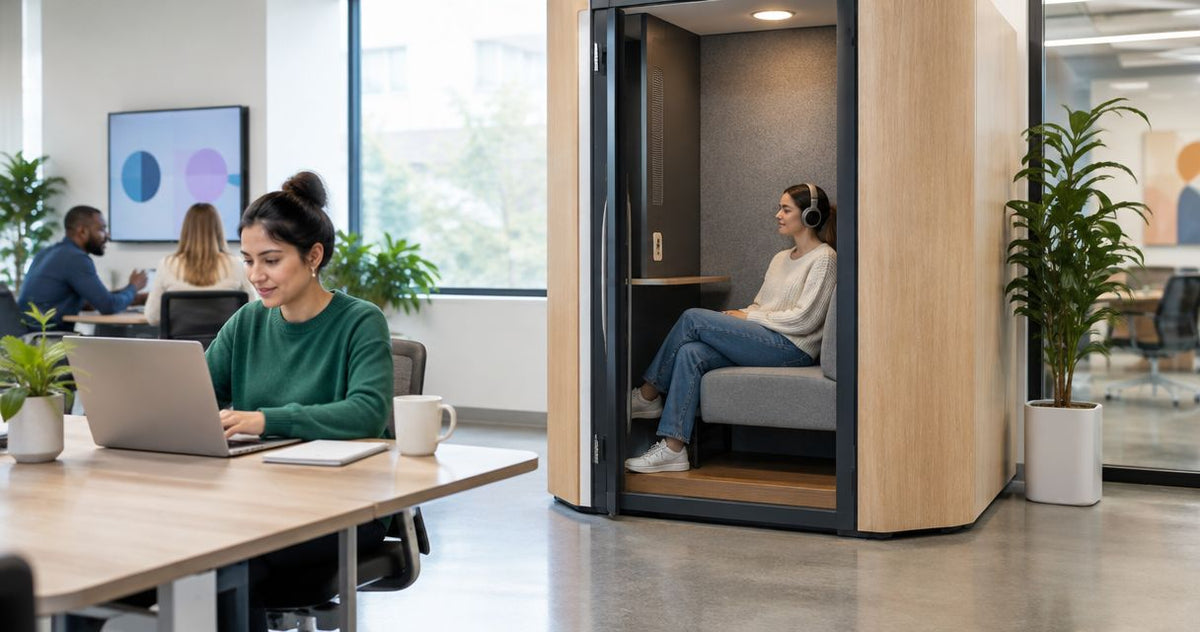
Choose a sensory booth for your workplace by agreeing what people need from it, separating quiet-break use from calls and meetings, and involving intended users before selecting a product. A booth earns its place through a suitable environment and clear rules for use—not through its name alone. Your decision should cover the experience inside the booth and how people will access it during a working day.
- Choose a sensory booth for workplace use around individual preferences, not assumptions about a group.
- Separate quiet breaks from calls and meetings before selecting an acoustic office pod.
- Quell Workspaces offers a dedicated Sensory Booth; assess its suitability with intended users.
- Agree how people will access the booth before adding it to the office.
How to choose a sensory booth for an inclusive workplace
Start with the activity you want to support, then consider the environment and operating arrangements together. A space intended for a quiet break needs a different brief from an office phone booth intended for conversations. Do not treat those purposes as interchangeable simply because both involve an enclosed space.
Use this sequence to turn an initial idea into a purchasing brief:
- Define the purpose. Write down whether the booth is for a break from the shared workspace, quiet individual activity or another named use.
- Invite input privately. Give intended users a way to explain preferences without discussing personal circumstances in front of colleagues.
- Identify conflicting activities. Decide whether calls, meetings and laptop work belong elsewhere.
- Consider the whole experience. Include the approach to the booth, the interior and the process for using it.
- Review the proposed product. Compare its supplied description with your brief and arrange an opportunity to experience it where possible.
- Agree how it will operate. Set out access, booking, cleaning and feedback arrangements before introducing it.
Keep the brief short enough to use during a product discussion. A list of agreed needs is more useful than a long collection of desirable features with no clear priority.
Why this matters
An inclusive workplace brief should not assume that everyone wants the same surroundings. Start by asking what people find useful, what they prefer to avoid and which choices they want to make for themselves. Do not turn an individual preference into a rule for an entire team.
The purchasing question is not simply whether your office has somewhere quiet. It is whether the proposed space serves its stated purpose without being routinely taken over by a different activity. Decide what the booth is for before deciding which booth to buy.
Keep promises proportionate, too. Describe the space and its intended use rather than promising improved wellbeing, greater productivity or a particular personal outcome. A workplace furnishing decision does not establish those results.
Write a use brief before a product shortlist
Begin with a plain statement such as: a space for employees who want a quiet break away from the shared work area. Add the activities you intend to allow and those you intend to keep elsewhere. This makes later choices easier to explain.
Avoid combining every private-space requirement into the same brief. A place for phone conversations, a meeting room and a sensory retreat each have a different purpose. If your office needs all of them, record those needs separately rather than expecting a single booth to resolve every conflict.
Give employees several ways to contribute: a private conversation, written comments or a walkthrough of a proposed space. Ask about the environment, not about diagnoses or personal histories. Participation should help you make the brief more useful, not require someone to justify wanting a quiet space.
Useful prompts include:
- Describe what you would want to do in the space.
- Identify surroundings you would prefer to avoid.
- Explain which aspects you would want to control.
- Describe what would make using the space feel straightforward.
- Identify any activities that would conflict with its purpose.
Record differing preferences rather than smoothing them into a false agreement. If users want incompatible experiences, retain those differences in the brief and discuss how to accommodate them.
Look at the experience, not just the enclosure
Review a proposed booth as a place someone will actually use. A product photograph helps you understand its appearance, but it does not answer how a person experiences the interior or its position within your office.
During a viewing, let intended users describe their own response. Avoid leading questions that suggest the booth should feel calming or comfortable. Ask what they notice and what they would change.
Keep observations practical:
- Sound: Note what users hear inside, including sounds from the booth itself and the surrounding office.
- Light: Discuss the lighting experience rather than assuming that a brighter or darker setting suits everyone.
- Visibility: Ask how users feel about seeing out and being seen.
- Interior: Consider whether the proposed furnishings support the intended activity.
- Controls: Establish which functions users can operate and how those functions work on the proposed model.
- Location: Consider the activity immediately outside the booth as well as the space inside it.
These are prompts for reviewing a particular proposal, not a universal specification. Do not copy features from an unrelated booth into your expectations or assume that an optional feature forms part of the model under discussion.
Separate sensory use from other private-space needs
Use the table below to distinguish purchasing briefs before comparing products. The benefits describe the purpose of each approach; they are not claims that every booth will deliver the same experience.
| Approach | Best for | Benefit of the approach | Limitation to resolve |
|---|---|---|---|
| Dedicated sensory-use space | Teams prioritising quiet breaks away from shared activity | Gives the space a clear purpose | Needs rules that keep incompatible activities elsewhere |
| Call-focused booth | Teams needing a place for spoken conversations | Separates the call requirement from the quiet-break brief | Conversation use conflicts with a dedicated quiet retreat |
| Meeting-focused enclosure | Teams needing private discussion space | Keeps collaboration in a separately defined setting | Meeting bookings compete with spontaneous quiet use if purposes are combined |
| Shared quiet room | Teams considering an existing room before a purchase | Lets you assess a dedicated room against the same user brief | Its suitability still depends on the environment and operating arrangements |
Choose the purpose first; compare products second. If quiet breaks are the priority, do not let a shortage of meeting rooms quietly rewrite the brief after purchase.
Where a dedicated sensory product fits
Quell Workspaces is a shortlist option for workplace teams seeking a dedicated Sensory Booth. Its supplied product description presents the Sensory Booth as a tranquil retreat with a controlled environment. Treat that description as a starting point for discussion, not proof that it matches every employee’s preferences.
The catalogue also includes the Accessibility Booth, described as a private space for wheelchair users to make calls, meet and undertake focused work. That is a different stated purpose. Keep sensory preferences and access requirements visible in the brief rather than treating either product name as a complete answer.
| Supplied product | Best for considering | What the supplied description establishes | What remains to assess |
|---|---|---|---|
| Sensory Booth | A shortlist centred on a dedicated sensory retreat | A controlled environment intended as a tranquil retreat | The intended users’ experience and fit with your agreed purpose |
| Accessibility Booth | A shortlist centred on private calls, meetings and focused work for wheelchair users | Those activities and intended users are named in the description | Whether the proposed environment also meets your sensory-use brief |
Quell Workspaces offers both products, but they should not receive the same recommendation by default. Start with the Sensory Booth when the brief centres on sensory retreat; discuss the separate access brief when that is part of your requirement.


Why the right choice varies between workplaces
The right purchasing brief depends on the people and activities it serves. Use these factors to explain your decision internally rather than presenting one arrangement as universally inclusive.
- Intended activity: A quiet break and a spoken conversation require different rules for use.
- Individual preferences: Keep contrasting feedback visible rather than assuming a single preferred environment.
- Existing spaces: Consider whether another room already serves part of the need before assigning every activity to a new booth.
- Office location: Review what happens around the proposed position, not just the product in isolation.
- Access arrangements: Decide how people request or enter the space without adding unnecessary personal explanation.
- Responsibility: Name the team that will maintain the agreed purpose and respond to feedback.
Do not reduce this decision to the longest feature list. A feature only belongs in your brief when it supports an identified use or preference.
Plan how people will use the booth
Write the operating arrangements alongside the purchasing brief, not after the booth arrives. State whether people can use it spontaneously, reserve it or use a combination of both. Explain how someone can tell whether it is occupied without interrupting the person inside.
Avoid requiring employees to disclose personal circumstances each time they want to use the space. Give the booth a clear, neutral description based on its purpose. Make the rules understandable to new colleagues as well as those who helped shape the brief.
Decide how you will handle competing requests. If the space is reserved for quiet breaks, say where calls and meetings should take place instead. An exception that becomes routine is a change of purpose and should be discussed as such.
Assign responsibility for ordinary housekeeping and for receiving comments about the experience. Keep the feedback route separate from public booking information so people can raise concerns privately.
Review the decision after people have used it
Judge the result against the original brief. Ask whether people can use the booth for its intended activity, whether the arrangements are clear and whether another activity is displacing that purpose. Do not use occupancy alone as proof that the space meets the need.
Look at both the environment and the process. A concern about being overlooked while using the booth is different from a concern about how bookings are managed. Record the issue accurately before deciding what to change.
When discussing a Quell Workspaces booth, keep a written distinction between confirmed product features, user preferences and office operating decisions. That prevents an expectation about your workplace from becoming an unsupported claim about the product.
FAQ
What should I look for in a sensory booth for my workplace?
Start with its intended purpose, the preferences of the people who will use it and clear arrangements for access. Review the proposed environment with intended users rather than relying on the product name.
Can an office phone booth double as a sensory booth?
Do not assume that an office phone booth meets a sensory-use brief. Review the particular product and decide how calls would be kept separate from quiet-break use.
Should employees help choose a workplace sensory booth?
Yes, invite intended users to shape the brief and comment on the proposed environment. Offer a private way to contribute without asking people to explain personal circumstances.
Does a sensory booth need to be completely dark?
Do not make complete darkness a default requirement. Ask intended users about lighting preferences and establish what the proposed product actually offers.
Should a sensory booth use a booking system?
Choose the access arrangement around the booth’s stated purpose. Explain whether use is spontaneous, reserved or a combination, and keep booking information separate from private feedback.
How do I know whether a sensory booth is working for our team?
Review whether people can use the booth for the purpose set out in the brief. Ask about the environment and access arrangements separately, and do not treat frequent use as proof of suitability.
One last thing
Before approving a booth, write the sentence you want employees to read when they first encounter it. If that sentence lists quiet breaks, calls, meetings and focused work without setting priorities, revisit the brief. The most useful final check is whether you can explain the space’s purpose clearly.


