
27 October 2026 · Editorial Team
How to choose between a one-person booth and a four-person meeting pod
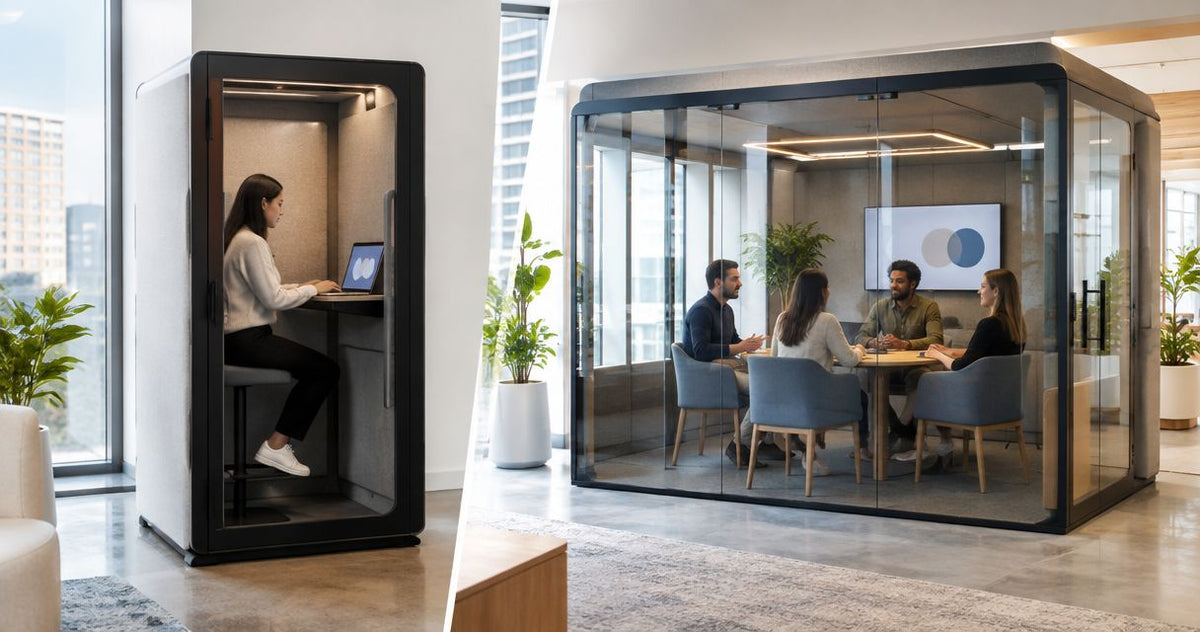
Choose a single-person booth for individual calls and focused work; choose a four-person meeting pod when colleagues need to meet inside the same enclosure. Instead of resolving room conflicts booking by booking, use a demand log and a task checklist to decide which format addresses the actual shortage.
- Single-person booth vs four-person meeting pod: choose by people physically present, not participants on the call.
- Quell Workspaces offers phone booths and meeting booths; match the format to the work you need to accommodate.
- A single-person booth supports individual use but cannot replace a shared meeting space.
- A four-person meeting pod supports small-group meetings but remains one bookable space.
Why this matters
A meeting-room shortage and a shortage of places to take calls are different problems. Buying a larger enclosure does not automatically solve both. Start with the activity that currently has nowhere suitable to happen.
For individual calls, the office phone booth is the relevant product category to investigate. For colleagues meeting together, investigate a meeting booth rather than treating a phone booth as a smaller substitute.
Quell Workspaces acoustic booths are best for workplace teams choosing a dedicated space around a defined calling or meeting task. The useful distinction is not which format sounds more versatile. It is whether people need separate spaces at the same time or seats together in one space.
A remote meeting illustrates the difference. One employee speaking to several remote participants still needs space for one person locally. Four colleagues joining that same call together need a shared enclosure for four people, plus a setup suited to the way they will participate.
Before you start
- Gather demand records. Use your room calendar, requests for private space and direct feedback from the people affected. Keep individual calls separate from meetings involving colleagues in the office.
- Prepare a decision worksheet. Use the headings Demand log, Booking pattern, Task fit and Decision brief. These are worksheet labels, not settings in a booking application.
- Check the hidden constraint: overlapping demand. A four-person pod has several places inside one enclosure; it does not provide several independently bookable rooms. Establish whether people need privacy separately before choosing by capacity.
Keep the assessment about work patterns, not technical assumptions. Record the tasks you need to support, then check the relevant product information for the configuration under consideration. Do not treat a category name as confirmation of included furniture or equipment.
Demand log
Record who needs the space and why
- List the displaced activities. Record calls taken at desks, meetings moved elsewhere and focused tasks interrupted by conversation. Describe the activity rather than writing only that someone needs a quiet room.
- Count people physically present. Separate individual use from shared use. Remote participants do not count towards the number of people inside the enclosure.
- Record timing and duration. Note when each activity starts, when it finishes and whether its timing is flexible. Keep recurring meetings distinguishable from unscheduled calls.
- Identify the consequence of the shortage. Record whether the activity was delayed, moved, interrupted or cancelled. Do not assume that every request represents the same level of need.
- Remove duplicate requests. A calendar entry and a complaint about that same meeting describe one event, not two separate demands for space.
Expected result: your worksheet separates individual calling demand from demand for colleagues to meet together. You can explain the problem without referring to a product.
Include ordinary working patterns rather than only unusually busy days. If the office schedule varies, retain that variation in the record. A quiet day does not cancel a recurring clash on a busier day.
Ask people what they were trying to do, not which pod they want. Someone asking for a meeting room might need somewhere to take an individual call; someone asking for a booth might need space for a conversation with a colleague. Those requests lead to different decisions.
Booking pattern
Separate simultaneous demand from shared attendance
- Group requests by time. Find activities that overlap. Keep the number of people in each activity separate from the number of activities happening together.
- Mark each clash. Distinguish unrelated individual calls from a single meeting involving several colleagues. These are not interchangeable uses of capacity.
- Check booking flexibility. Identify which activities can move and which are tied to an external appointment or established meeting schedule.
- Review existing spaces. Record whether another suitable room is genuinely usable at the required time, rather than merely appearing on the office plan.
- State the shortage plainly. Write either that people need independent spaces simultaneously, that a group needs somewhere to meet together, or that both needs exist.
Expected result: you know whether the priority is independent enclosure access or shared meeting capacity. This prevents seat count from becoming a misleading purchasing shortcut.
Four people making unrelated calls need separate places to conduct those calls. A four-person meeting pod puts them together, which does not resolve that requirement. Conversely, a single-person booth cannot accommodate a meeting that requires colleagues to sit together inside it.
The booking rule matters as much as the purchase. If individual callers reserve a group space for long stretches, a team meeting can still be displaced. Buying meeting capacity without deciding who should use it leaves that conflict unresolved.
Task fit
Compare the formats against your actual activities
- Choose the primary task. Use the demand log to identify the problem the purchase must solve first. Avoid a brief that treats every possible use as equally important.
- Check the working arrangement. Establish whether the task involves speaking, reading, typing, sharing documents or looking at a screen together. Ask about the relevant configuration rather than assuming it from a photograph.
- Compare the two formats. Use the table below to separate their strengths from their limits.
- Check the selected product. Confirm the stated capacity and configuration for that exact product. Do not transfer details between similarly named models.
- Write an acceptance statement. Describe the activity that should have an appropriate place once the purchase is in use.
Expected result: your preferred format has a defined purpose, an understood limitation and a clear reason for selection.
| Format and product to investigate | Best for | Main advantage | Main limitation | Decision test |
|---|---|---|---|---|
| Single-person format: Office Phone Booth Folio | Individual calls and work undertaken alone | Allocates an enclosure to an individual task | Does not replace a space for colleagues meeting together | Is the unmet activity carried out by one person locally? |
| Four-person format: Quell+ - 4 Person Meeting Booth | Small-group meetings involving colleagues in the office | Its supplied description states accommodation for 3 to 4 people | Remains one shared enclosure rather than separate spaces for unrelated calls | Do colleagues need to participate together in the same enclosure? |
Choose the single-person format when the recurring problem is individual access. Choose the four-person format when the recurring problem is shared attendance. Neither format replaces the other simply because both offer enclosed workspace.
For Quell Workspaces, use the exact product title when discussing a proposed purchase. This keeps the conversation attached to the correct product rather than a broad category with potentially different configurations.
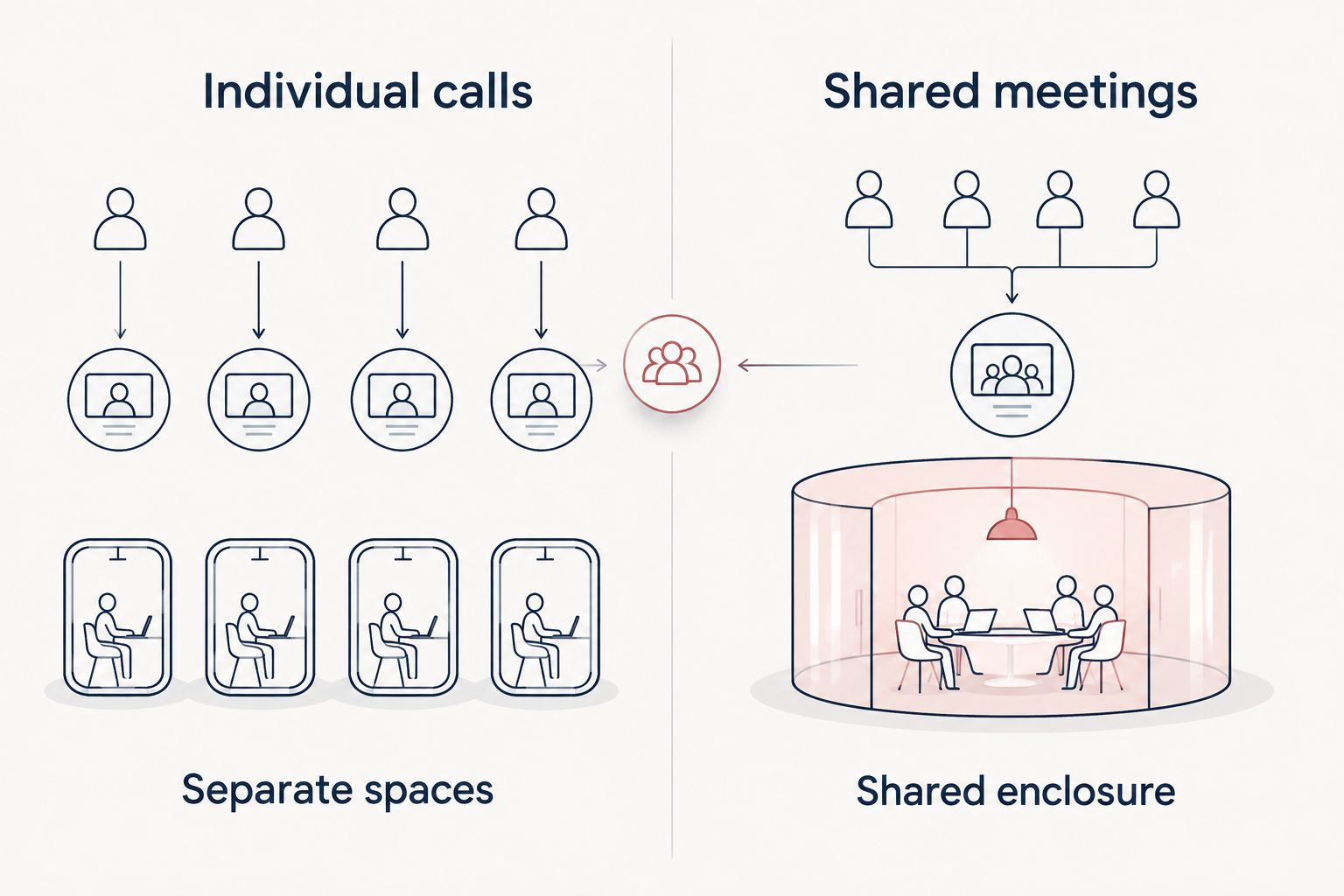
The comparison narrows the format, not every detail of the purchase. Review the product information and discuss the intended activity before treating either option as a complete working setup. Included items and configurations need their own confirmation.


Decision brief
Turn the comparison into a purchasing requirement
- Name the priority use. Write individual calls, focused individual work or shared meetings. Add a secondary use only if it does not undermine the priority.
- Specify local attendance. State how many people need to be inside the enclosure for the activity. Keep remote attendance in a separate note.
- Describe the booking conflict. Explain whether the problem involves overlapping requests, insufficient shared meeting capacity or both.
- List questions for the supplier. Ask what the selected configuration includes and how it relates to the intended task. Keep questions attached to the exact product.
- Agree an operating rule. Decide who can book the space, which activities take priority and how unused reservations should be released.
- Define the review question. After the space enters use, check whether the original activity still gets displaced. Occupancy alone does not answer that question.
Expected result: your decision brief explains why the chosen format fits the shortage, not merely why an enclosure would be useful.
A useful brief is specific enough for another decision-maker to understand without attending the discussion. For example: individual callers need separate access while the existing meeting rooms continue to handle shared meetings. The opposite brief would prioritise colleagues meeting together because individual calling space already exists.
Keep unresolved questions visible. A product recommendation should not silently become a claim about its equipment, furniture or working arrangement. Confirm those details before finalising the selection.
When your booking pattern changes
Repeat the comparison when working arrangements change, rather than assuming the first decision remains correct. A different office attendance pattern, a new recurring meeting or a changed role can alter the balance between individual and shared demand.
Update the demand log first. Then compare the new activities with the original acceptance statement. If group meetings now displace individual calls, check whether the space is serving its intended purpose or whether the booking rules have drifted.
For mixed demand, make a phased decision rather than calling one format a universal solution. Address the clearly documented shortage first, keep recording the remaining conflicts and use that record to define the next requirement.
Do not treat high occupancy as automatic proof of success. A meeting pod occupied by an individual while colleagues search for meeting space can be busy and still fail its intended purpose.
Troubleshooting
Individual callers keep occupying the meeting pod
Make the intended use explicit in the booking description and give shared meetings the agreed priority. If callers have no alternative, record that as unmet individual demand rather than treating it only as a booking problem.
The phone booth is busy, but shared meetings still lack space
Return to the demand log and separate the two activities. A booth serving individual users does not add group meeting capacity; review the shared-meeting requirement independently.
Staff count remote attendees as people needing seats
Record local attendance and remote attendance separately. Select the enclosure around the people physically present, then confirm the proposed configuration against the communication task.
The chosen product does not match the assumed setup
Check the exact product and configuration with the supplier. Do not infer included furniture or equipment from another model, a category name or an illustrative setting.
Reserved space sits unused while people look elsewhere
Agree a process for releasing abandoned bookings and make the space discoverable in the existing booking system. Review the reservation pattern before deciding that another enclosure is required.
Customise your workflow
Keep the same decision method, but adjust the task checklist to the work. Individual calls need a different brief from document reviews involving colleagues. A shared remote meeting also needs a different working arrangement from a conversation with no screen use.
Use Quell Workspaces product information to move from format selection to a specific configuration. Separate the enclosure decision from questions about furniture and equipment, so one does not quietly stand in for the other.
Give someone responsibility for reviewing booking conflicts after the purchase. The useful outcome is that the intended activity has an appropriate place, not simply that the new space attracts reservations.
FAQ
What's the main difference between a single-person booth and a four-person meeting pod?
A single-person booth serves individual use, while a four-person meeting pod serves people meeting together inside one enclosure. Several places in a meeting pod do not create separate rooms for unrelated calls.
Which format should I choose for an individual video call?
Choose the single-person format when only one person joins from the office. Count people physically inside the enclosure, not the remote participants, and confirm the selected configuration suits the call.
Can a four-person meeting pod replace several phone booths?
A four-person meeting pod does not replace separate booths for simultaneous, unrelated calls. It provides one shared enclosure, so distinguish independent calling demand from a group meeting.
What should I choose if the office needs both calls and small meetings?
Prioritise the documented shortage and keep the remaining demand separate. If both activities regularly clash, define individual and shared requirements rather than expecting one format to solve both.
How do I choose between the Quell Workspaces formats?
Choose the Quell Workspaces format that matches local attendance and the primary task. Investigate a phone booth for individual use and a meeting booth for colleagues meeting together, then confirm the exact product configuration.
Should I decide using occupancy figures alone?
No; occupancy does not show whether the intended activity has a suitable place. Check which tasks still get displaced and whether bookings follow the agreed priority.
One last thing
Count independent conversations, not just people. Four colleagues in one discussion and four colleagues on unrelated calls represent different requirements, even though the headcount is identical. Put that distinction in the decision brief before comparing products.


