
26 October 2026 · Editorial Team
How to cut noise in a call centre with phone booths
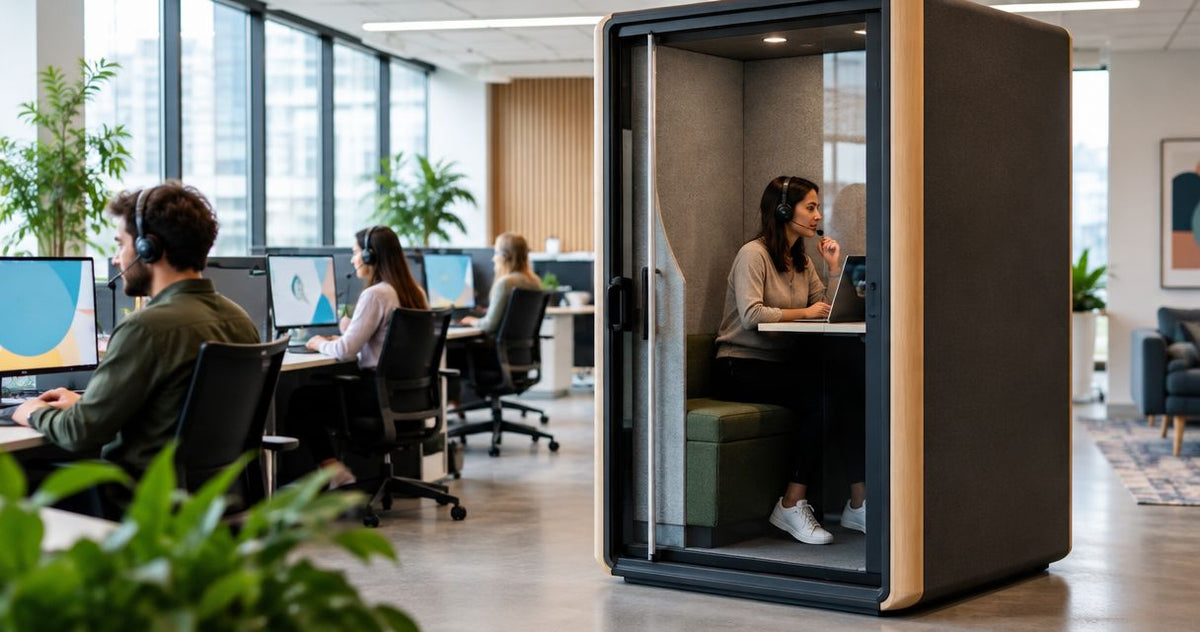
To reduce call centre noise, use phone booths for selected calls that need separation from the open floor, rather than trying to move every agent into a booth. Combine that separation with measures that address noise across the room: a booth helps with the conversation inside it, but does not treat every other voice or reflective surface.
- Quell Workspaces phone booths suit call centre teams seeking a separate space for selected customer conversations.
- To reduce call centre noise, booths should support a defined call-handling workflow, not replace the entire agent floor.
- Separate speech isolation from echo control: enclosed booths and room acoustic treatment address different problems.
- Check booth demand during busy periods before deciding how much shared call space you need.
How do you cut noise in a call centre with phone booths?
Move the right conversations off the floor, give agents clear access rules, and check the result during live operations. Start with calls that repeatedly suffer from nearby speech or create disruption for neighbouring agents.
An office phone booth provides a separate place to take those calls. Quell Workspaces supplies phone booths, but the operational decision comes first: identify which conversations belong there before choosing a product.
Use this sequence to build the plan:
- Identify the problem. Distinguish neighbouring speech, room echo and noise reaching the customer's microphone.
- Choose the call types. Define which conversations justify leaving the main desk.
- Check the workflow. Confirm that agents can access the systems and support those calls require.
- Set access rules. Decide how an agent finds and reserves an available booth.
- Review the outcome. Compare similar operating periods and record whether the original disruption persists.
Do not begin with a booth quantity. Begin with the work you need the booths to accommodate; otherwise, you risk creating a quiet space that agents cannot use when they need it.
Why this matters
Call centre noise is not a single problem. Speech travelling between desks, sound reflecting around the room and unwanted sound picked up by a microphone need different responses.
A booth separates a conversation from the shared floor. Absorptive room treatment addresses reflections, while headset and microphone settings affect what enters the call audio. Fix the noise path that is causing the complaint, rather than buying a solution for a different problem.
That distinction also sets realistic expectations. Moving an escalation into an enclosure does not stop the remaining agents from speaking, and reducing echo does not turn an open desk into an enclosed call space.
Choose the response that matches the noise problem
Use the comparison below to decide where a booth belongs in your plan. These are complementary approaches, not a ranking of products.
| Approach | Best for | Main benefit | Main limitation |
|---|---|---|---|
| Phone booth | Selected calls needing separation from nearby speech | Creates a separate place for the conversation | Helps only the calls that use it; shared access needs managing |
| Room acoustic treatment | Reflected sound across the shared floor | Addresses sound reflections within the room | Does not enclose individual conversations |
| Headset and microphone adjustments | Unwanted sound entering call audio | Targets the audio path used by the caller | Does not remove noise heard around the agent |
| Call-handling rules | Avoidable interruptions and competing activities | Clarifies where different conversations happen | Depends on consistent use and does not change the room itself |
A mixed response is appropriate when the problems are mixed. If customers hear surrounding agents and staff also complain about echo, treat those as separate issues to investigate.
Do not describe a booth as a promise of silence. Assess the actual product information and the intended task; a name alone does not establish acoustic performance.
Identify which calls should move into a booth
Give agents a short list of qualifying situations. A broad instruction such as ‘use the booth whenever it is noisy’ leaves everyone competing for the same space without a clear priority.
Escalations requiring sustained attention
An escalation is a useful candidate when nearby speech interrupts the agent's ability to follow the conversation. Define the point at which the agent offers a callback or moves to a separate space, rather than expecting an improvised decision during every difficult call.
The limitation is continuity. If moving means losing access to customer records or supervisor support, the separate space introduces another obstacle instead of solving the original one.
Scheduled customer callbacks
Scheduled callbacks are easier to match to shared booth access than unpredictable incoming calls. Reserve the space as part of the callback process and release the booking when the conversation finishes.
Keep the reservation tied to the task. A booth booked for general desk work is unavailable to an agent who needs a separate call space.
Conversations that disrupt neighbouring desks
Some conversations require more back-and-forth or supervisor involvement than routine calls. Moving an appropriate conversation away from the main desk bank separates that activity from neighbouring agents.
Do not make volume the only trigger. Check whether coaching, microphone position or another workflow change addresses the issue before treating every louder conversation as a booth requirement.
Make the booth usable within the call-handling workflow
A separate space only helps if an agent can complete the task there. Write down what must remain available during a customer conversation, including customer records, call controls, notes and access to assistance.
Test the intended working process rather than assuming that a change of location is straightforward. A mobile agent using a laptop has a different workflow from an agent working at a fixed desktop.
Before assigning calls to the booth, answer these questions:
- Can the agent continue or resume the call through the approved process?
- Can the agent reach the information needed to resolve the enquiry?
- Can a supervisor provide assistance without creating a second conversation on the open floor?
- Can the agent finish notes without holding the booth unnecessarily?
- Is there a clear alternative when the booth is occupied?
Do not send agents into a quieter space at the expense of the customer task. If a call cannot move without interruption, use the booth for planned callbacks instead of treating it as an immediate escape route.
Quell Workspaces phone booths belong in this discussion as separate call spaces, not as a substitute for checking how your team works. Product selection should follow the workflow brief.
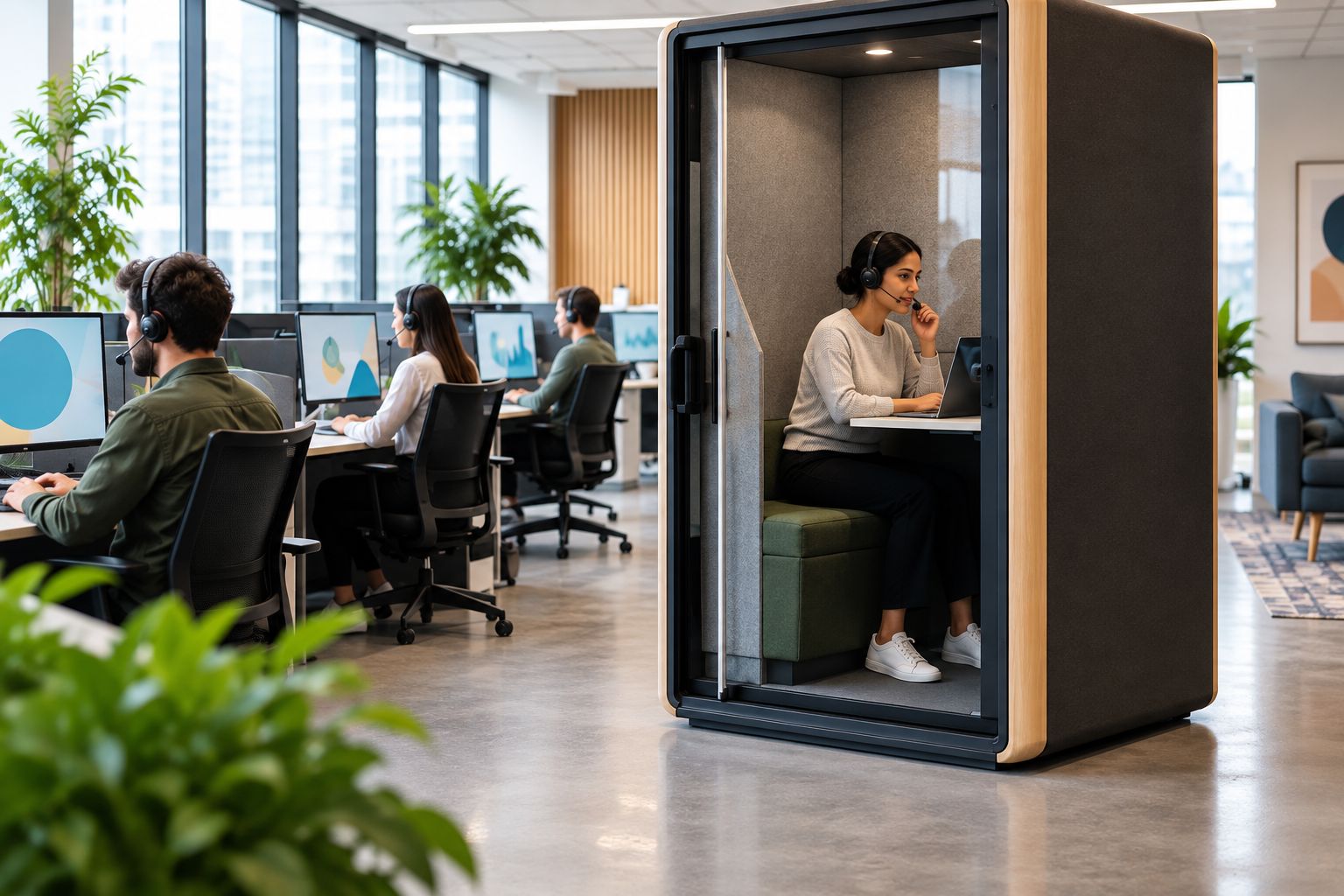
Why results vary between call centres
The same booth-use policy does not address every room or working pattern. Review these factors against the specific problem you identified:
- Simultaneous speech. Moving selected conversations leaves the other active calls on the shared floor.
- Sound reflections. Hard, reflective surfaces affect the room beyond the enclosed space.
- Call mix. Scheduled callbacks are easier to reserve space for than unexpected escalations.
- Access patterns. Shared booths help only when agents can use them at the relevant time.
- Working process. Customer systems and supervisor access influence which calls can move.
- Consistent use. Clear priorities matter when several people want the same space.
These factors explain why a booth count alone is not a noise-reduction plan. Specify the conversations, the access process and the remaining room problem together.
Write a practical brief before choosing a booth
Describe the task in plain language: ‘A separate space for scheduled customer callbacks that require uninterrupted attention.’ That tells everyone more than a request for a generic quiet pod.
Include the intended call types, the equipment agents already use and how shared access will work. Distinguish requirements you have confirmed from questions you still need answered about the product.
Facilities planning also belongs in the brief. Questions about connecting phone booths to office HVAC should be resolved with the relevant supplier and facilities team, not treated as an assumed feature of an enclosed call space. Keep the acoustic objective and the building-services questions separate so neither disappears from the discussion.
Avoid converting assumptions into specifications. Do not state that a booth will support a particular connection, work arrangement or acoustic outcome unless the supplied product information establishes it.
For Quell Workspaces, keep the enquiry tied to the call-centre task. Explain what agents need to do inside the space and ask which documented configuration matches that use.
Set access rules before the first busy shift
Decide who gets priority when demand overlaps. An escalation, a scheduled callback and an internal discussion should not all have the same claim on a space intended for customer calls.
Publish a short operating policy that covers booking, arrival, release and the alternative when no booth is available. Give supervisors responsibility for resolving clashes rather than leaving agents to negotiate during customer conversations.
Keep the policy proportionate. The aim is to make the separate space usable, not to add another administrative task to every call.
Watch for displaced noise as well. If agents wait outside the booth discussing cases, or supervisors gather nearby to help, the surrounding area can become another source of interruption. Adjust the workflow rather than assuming the enclosure has solved everything around it.
Check whether the change addresses the original complaint
Return to the problem statement after introducing the booth workflow. If the original issue was customers hearing neighbouring conversations, ask whether that issue persists on the calls assigned to the booth.
Compare like with like. Record the call type, operating conditions and whether the agent used the intended process; a quiet period and a busy shift are not interchangeable evidence.
Keep a simple operational log:
- Which qualifying calls used the booth?
- Which calls could not use it because it was occupied?
- Did agents complete the task without returning to their desks?
- Did the original noise complaint persist?
- Did another bottleneck appear?
These observations support decisions about the workflow and further investigation. They do not establish a product's sound-reduction rating or justify a claim about a measured acoustic improvement.
Judge success against the problem you set out to solve. High booth use does not prove lower noise, and low use does not automatically prove that the space is unnecessary.
FAQ
Can phone booths reduce noise across an entire call centre?
Phone booths separate the calls taken inside them, but do not treat every sound source across a call centre. If the shared floor remains noisy, investigate the remaining speech activity and sound reflections separately.
Should every call centre agent work in a phone booth?
Do not assume every agent needs a booth. Start with defined call types that benefit from separation, then check whether the shared-space workflow meets demand.
How many phone booths does a call centre need?
Base the quantity on simultaneous demand for qualifying calls, not total headcount alone. Record when those calls occur and when agents cannot access a booth before deciding on further capacity.
Will a phone booth replace acoustic treatment on the call centre floor?
A phone booth does not replace acoustic treatment where the problem is sound reflecting around the shared floor. Enclosing selected conversations and controlling room reflections address different noise paths.
Can agents move a live customer call into a booth?
Only plan live-call moves around a confirmed call-handling process. If the agent cannot retain the necessary systems and call continuity, use the booth for scheduled callbacks instead.
How do I check whether a booth is helping our team?
Check whether the original complaint persists during the call types assigned to the booth. Also record access clashes and workflow interruptions so a quieter location does not conceal a new operational problem.
One last thing
The best first question is not ‘How many booths do we need?’ but ‘Which calls need to leave the shared floor?’ Write that answer before discussing quantities.
A clearly defined callback or escalation process gives a phone booth a job. Without that job, even a frequently occupied space tells you little about whether you have reduced the noise that prompted the purchase.


