
28 October 2026 · Editorial Team
How to make a hot-desk area quieter
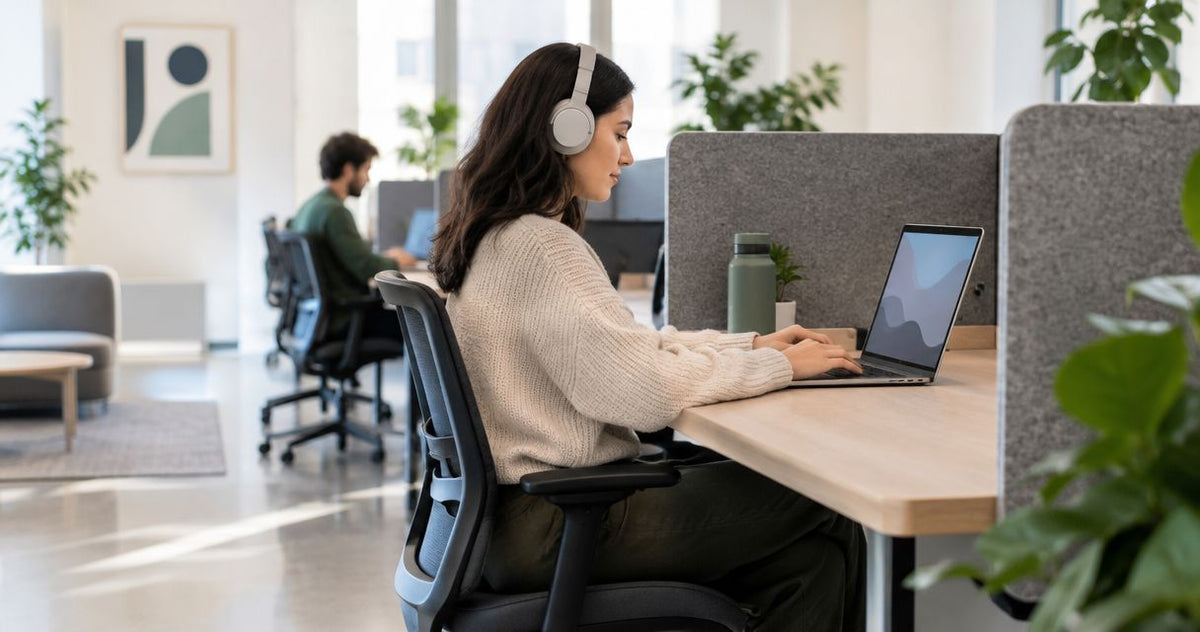
To create a quieter hot-desk area, move calls and discussions away from focus desks, separate quiet and collaborative activities, and use acoustic treatment to reduce reflected sound. Match each change to the problem: panels address reverberation, while enclosed booths provide a separate setting for conversations. Neither replaces clear rules about how shared desks are used.
- A quieter hot-desk area starts with separating focused work from calls and discussions.
- Acoustic panels reduce reflected sound; they do not turn shared desks into private rooms.
- Quell Workspaces acoustic meeting booths suit teams needing separate spaces for conversations beside shared desks.
- Review noise during busy periods before choosing furniture, panels or meeting booths.
Why this matters
Hot-desking changes who sits beside whom, but your rules for noise should stay consistent. A desk cannot reliably serve as a quiet writing space and an informal meeting point at the same time.
Start by distinguishing speech coming directly from nearby colleagues from sound reflecting around the room. If voices linger in a hard-surfaced space, acoustic wall panels address a different issue from relocating a call. Buying either without identifying the problem leaves part of the disturbance untouched.
The aim is not silence everywhere. It is to give people a dependable place for focused work without asking colleagues to stop collaborating.
How do you make a hot-desk area quieter?
Follow this sequence before committing to new furniture or acoustic products. Each step answers a different question about how the space works.
- Identify the interruption. Note whether people report nearby conversations, remote meetings, passing discussions or a generally echoing room.
- Separate incompatible activities. Give calls and collaborative work a destination outside the quiet desk area.
- Set desk-use expectations. Make it clear which activities belong at focus desks and where people should move instead.
- Address reflected sound. Consider acoustic treatment where reverberation remains a problem after activity changes.
- Review the result. Return during comparable busy periods and ask whether the original interruption still occurs.
Use the following comparison to choose the first intervention, rather than treating every noise complaint as the same problem.
| Intervention | Best for | Main benefit | Limitation |
|---|---|---|---|
| Quiet-desk rules | Calls and conversations taking place at focus desks | Sets consistent expectations for everyone | Depends on people having somewhere else to go |
| Separate collaboration area | Informal discussions gathering beside desks | Gives shared work a defined destination | An open discussion area still produces sound |
| Acoustic treatment | Reflected sound and reverberation | Absorbs some sound energy within the room | Does not enclose a conversation |
| Enclosed call or meeting booth | Calls and discussions needing a separate setting | Moves the activity away from shared desks | Needs to remain available for its intended use |
Choose the intervention that matches the interruption, not the product that looks most acoustic. A screen, a panel and an enclosed booth perform different jobs.
Establish quiet desks without banning collaboration
Define what a quiet desk is for in practical terms: reading, writing, analysis and other individual tasks. Then state where calls, group discussions and remote meetings belong.
Avoid instructions such as keeping noise reasonable. People interpret that differently. A clearer expectation is that sustained conversations move out of the focus area, even when everyone involved is speaking at a normal volume.
Apply the rule to the desk rather than the person. Someone doing individual work in the morning and attending remote meetings later should choose the appropriate setting for each activity.
Give visitors and occasional office users the same explanation as regular occupants. Quiet working arrangements fail when only established teams know how the area operates.
Keep the booking description consistent
If desks are bookable, describe their intended use in the booking information. A desk presented as suitable for calls should not sit inside an area where colleagues expect uninterrupted concentration.
Make the alternative equally clear. Tell people where to take a call, where to hold an informal discussion and what to do when those spaces are occupied.
Separate focus desks from conversation destinations
Put collaboration where you want conversations to happen. A discussion table immediately beside quiet desks creates conflicting expectations, regardless of what the desk area is called.
Review the relationship between the spaces, not just the distance between individual chairs. Consider where colleagues gather before meetings, where people pause to speak and which desks sit beside those gathering points.
A breakout area is useful for ordinary conversation, but it is not automatically a quiet neighbour. Treat its relationship with focus desks as part of the same planning decision.
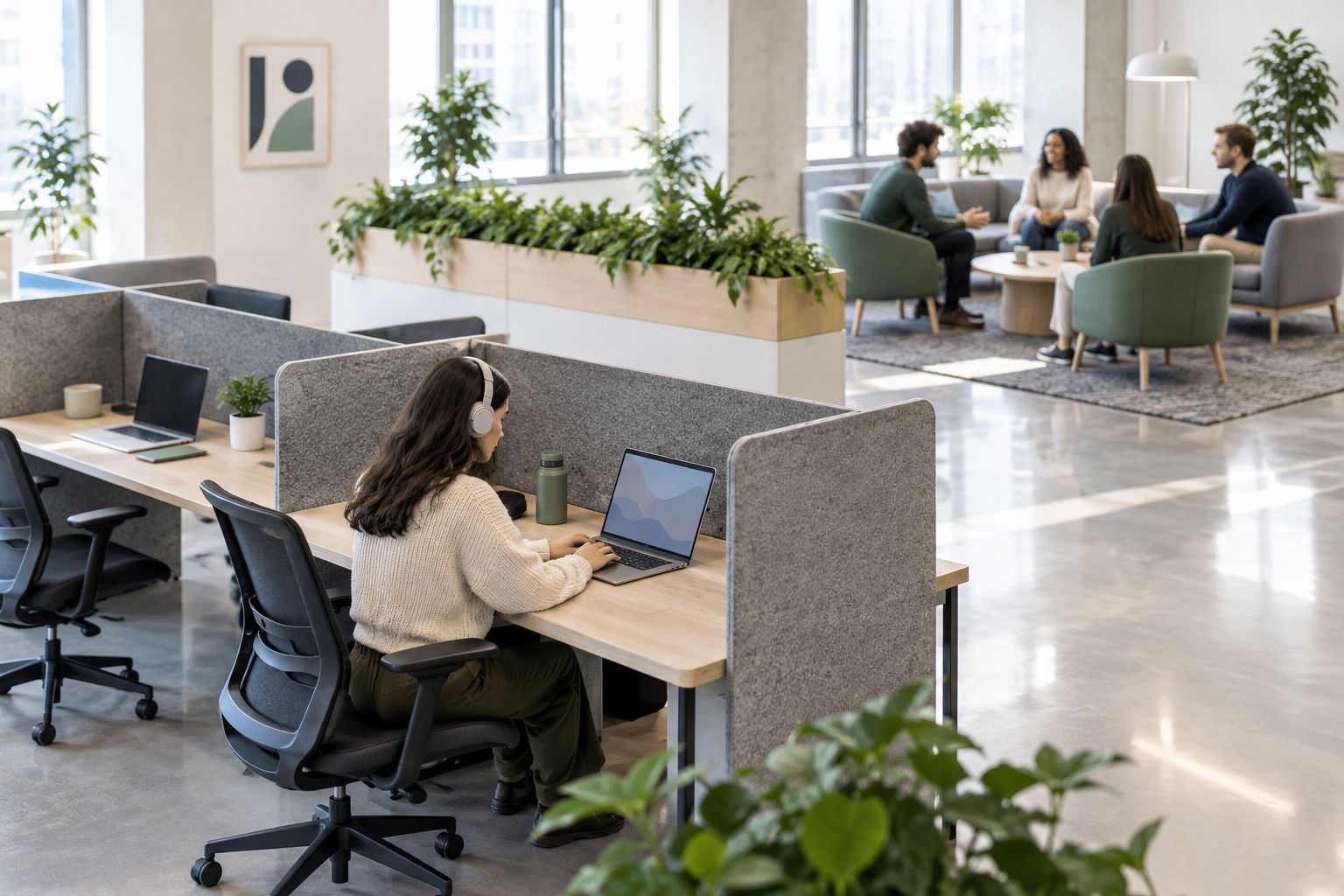
Walk through an ordinary working day from the user's perspective. If taking a call means abandoning a laptop, searching for a room and returning to find the desk occupied, the arrangement needs clearer shared-desk and room-use rules.
This is an operational decision as much as a furniture decision. Make the quieter behaviour straightforward to follow.
Match meeting space to the conversations leaving the desk area
Separate individual calls from face-to-face discussions when you assess demand. A person attending a remote meeting needs a different setting from colleagues reviewing work together.
Quell Workspaces acoustic meeting booths include different group capacities. Use the actual activity to narrow the choice; do not assume the largest booth is the best answer to every interruption.
| Meeting booth | Stated capacity | Best for | Planning trade-off |
|---|---|---|---|
| Quell+ - 2 Person Pod | 2 people | Private conversations between colleagues | Does not cover larger group discussions |
| Quell+ - 4 Person Meeting Booth | 3–4 people | Small-group discussions | Using it for individual calls removes a group setting |
| Quell+ - 6 Person Meeting Booth | 4–6 people | Meetings involving a larger group | It is not a substitute for separate individual-call provision |
The Quell+ - 2 Person Pod accommodates 2 people; the Quell+ - 4 Person Meeting Booth accommodates 3–4 people; and the Quell+ - 6 Person Meeting Booth accommodates 4–6 people. Those capacities help distinguish conversation types, but they do not establish how many booths your office needs.
For Quell Workspaces meeting booths, the practical benefit is a separate conversation setting. The limitation is equally important: a meeting booth does not treat reverberation across the surrounding hot-desk area.
Before choosing a format, record which conversations currently spill into the desk area. If individual remote meetings dominate, group capacity alone is the wrong basis for the decision.
Keep call spaces available for calls
A call space cannot support quieter desks if it is routinely occupied by someone doing unrelated individual work. Define its purpose and explain how that purpose differs from a quiet workstation.
Booking rules should reflect the activity you need to accommodate. Scheduled meetings and unexpected calls create different demands, so decide how each will work rather than assuming a calendar solves both.
Ask users to release bookings they no longer need and leave promptly when their conversation ends. These are simple expectations, but they determine whether colleagues have a realistic alternative to speaking at their desks.
Do not interpret an occupied booth as proof that provision is adequate. Check whether people are waiting, returning to desk-based calls or using larger meeting spaces because the intended option is unavailable to them.
Treat room echo separately from nearby speech
Acoustic absorption and activity separation solve different parts of the problem. Panels reduce reflected sound; moving a conversation changes where the sound begins.
In a shared office, nearby speech can remain distracting even when the room sounds less echoing. That is why adding panels should not be presented as permission to place calls anywhere.
The case for acoustic panels for coworking spaces rests on controlling reflections across a shared room, not making every desk acoustically private. Keep that distinction in the brief so that room treatment and conversation spaces are assessed separately.
Describe the problem in observable terms when discussing acoustic treatment: speech seems to linger, conversations carry across the room, or a particular desk group is disturbed by activity elsewhere. Ask an acoustic specialist to distinguish the causes rather than prescribing a quantity of panels from appearance alone.
Avoid treating upholstered furniture, privacy screens and acoustic panels as interchangeable. A visual boundary can make a desk feel more defined without providing the sound separation needed for a call.
Why noise varies across a hot-desk area
A hot-desk area does not have a single noise condition throughout the day. Use these factors to explain where the problem changes and which intervention deserves attention.
- Activity mix: individual work, remote meetings and group discussions place different demands on the same area.
- Conversation location: speech beside a focus desk creates a different problem from a discussion in a separate room.
- Room reflections: hard surfaces and the room's acoustic treatment affect how sound reflects within the space.
- Access to alternatives: a quiet-desk rule needs usable call and meeting destinations behind it.
- Consistency of use: changing occupants need the same expectations about what each area is for.
Do not average these differences into a vague complaint that the office is noisy. Name the activity, location and time pattern so you can make a targeted change.
Review the change from the desk, not just the floor plan
Return to the affected desks during comparable working conditions. An empty office tells you little about how the arrangement handles simultaneous calls and discussions.
Ask whether the original interruption has changed. Can people complete focused tasks without a conversation starting beside them? Are calls moving to their intended spaces, or simply shifting to another desk group?
Keep a straightforward record of the issue, the change and the remaining problem. This is an internal improvement log, not a measured acoustic assessment, and it should not be presented as evidence of a particular sound-reduction result.
If the room still sounds reverberant, investigate treatment. If nearby conversations remain the main complaint, revisit activity boundaries and access to call spaces before adding more panels.
For the distinction between conversation formats, the guide to phone booths and meeting pods explains the different uses. Keep that choice tied to what people need to do away from shared desks.
FAQ
What's the first thing to change in a noisy hot-desk area?
Move sustained calls and discussions away from focus desks, with a clear alternative destination. Then check whether reflected sound remains a separate problem.
Will acoustic panels stop colleagues hearing my calls?
Acoustic panels do not make an open desk private. They absorb sound within a room, while a separate enclosed setting addresses a different need.
Should a quiet hot-desk area allow video meetings?
A focus-only hot-desk area should direct spoken video meetings elsewhere. State that expectation in desk-booking information so occupants know what the space is for.
Are desk privacy screens the same as acoustic treatment?
Desk privacy screens and acoustic treatment are not interchangeable. A screen's visual separation does not establish how much sound it absorbs or blocks.
How do I choose between individual call space and a group meeting booth?
Choose according to the activity currently disturbing the desks. Individual remote meetings need individual-call provision, while face-to-face discussions need space for the group involved.
How can I tell whether the changes have worked?
Review the affected desks under comparable busy conditions and check whether the original interruptions still occur. Separate staff feedback from any formal acoustic measurements.
One last thing
Protect the purpose of the quiet desk, not just its location. A carefully separated area stops being dependable when its rules change according to who happens to sit there.
Make the next move specific: identify the conversation most often interrupting focused work, give it a destination, and check whether people actually use that destination. Only then decide what additional acoustic treatment the shared room needs.


