
27 October 2026 · Editorial Team
Meeting pods for hot-desking and hybrid office floors

Hot-desking office meeting pods are enclosed spaces for calls and small-group discussions, with the aim of keeping shared desks available for everyday work. For a hybrid floor, choose meeting pods for hot-desking offices around the conversations that happen together, rather than the total number of desks.
- Choose meeting pods for hot-desking offices by group size, call demand and shared access—not total headcount.
- Quell Workspaces meeting pods suit workplace teams seeking dedicated spaces for small-group discussions alongside shared desks.
- Separate solo calls from group meetings so one person does not occupy the only shared meeting space.
- Use booking records and actual occupancy to decide whether your next space should support calls or collaboration.
Why meeting pods matter for hot-desking offices
A hot desk gives someone a place to work. It does not give them a separate place to take a call, interview a colleague or discuss a project with the people sitting nearby. Treat these as different workplace needs.
Hybrid working adds another planning question: which activities happen when colleagues attend together? A floor organised only around individual desk bookings leaves that question unanswered. Your meeting-space brief should describe the work people need to do, not simply how many employees belong to the business.
The Quell+ - 4 Person Meeting Booth is described as accommodating 3 to 4 people. That makes group size a concrete starting point, rather than an assumption that any enclosed space will serve every meeting.
Quell Workspaces meeting pods suit workplace teams seeking dedicated spaces for small-group discussions alongside shared desks. The practical limitation is equally clear: adding a booth does not decide who gets access, how bookings work or which meetings belong there.
Plan meeting space around shared use
Identify the activities your desks cannot support
Start with a manual activity log. Ask office users to record when they leave their desk for a conversation, what they need from the alternative space and whether they find it.
Keep the language specific. A private video call, a paired project review and a team discussion are different requests, even when employees describe all of them as needing somewhere quiet. Record the activity before suggesting a product.
Include people who attend less frequently. Their experience matters because a shared floor should remain understandable without someone explaining its arrangements each time they arrive. A clear brief distinguishes regular demand from an occasional request.
- Record solo calls separately from group discussions.
- Note whether participants are present, remote or mixed.
- Identify conversations that need separation from desk activity.
- Record the space people actually use, including unsuitable substitutes.
- Ask what prevented people from using the intended meeting area.
Map simultaneous demand, not average attendance
Use your existing desk and room calendars before introducing another system. Compare periods when people attend with periods when meeting spaces are requested. You need to understand overlap.
Average office attendance cannot tell you whether several teams need a meeting space at the same time. Equally, a calendar full of reservations does not prove every booked space is occupied. Keep reservations and observed use separate in your notes.
For a hybrid floor, map demand by activity as well as attendance. A day dominated by individual video calls needs a different mix from a day organised around colleagues working together. Neither should automatically determine the layout for every other day.
- Compare desk bookings with meeting-space reservations.
- Record overlapping requests for the same type of space.
- Separate booked time from observed occupied time.
- Note group size for each meeting request.
- Mark occasions when people abandon or relocate a meeting.
Separate solo calls from small-group meetings
Allocate existing rooms more clearly before buying anything. Give solo calls an appropriate destination and reserve group spaces for conversations that genuinely require them. This is the manual way to test whether your problem is space allocation or insufficient provision.
An office phone booth is a relevant category to consider for individual call demand; a meeting booth addresses a different use. Do not treat the two as interchangeable simply because both separate a conversation from the desk area.
Quell Workspaces offers phone booths and private meeting rooms alongside acoustic office pods. Use those categories to shape your shortlist, then check the selected product against the activity brief. A solo caller should not routinely displace a group from its only suitable meeting space.
- Give individual calls a clearly identified destination.
- Keep small-group discussions in spaces intended for them.
- Distinguish short calls from extended individual work.
- Route larger meetings to an appropriate existing room.
- Review whether users understand the distinction without prompting.
Match the booth to the recurring group
Group size is a useful starting point because it connects the product to a named activity. Begin with the meetings you recorded, not the largest gathering your company has ever held.
The supplied description for Quell+ - 4 Person Meeting Booth states accommodation for 3 to 4 people. Quell+ - 6 Person Meeting Booth is described as accommodating 4 to 6 people. Choose between those stated uses according to recurring demand, while retaining another destination for meetings outside that range.
A larger meeting booth offers space for a larger group, but it does not answer every demand problem. If unrelated groups need separate conversations simultaneously, putting them into one larger space does not provide separate meetings.
- Match the stated group size to recurring discussions.
- Distinguish extra seats from extra independent meeting spaces.
- Keep larger gatherings in a suitable existing room.
- Check the selected configuration against your meeting brief.
- Retain a separate plan for individual calls.
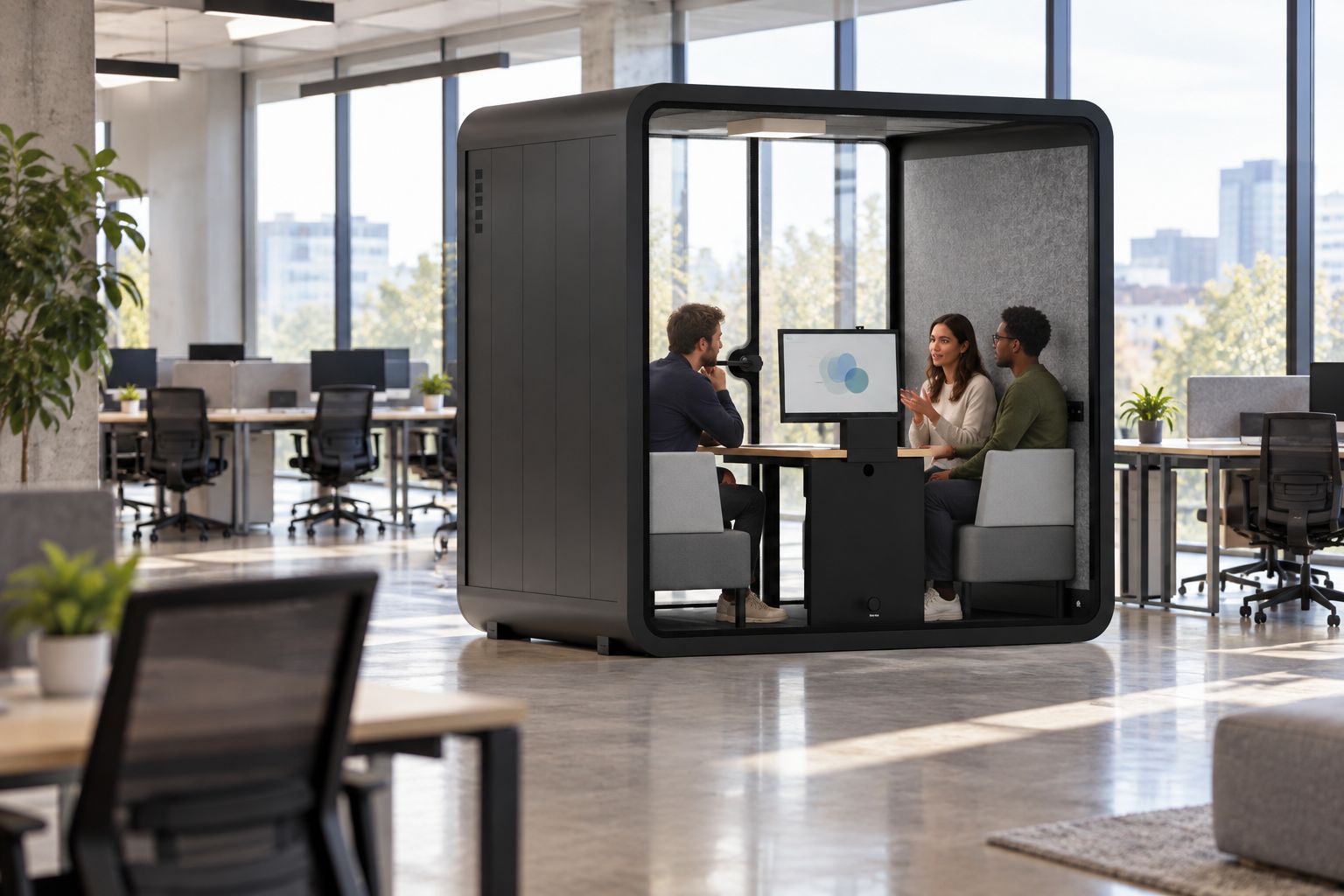
These two supplied products address small-group meetings. Neither replaces the need to manage shared access or provide another destination for groups outside its stated accommodation.


Make shared access easy to understand
Begin with the calendar or booking process your workplace already uses. Give every shared space an identifiable name and a short description of its intended use. Avoid creating a separate process unless the existing one cannot handle the task.
Agree whether each space is bookable, available for spontaneous use or divided between the two. The right arrangement follows your activity log. A project discussion planned in advance and an unexpected call do not have the same booking needs.
Make the rules visible in the information employees use to plan their office visit. Someone who attends occasionally should be able to find a suitable space without relying on a colleague's memory or an informal claim to a favourite booth.
- Publish each space's intended use in its calendar entry.
- State whether advance booking is required.
- Explain how to release a booking that is no longer needed.
- Give spontaneous calls an identified alternative.
- Apply the same rules across teams and seniority levels.
Test the meeting workflow before standardising it
Run representative meeting activities in the proposed arrangement. Start with your existing spaces and equipment so you can identify process problems before attributing every difficulty to the room itself.
For a hybrid meeting, check what remote participants experience as well as what people in the office experience. A group sitting together still needs a workable way to hear, speak and share information with colleagues elsewhere. Do not assume those arrangements are included with a booth.
Ask the supplier about the selected configuration where your workflow depends on a particular feature. Keep that question tied to the task: what must people do during the meeting, and what is supplied to support it?
- Try a discussion with both present and remote participants.
- Check how participants share documents during the conversation.
- Confirm what equipment belongs to the chosen configuration.
- Ask users to report awkward or unclear parts of the workflow.
- Record which issues concern the space and which concern equipment.
Measure whether the space solves the original problem
Return to the activity log after people begin using the arrangement. Compare the same categories of demand rather than introducing a new success measure because it is easier to count.
Occupancy alone is not the verdict. A booth used continually by an individual does not prove that group-meeting demand has been addressed. Equally, an empty booth is not automatically unnecessary if people cannot find it in the booking process or misunderstand its purpose.
Review unmet requests alongside actual use. That combination tells you whether to change booking rules, redirect activities or consider another type of space. Add the space your records show is missing, not a duplicate of whichever booth looks busiest.
- Compare intended use with actual use.
- Record group size alongside occupied sessions.
- Check whether solo callers still take group spaces.
- Review unused reservations and abandoned meeting requests.
- Adjust the rules before deciding that another booth is required.
Compare the options for a hot-desking floor
Use this comparison to match an option to the work it supports. It compares meeting arrangements, not acoustic performance or equipment specifications.
| Option | Best for | Practical advantage | Key limitation |
|---|---|---|---|
| Shared desk area | Individual work and informal exchanges | Keeps everyday work in the main workspace | Does not separate a discussion from surrounding desk activity |
| Individual phone booth | Solo calls away from shared desks | Gives individual conversations a separate destination | Does not serve a small-group meeting |
| Quell+ - 4 Person Meeting Booth | Discussions involving 3 to 4 people | Matches the supplied accommodation to a small-group use case | Requires another destination for groups outside that stated range |
| Quell+ - 6 Person Meeting Booth | Discussions involving 4 to 6 people | Supports the larger group stated in the supplied description | One larger booth does not provide separate spaces for simultaneous meetings |
| Existing meeting room | Meetings suited to the room's actual layout and equipment | Uses a space you already have | Its suitability depends on its existing provision and booking demand |
For Quell Workspaces meeting pods, the decision is therefore functional: select a stated group size, define the intended activities and check the chosen configuration. Keep other meeting destinations in the plan rather than expecting one product to cover every conversation.
Common mistakes on hot-desking floors
Planning from employee headcount alone
Company headcount does not describe the meetings happening together on a shared floor. Use attendance overlap, activity type and group size to write the brief. A desk allocation plan and a meeting-space plan answer different questions.
Letting solo work occupy group space by default
Without another destination, individual callers compete with project discussions for the same enclosure. Define the intended use and provide a clear alternative. Booking rules are ineffective when employees have nowhere else to carry out the activity.
Treating every reservation as real demand
A booking shows an intention to use a space, not proof of occupation. Compare reservations with actual use before adding capacity. Keep the review about workplace provision rather than individual employee performance.
Assuming the booth includes the whole hybrid-meeting setup
The enclosure and the meeting workflow are separate parts of your brief. Confirm the selected configuration instead of assuming furniture, screens or conferencing equipment are included. Test the task people need to complete, not just whether they can sit together.
FAQ
What are meeting pods for hot-desking offices used for?
Meeting pods for hot-desking offices provide a separate space for small-group discussions alongside shared desks. Define the activities they should support, such as project reviews or meetings with remote colleagues, before selecting a configuration.
Should a hot-desking office choose phone booths or meeting booths?
Choose phone booths for individual call demand and meeting booths for small-group discussions. If both activities recur, plan separate destinations rather than expecting the same space to serve them simultaneously.
How do you decide how many meeting pods an office needs?
Decide from simultaneous meeting demand and unmet requests, not employee headcount alone. Compare room bookings, actual occupancy and group size to identify which type of space is missing.
What is the difference between the supplied four-person and six-person booths?
Quell+ - 4 Person Meeting Booth is described as accommodating 3 to 4 people, while Quell+ - 6 Person Meeting Booth accommodates 4 to 6 people. Match those stated ranges to recurring discussions and check the selected configuration against your requirements.
Do meeting pods need an advance booking system?
Advance booking is appropriate for planned discussions, while spontaneous calls need an arrangement that allows immediate access. Decide which use each space supports and publish the rules in the workplace's existing booking information.
Can a meeting pod replace every meeting room?
A meeting pod should not be treated as a replacement for every meeting room. Keep another destination for groups, activities or equipment requirements that fall outside the selected booth's stated provision.
One last thing
Before adding another booth, examine the meetings that did not happen in the right space. An occupied pod tells you that someone used it; an unmet request tells you what the floor still lacks.
Your next space should answer a named unmet activity. That might mean separating individual calls, accommodating a recurring group or making the existing booking process clearer. Decide which problem you are solving before choosing another product.


