
16 October 2026 · Editorial Team
Meeting pods for management consultancies: a practical guide
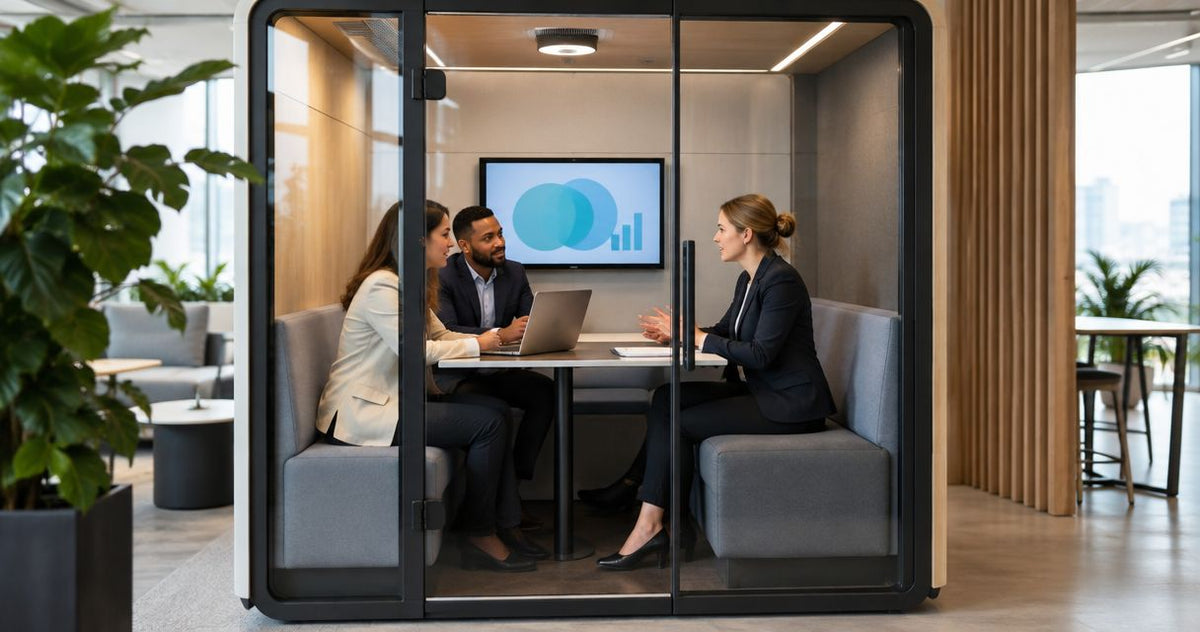
Management consultancies’ meeting-pod planning is the process of matching enclosed meeting spaces to client calls, project discussions and internal reviews, with the aim of giving each activity an appropriate place. This guide explains how to choose meeting pods for management consultancies without treating every conversation as the same room requirement.
- Choose meeting pods for management consultancies around actual attendance, call formats and overlapping bookings, not nominal team size.
- Quell Workspaces offers meeting booths for small project discussions; keep larger workshops in rooms suited to their format.
- Separate solo client calls from team meetings before deciding which spaces to add.
- An enclosed meeting space is not, by itself, a guarantee of confidential conversation.
Why meeting pods matter for management consultancies
A client interview, an engagement-team review and a proposal rehearsal need different spaces. The useful distinction is not simply whether a meeting is internal or external: it is how many people attend in person, what they need to share and whether nearby colleagues should hear the discussion.
Start by separating individual calls from group sessions. An office phone booth belongs in the solo-call discussion; a meeting booth belongs in the discussion about people working together. Treating both as interchangeable makes your room brief less precise.
Quell Workspaces meeting booths are best suited to consultancies seeking dedicated spaces for small, in-person project discussions. Their role should be specific, rather than becoming the default answer to every room request.
Recognise the consultancy-specific requirement
Build your brief around named activities: client interviews, project handovers, partner reviews, remote presentations and proposal preparation. These are different meeting formats, even when the calendar labels all of them as a project meeting.
For each format, ask what participants actually do. Reviewing a shared model needs a different working arrangement from speaking to a remote client, while a discussion involving sensitive material needs an agreed information-handling process as well as an appropriate room.
How to plan meeting pods for your consultancy
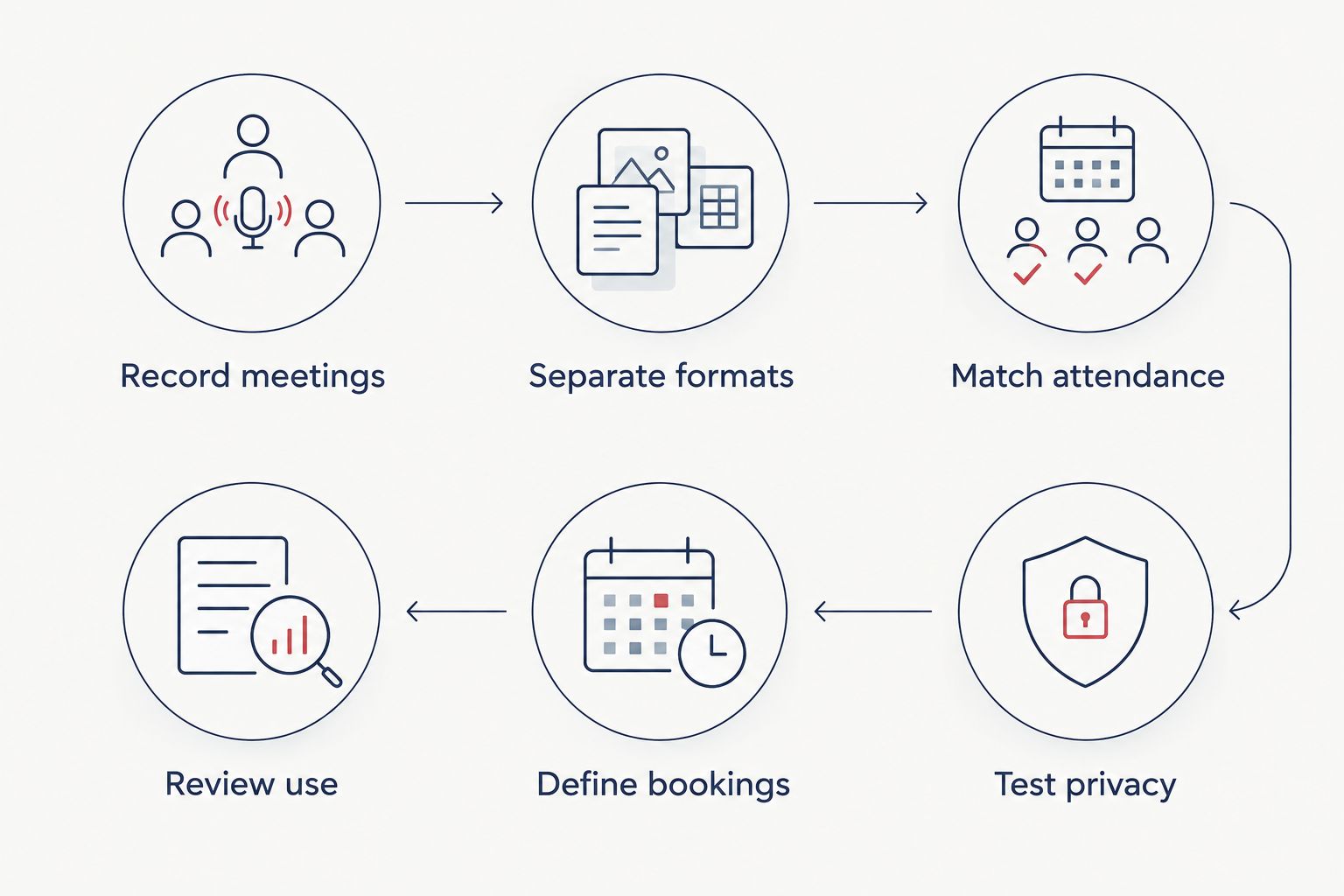
1. Record the meetings that lack a suitable space
Begin with your existing calendar and a shared spreadsheet. Ask engagement leads and office managers to record occasions when a meeting had to move, a call occupied an oversized room or a team could not find an appropriate place to work together.
Record the activity rather than the client’s identity. You need to understand space requirements, not create another document containing engagement details. A neutral label such as proposal review gives you a useful planning category without exposing the substance of the work.
Distinguish a repeated problem from a memorable exception. One unusually large workshop should not determine the specification for the small discussions that your team needs to accommodate routinely.
- Record the meeting purpose using a neutral category.
- Separate people attending locally from remote participants.
- Note when demand overlaps with other bookings.
- Identify which existing space was unavailable or unsuitable.
- Record whether rescheduling would have solved the problem.
2. Separate solo calls, project discussions and workshops
Use the meeting record to create distinct space briefs before reviewing products. A consultant joining a remote interview alone does not have the same requirement as several colleagues discussing a presentation together.
Keep workshop requirements separate too. A session involving movement, wall-based exercises or several working groups needs a brief based on those activities. A booth selected for seated discussion should not become a workshop room simply because the calendar is full.
Write a short purpose statement for each proposed space. For example, a booth intended for project reviews should be assessed against project reviews, not against every activity your office hosts. This gives you a clear reason to accept or reject an option.
- Group individual client calls into a solo-call brief.
- Group seated team discussions into a meeting-space brief.
- Give collaborative workshops a separate room brief.
- Identify sessions that need shared documents or presentation equipment.
- List activities that will remain in existing meeting rooms.
3. Match the booth to attendance and working format
Start with the number of people physically present, then consider what they need to do. Remote attendees do not occupy seats, but their participation changes the communication equipment and meeting process you need to evaluate.
The supplied Quell Workspaces product information describes the Quell+ - 4 Person Meeting Booth as accommodating 3 to 4 people, and the Quell+ - 6 Person Meeting Booth as accommodating 4 to 6 people. Those are attendance references, not proof that either arrangement suits every consultancy meeting.
For a practical shortlist, compare the proposed arrangement with a representative task. A project review involving laptops and shared documents needs to be considered differently from a conversation without working materials. Do not assume the product name answers every question about how your team will use the space.
- Count people attending in person for each meeting type.
- Distinguish discussion from document-heavy working sessions.
- List the equipment your meeting format requires.
- Compare shortlisted arrangements with a representative task.
- Keep larger or differently structured sessions outside the booth brief.
4. Test conversation privacy and remote participation separately
Begin with a representative discussion in the space you are considering. Assess the experience inside and outside the enclosure rather than assuming that the presence of walls answers every privacy question.
Keep acoustic privacy, visual privacy and digital information handling separate. A conversation that is difficult to follow from outside can still expose a document on a screen. Equally, a visually discreet position does not establish how speech carries to neighbouring desks.
For remote meetings, assess the actual call experience using the equipment and software you intend to use. A booth and a complete video-meeting setup are not the same thing. Confirm what is included in the proposed configuration instead of assuming cameras, microphones or displays form part of the purchase.
- Use non-sensitive material for a representative conversation.
- Check whether speech is intelligible from neighbouring work areas.
- Review views of screens and working documents.
- Test remote audio with your intended meeting equipment.
- Confirm equipment inclusions directly for the shortlisted configuration.
5. Define booking rules before adding another space
Use your current calendar or a shared booking sheet first. Give each space a clear purpose and explain when colleagues should choose it instead of a solo-call space or a larger meeting room.
For a consultancy, the booking description should reveal the room requirement without revealing client information. Labels such as internal review or remote presentation are more useful for facilities planning than detailed engagement names.
Agree how unused bookings are released and who resolves competing requests. A physical space cannot correct an unclear booking process. Establish the rules before introducing another system, then decide whether your existing tools are sufficient.
- Give every space a clear, activity-based description.
- Keep sensitive client details out of visible booking titles.
- Explain which meeting formats take priority.
- Set a process for releasing abandoned bookings.
- Assign an owner for booking disputes and recurring problems.
6. Review use against the original brief
Use the same meeting categories before and after introducing a space. This keeps the review focused on whether the original problem changed, rather than on whether the new booth attracted attention.
Record unmet requests as well as completed bookings. A full calendar does not reveal whether the right activities used the space, whether bookings actually happened or whether other teams still lacked somewhere suitable to meet.
Agree the review period internally and retain the same definitions throughout it. Only expand the provision when your records show which requirement remains unresolved. The next move might be another meeting space, a separate solo-call option or a change to booking rules.
- Compare intended use with actual meeting categories.
- Record unused bookings and unresolved room requests.
- Ask whether participants completed their intended task.
- Separate booking-process problems from space problems.
- Change the brief before repeating a purchase that did not fit.
Compare the options by meeting purpose
Choose the option that addresses the recorded problem, not the one with the broadest description. Existing rooms and clearer scheduling deserve consideration alongside a new booth because they address different causes of unavailable meeting space.
The product attendance figures below come from the supplied product descriptions. The best-for labels describe proposed use cases, not measured performance results or guarantees of privacy.
| Option | Best for | Main advantage | Key limitation |
|---|---|---|---|
| Existing meeting room | Workshops or sessions already suited to the room | Uses a space your team already knows | Retains any existing conflicts between meeting types |
| Revised booking rules | Unused reservations and unclear room priorities | Addresses how existing spaces are allocated | Does not add physical meeting space |
| Quell+ - 4 Person Meeting Booth | Small project reviews with 3 to 4 people attending locally | Provides a defined option for a small-group meeting brief | Its attendance range does not establish suitability for your equipment or task |
| Quell+ - 6 Person Meeting Booth | Team discussions with 4 to 6 people attending locally | Covers a larger local discussion group within the supplied range | Does not replace a separate brief for workshops or larger groups |
Quell Workspaces meeting booths belong on a shortlist when the unresolved requirement is a dedicated small-group space. Booking changes remain the better starting point when your evidence shows that existing rooms sit reserved but unused.
Common mistakes management consultancies make
Specifying for the engagement team rather than the meeting
An engagement team’s total size is not the same as local attendance. Record who joins each meeting in person, then distinguish recurring sessions from occasional full-team events. Otherwise, the brief answers an organisational question rather than a space question.
Treating an enclosure as a confidentiality guarantee
A meeting booth does not replace your consultancy’s information-handling process. Review speech, screen visibility, booking descriptions and participants’ use of documents separately. Keep especially sensitive discussions within the arrangements your organisation has approved for that purpose.
Combining client presentations and internal working sessions
A remote client presentation needs a deliberate communication setup; an internal working session needs an arrangement suited to the task. Describe both formats explicitly. Do not let a single meeting label conceal requirements that differ in practice.
Buying before fixing the calendar
A new space adds another resource to manage, not a booking policy. If colleagues reserve rooms they do not use or cannot tell which space fits their activity, address those behaviours first. Then use the remaining unmet requests to shape the purchasing brief.
FAQ
What are the best meeting pods for management consultancies?
The best meeting pods for management consultancies match the meetings that lack a suitable space: attendance, working format and remote participation should determine the shortlist. Quell Workspaces offers meeting booths described for 3 to 4 people and 4 to 6 people, but task suitability needs a separate assessment.
Should individual client calls use a meeting pod?
Separate individual client calls from group-meeting requirements when planning your spaces. A solo-call option and a meeting booth serve different attendance patterns, so record both before deciding what to add.
Does a meeting booth guarantee a confidential conversation?
No, an enclosure alone does not establish that a conversation is confidential. Assess speech intelligibility outside the space, screen visibility and your organisation’s information-handling procedures separately.
Can a meeting booth replace a consultancy workshop room?
A meeting booth should not automatically replace a workshop room. Workshops involving movement, wall-based exercises or several working groups need a brief based on those activities rather than seated attendance alone.
What should we check for remote client presentations?
Check the complete meeting setup using the equipment and software you intend to use. Confirm equipment inclusions for the proposed configuration, then assess audio, camera framing and document sharing with non-sensitive material.
How do we decide whether to add another meeting booth?
Add another meeting booth when consistent records show an unresolved need for that type of space. Compare actual use, unused bookings and unmet requests against the original brief before repeating the purchase.
One last thing
A booking calendar records reservations, not completed meetings. Before approving another space, compare the calendar with whether meetings happened and whether participants had the right setting for their work. That distinction keeps an unused reservation from becoming the justification for another purchase.


