
22 October 2026 · Editorial Team
Office meeting pods for law firms: complete 2026 guide
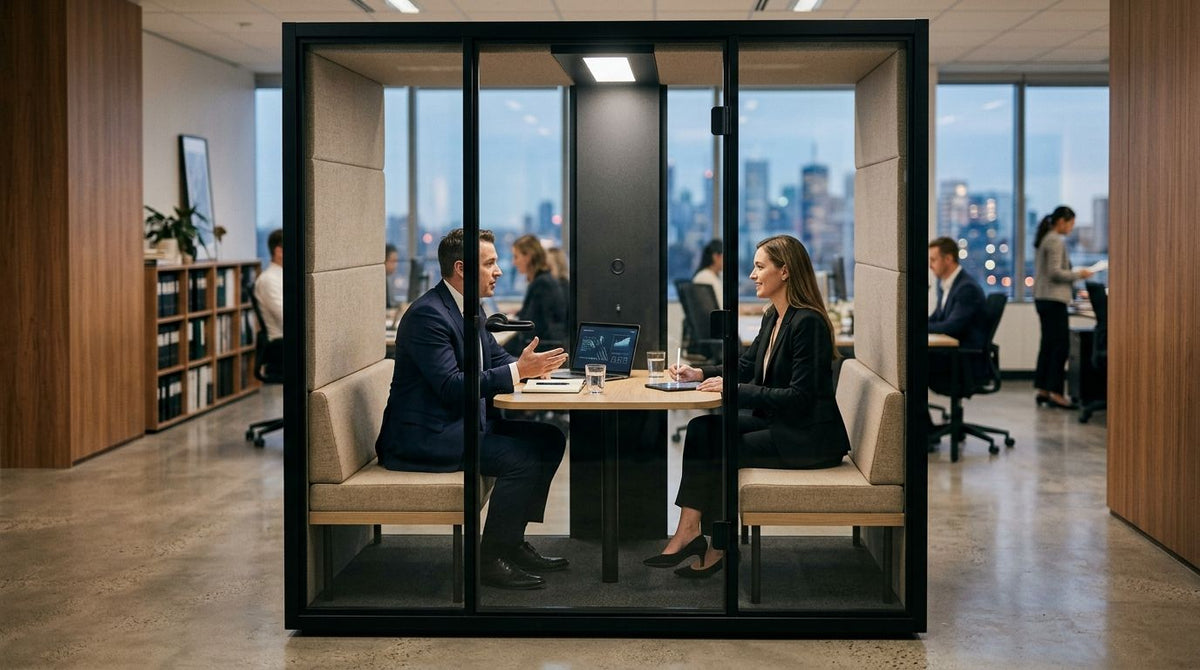
Office meeting pods for law firms are enclosed acoustic booths that give solicitors, paralegals and case teams a private space for client consultations, depositions and quick calls inside an otherwise open-plan office. Legal work runs on confidentiality and unpredictable scheduling, which means the sizing, furniture and layout brief for a law firm looks different from a generic office breakout pod.
- Office meeting pods for law firms range from single-person phone booths to 6-person meeting booths for case teams.
- Sizing by meeting type, not headcount, is the single biggest planning mistake law firms make when fitting out a floor.
- The Folio Office Pod (2-4 person) and Office Phone Booth Folio cover most client-facing legal work without a full room build.
- Furniture and security add-ons matter as much as the pod shell for confidential case discussions.
Why office meeting pods matter for law firms
A law firm's meeting space carries a different weight than a sales team's huddle spot. Client conversations touch on divorce settlements, criminal charges, commercial disputes and estate matters — content nobody wants drifting across an open floor. An office phone booth solves the smaller, more frequent version of this problem: the quick client callback, the five-minute update, the call a junior associate needs to take without booking a full room.
Open-plan legal offices have become the norm rather than the exception, which pushes the privacy problem onto pods rather than walls. Firms with only two or three large meeting rooms end up double-booking them for everything from partner strategy sessions to a single confidential call, and the call loses every time. A meeting pod for law firms fixes that mismatch by giving every practice group a private space sized to the job, not the building's original floor plan.
Audit how your firm actually uses meeting space
Before buying anything, work out where the current bottleneck sits. Most firms discover the shortage is in short, private conversations, not big meetings.
- Track how many meeting-room bookings under 30 minutes happen in a typical week
- Note how often associates take confidential calls at their desk or in a stairwell
- Flag practice areas — family law, criminal defence, employment — with the highest volume of sensitive one-to-one conversations
- Count how many client visits per week need a private room versus a quick booth
- Ask reception how often visitors wait because no private space is free
Define your confidentiality requirements before you shop
Not every conversation needs the same level of acoustic separation. A partner discussing settlement terms needs a different pod brief than a paralegal taking a scheduling call.
- Separate confidential-content conversations from routine internal check-ins
- Decide which practice groups need a dedicated pod versus a shared booking system
- Map which meetings involve documents that shouldn't be visible through glass panels
- Identify which teams need a pod near their desks versus a central booking hub
- Set a rule for how visitors are routed to pods versus formal meeting rooms
Match pod size to the type of legal meeting
Sizing by headcount alone is where most firms go wrong. A pod brief for a law firm should map to meeting type: single calls, two-person consultations, case-team reviews and small mediations.
- One-person calls and quick client callbacks: a phone booth format
- Two-to-four person client consultations and case reviews: the Folio Office Pod (2-4 person) fits this bracket
- Four-to-six person case-team strategy sessions: a larger meeting booth format
- Deposition-style sessions with a client and two solicitors: mid-size pods with a proper table, not a two-seat booth
- Overflow client visits during busy trial periods: a mix of booth sizes rather than one large room booked all day
Furnish each pod for the length of a legal meeting
A pod shell handles the acoustics; the furniture inside decides whether a two-hour client consultation is workable. Legal meetings run longer than a quick stand-up call, so seating and desk space matter more here than in a generic office pod.
- Choose seating built for extended sitting, not a bench meant for five-minute calls
- Add a proper work surface for note-taking, laptops and document review
- Fit lighting that supports reading contracts and case files, not just video calls
- Match chair height and desk depth to how many people actually sit in the pod
- Keep cable routing tidy so document review sessions aren't interrupted by clutter
Furniture built specifically for 4-person office pods is the faster route here — it's sized to the pod shell rather than repurposed from a general office chair range, which cuts out the guesswork on fit.
Add security features for confidential case material
Legal meetings often involve documents and case files that shouldn't be left visible or accessible when a pod is empty. A smart lock system on a booth door adds a layer of control that a standard meeting room door doesn't.
- Restrict which staff can access which pods during active case work
- Log booking and access patterns for pods used for sensitive client work
- Pair locking with booking software so pods aren't left open between sessions
- Separate access rules for client-facing pods versus internal case-team pods
Budget across pod sizes rather than buying one format
Firms that buy a single pod size for the whole floor either overspend on capacity they rarely use or under-provide for the meetings that actually happen most often.
| Pod option | Best for | Key limitation |
|---|---|---|
| Office Phone Booth Folio | Solo calls and quick client callbacks | Fits one person, no space for a shared consultation |
| Folio Office Pod (2-4 person) | Client consultations and case reviews | Not sized for full case-team strategy sessions |
| Quell+ 4 Person Meeting Booth | Client intake meetings, small mediations | Needs more floor space than a phone booth |
| Quell+ 6 Person Meeting Booth | Partner strategy sessions, larger case teams | Largest footprint of the range, best kept to one or two per floor |
The right mix for most firms is more small pods and fewer large ones. A phone booth clears far more scheduling conflicts per square metre than a six-person booth that sits half-empty most of the week.
Common mistakes law firms make with meeting pods
- Buying one pod size for the whole floor. A firm that installs only 4-person booths ends up with associates booking a full pod for a two-minute call, recreating the exact bottleneck the pods were meant to fix.
- Placing consultation pods too close to reception. Foot traffic and waiting-room chatter undercut the privacy the pod is there to provide, even with the door shut.
- Skipping furniture upgrades. Base bench seating works for a ten-minute call; it doesn't hold up for a two-hour client consultation or a document-heavy case review.
- Underestimating phone booth demand. Junior associates and paralegals take short, frequent calls all day. Firms that plan pods around partner-level meetings alone run out of phone booth capacity fastest.
- Treating every pod as interchangeable. A pod bought for quiet document review isn't the same brief as one bought for a five-person mediation, and buying on price alone tends to blur that line.


FAQ
What size office meeting pod does a law firm need for client consultations?
Most one-to-one and small client consultations fit a 2-4 person pod like the Folio Office Pod. Larger case-team reviews or partner strategy sessions need a 4-6 person meeting booth instead.
Is an office phone booth enough for confidential client calls?
A single-person phone booth covers quick client callbacks and short confidential calls well. It isn't a substitute for a multi-person pod when a client visits in person for a full consultation.
How many meeting pods should a law firm install per floor?
The right number depends on how many short private calls versus multi-person consultations your teams actually run each week. Firms generally need more small pods than large ones, since phone-length calls happen far more often than sit-down meetings.
Can meeting pods work for depositions and mediation sessions?
A 4-6 person meeting booth can accommodate a client, solicitors and a mediator for shorter sessions. Longer depositions with several attendees and document review usually still need a dedicated room.
What's the difference between a 4-person and 6-person meeting booth for legal teams?
The 4-person booth suits client intake meetings and small mediations, while the 6-person format fits larger case-team strategy sessions. The 6-person option has the larger footprint of the two, so most firms only need one or two per floor.
Do office meeting pods work in open-plan legal offices?
Yes, pods are built for exactly this scenario, adding private space inside an open floor plan without a construction project. They suit firms that have outgrown their existing meeting rooms but don't have space to build new ones.
One last thing
The pod size firms think they need and the pod size they actually use most rarely match. Phone booths clear more scheduling conflicts than any other format because short private calls happen many times a day, while a six-person booth might get booked once. Start any pod plan by covering phone booth capacity first, then add larger meeting booths for the case work that genuinely needs a table for four to six people.


