
15 October 2026 · Editorial Team
Office pods for insurance firms: a practical guide
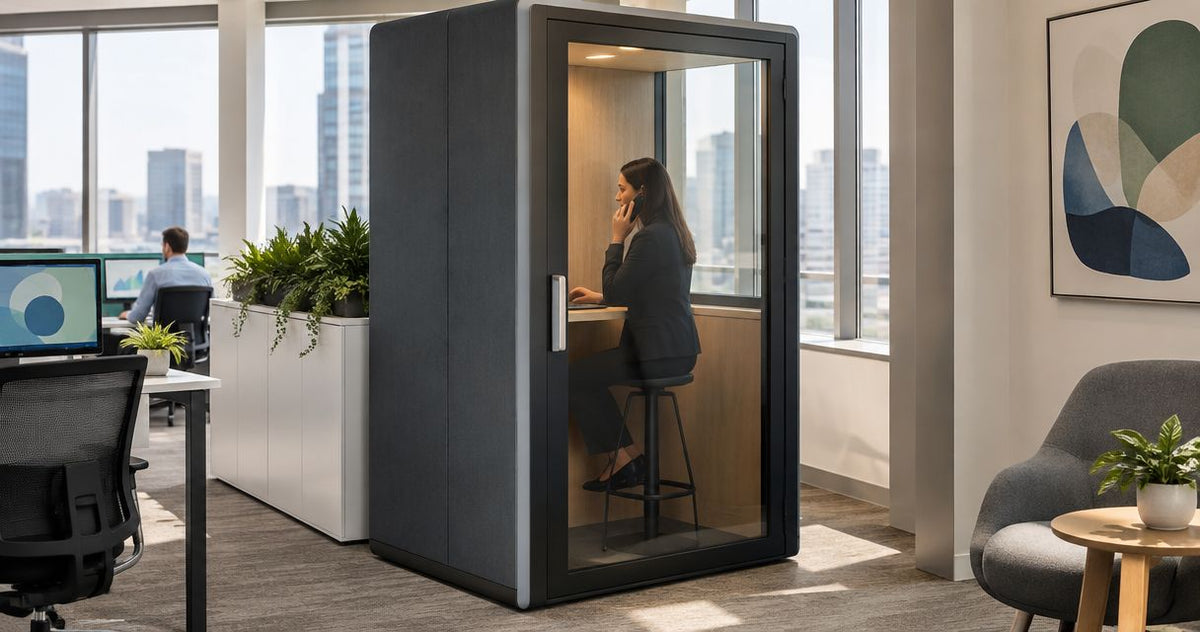
Insurance firms’ office-pod planning is the process of matching enclosed workspaces to claims calls, policy conversations and internal discussions, with the aim of keeping those activities separate from shared desk work. This guide explains how to choose office pods for insurance firms by task, rather than treating every conversation as a meeting-room booking.
- Choose office pods for insurance firms around claims calls, policy discussions and the number of people taking part.
- Quell Workspaces suits insurance teams comparing dedicated phone booths with small meeting pods.
- A phone booth and a meeting pod serve different tasks; neither guarantees confidentiality by itself.
- Keep existing rooms for suitable discussions, and use booking records to identify the remaining need.
Why office pods matter for insurance firms
A claims call, a policy review and an internal case discussion need different working arrangements. Start by separating those activities: someone speaking to a customer remotely does not need the same space as colleagues reviewing documents together.
For individual calls, the Office Phone Booth Folio is one option to include in your shortlist. Compare it against the task and your existing rooms, not against an assumed need to put every employee in an enclosure.
Quell Workspaces is best suited to insurance teams comparing dedicated call spaces with small meeting pods. The decision still rests on which conversations need a separate space and whether employees can use that space when they need it.
Keep the brief specific. An insurance team handling telephone enquiries needs somewhere to conduct those conversations; a team holding joint case reviews needs somewhere to work together. Buying around the label “insurance office” alone does not distinguish those requirements.
How to plan office pods for your insurance team
Define the conversations you need to accommodate
Start manually with a task list. Ask claims handlers, policy advisers and team leaders which conversations they currently take at their desks, which they move to another room and which they postpone because a suitable space is occupied.
Record the activity without collecting customer names, policy details or case information. Your workspace brief needs to describe the conversation, not reproduce its content. Separate scheduled reviews from incoming calls: a space that works well with advance bookings needs a different booking approach from one used for immediate enquiries.
Distinguish remote participants from people physically present. Two colleagues speaking to a customer on a video call need a shared workspace; one adviser speaking to several remote participants still needs an individual workspace.
Turn those observations into named use cases before looking at products. “Customer calls” is a start, but “individual claims callbacks” gives you a clearer task to evaluate.
- List individual claims callbacks separately from internal case reviews.
- Identify policy conversations that involve a colleague in the room.
- Separate telephone work from document-heavy video meetings.
- Mark each activity as scheduled or unscheduled.
- Record the people physically present, not just everyone on the call.
Measure the gap in your existing rooms
Use your room calendar and a simple shared record before considering another enclosed workspace. Note the task, the space requested, whether it was available and what the employee did instead. A declined booking and a room left unused describe different problems.
Check why each request failed. A room might be occupied, unsuitable for an individual call or reserved for a group discussion. Treat these as separate issues rather than adding them together as “meeting-space demand”.
Also examine bookings that do not happen. Employees who expect every room to be occupied might stop trying to reserve one. Ask about those workarounds without turning informal feedback into a claimed utilisation statistic.
Fix booking behaviour before buying additional capacity. If abandoned reservations explain the problem, clearer room rules are the first move. If the remaining gap is individual calls competing with group discussions, put those tasks into separate workspace briefs.
- Review reservations alongside actual room use.
- Record unsuccessful requests and their reasons.
- Ask where employees take calls when rooms are occupied.
- Identify rooms used by one person for remote conversations.
- Separate booking problems from genuine workspace shortages.
Match each task to an enclosed workspace
Use your task list to compare workspace types manually. Begin with what the employee needs to do: speak alone, share documents with a colleague or hold a small group discussion. Only then consider a product shortlist.
Quell Workspaces offers phone booths and meeting pods, allowing you to compare those formats within one range. The Folio Office Pod - 2-4 Person is explicitly named for 2–4 people; that makes it a relevant option to examine for small, in-person discussions rather than individual callbacks alone.
Do not treat capacity as a complete description of suitability. A discussion involving 2 people and a review involving 4 people can place different demands on the working arrangement. Consider the documents, devices and participation required, without assuming a product includes particular furniture or equipment.
The comparison table below separates the options by task. It is not a performance ranking, and it does not establish that one enclosure offers better speech privacy than another.
- Shortlist a phone booth for individual telephone work.
- Shortlist a meeting pod for colleagues working together.
- Retain existing rooms for tasks they already accommodate.
- Check supplied product information against the intended activity.
- Avoid choosing a larger workspace solely for occasional exceptions.
Assess privacy as a working practice
Begin with the way employees handle conversations and information, not with a product adjective. An enclosed workspace is one part of the arrangement; documents, screens, participants and behaviour outside the enclosure also need attention.
For insurance work, write a clear brief for the conversations you intend to move. A routine policy enquiry and a detailed case discussion are distinct activities. Decide which tasks belong in the proposed space and which should remain in an existing room under your organisation’s own procedures.
Do not interpret the word “soundproof” in a product name as a guarantee that speech cannot be heard outside. Equally, do not assume a visually enclosed space hides every screen or document. Request the supplied acoustic information and assess the proposed use rather than inventing a performance threshold.
A demonstration is useful when it follows the actual task. Use a fictional conversation and non-sensitive documents to examine the working arrangement without exposing customer information.
- Define which conversations belong in each workspace.
- Review sightlines to screens and documents.
- Request the acoustic information supplied for the shortlisted product.
- Use fictional material during demonstrations.
- Keep customer information out of workspace-planning records.
Plan the user’s route through the working day
Map the activity from the employee’s desk to the enclosed workspace and back. This is an operational exercise, not an installation plan: concentrate on whether the employee can find, reserve and use an appropriate space for the task.
An incoming call and a scheduled policy review need different arrangements. Decide whether your phone workspace is intended for immediate use, advance reservations or a defined mixture of both. Avoid leaving that decision to employees after the workspace is introduced.
Check the practical workflow with the devices and systems your team actually uses. Do not assume that a shortlisted pod includes connections, equipment or furniture unless the supplied product information says so. Keep any requirements for these items in the brief.
Location should follow the task. Compare the convenience of reaching a proposed workspace with the surrounding activity and the intended conversation. Leave physical siting and installation questions to the appropriate project discussion rather than improvising instructions.
- Map the move from desk work to enclosed conversation.
- Set separate rules for immediate and scheduled use.
- Check the intended workflow with your usual devices.
- Confirm included items from supplied product information.
- Assign responsibility for managing bookings and reporting issues.
Review use against the original brief
After introducing a workspace, use the same task categories you recorded at the start. Ask whether individual calls now have an appropriate place, whether colleagues can hold the intended discussions and whether existing rooms still face the same booking conflicts.
Do not judge success by occupancy alone. A phone booth occupied by someone doing quiet desk work might be unavailable when a claims handler needs to make a callback. That is a mismatch between the intended purpose and actual use, even if the space appears busy.
Keep the review focused on observable behaviour. Record bookings, unsuccessful requests and the task being accommodated, without collecting the substance of customer conversations. Compare like with like before deciding that another workspace is necessary.
Change the operating rules before repeating the purchase. Additional capacity does not resolve a booking policy that lets unrelated activities displace the use case you bought the workspace to support.
- Compare actual use with the original task list.
- Record requests that still cannot be accommodated.
- Check whether desk work displaces telephone conversations.
- Ask employees which tasks remain awkward.
- Revise the booking rules before expanding the shortlist.
Compare the options by task
Start with the spaces you already have. A new pod earns its place when it addresses a defined gap rather than duplicating a room that already works for the same activity.
| Option | Best for | Main advantage | Key limitation |
|---|---|---|---|
| Existing enclosed room | Scheduled case reviews and discussions already suited to the room | Uses your current workspace | Shares its booking calendar with other activities |
| Open desk with a headset | Desk-based work that your procedures permit in a shared area | Keeps the employee at their usual workstation | Does not enclose the conversation or screen |
| Office Phone Booth Folio | Individual telephone conversations | Provides a dedicated phone-booth option | A booth does not replace a shared workspace for colleagues meeting together |
| Folio Office Pod - 2-4 Person | Small, in-person case discussions | A meeting-pod option explicitly named for 2–4 people | Assigning it to individual calls competes with its group-discussion purpose |
Neither Quell Workspaces option removes the need to manage bookings and information handling. Choose the format around the task, then examine the supplied details before making a purchasing decision.
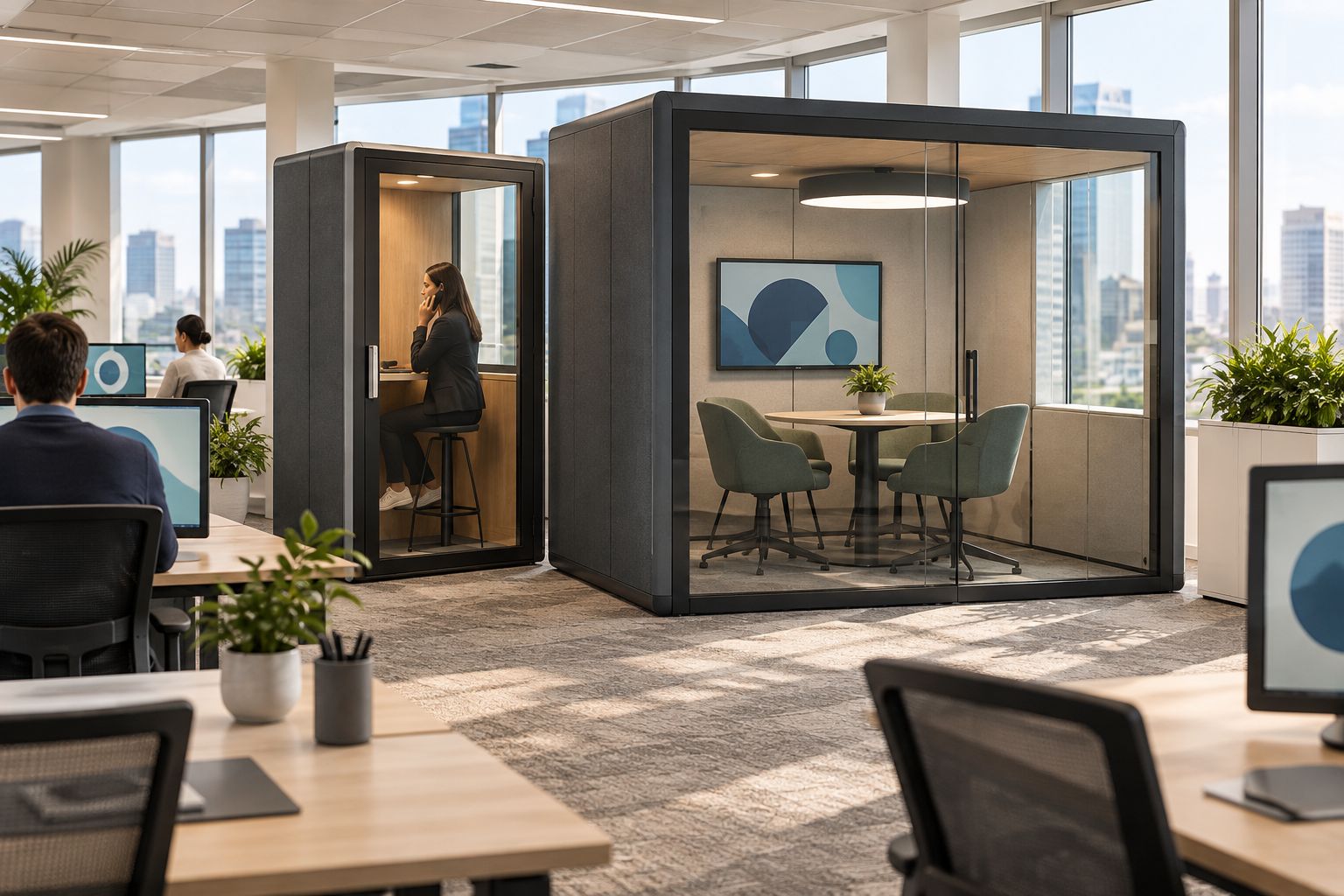
The products below represent the phone-booth and small-meeting formats discussed in this guide. Check their current product information against your brief; the cards do not establish acoustic performance or suitability for a particular conversation.


Common mistakes insurance firms make
Counting calls instead of simultaneous workspace needs
A list of calls does not tell you how many enclosed spaces are needed at the same time. Separate scheduled callbacks from incoming enquiries, and record when employees compete for a space. Do not turn the total number of conversations into a purchasing quantity.
Using a meeting pod as the default callback booth
Individual callbacks and joint case discussions need separate consideration. If either activity can reserve every available enclosure, one can displace the other. Give each workspace a primary purpose and explain how exceptions are handled.
Treating enclosure as guaranteed confidentiality
Walls and a door do not answer every question about speech, screens or documents. Keep acoustic information separate from visual privacy and working procedures. Avoid promising that a pod makes every insurance conversation confidential.
Choosing furniture before defining the task
A space for telephone work and a space for reviewing documents together have different briefs. Decide what employees must do before considering the working arrangement. Confirm included furniture from product information rather than assuming it comes with the enclosure.
Measuring success through bookings alone
Reservations show intended use, not necessarily useful use. Check which tasks were accommodated and which still lacked an appropriate space. A busy pod does not establish that the original claims-call or policy-review problem has been resolved.
FAQ
What are the best office pods for insurance firms?
The best office pods for insurance firms are those matched to a named task: individual calls, joint case reviews or small group discussions. Compare phone booths with meeting pods, then check supplied product information against your workspace brief.
Should claims handlers use a phone booth or a meeting pod?
A phone booth is the format to examine for an individual claims callback; a meeting pod is the format to examine when colleagues need to participate together. Count the people physically present rather than the remote participants on the call.
Does an office pod guarantee that a policy conversation is confidential?
No, an office pod does not by itself guarantee confidentiality. Review the supplied acoustic information, visibility of screens and documents, and your organisation’s working procedures separately.
Can an insurance firm keep its existing meeting rooms?
Yes, keep existing meeting rooms for activities they already accommodate appropriately. Use booking records to identify the remaining gap before adding a phone booth or meeting pod.
How do we decide how many pods to shortlist?
Base the shortlist on simultaneous requests for suitable spaces, not the total number of employees or calls. Separate individual telephone work from discussions involving colleagues and check why existing rooms cannot accommodate them.
Which Quell Workspaces products should we compare for calls and small meetings?
Compare Office Phone Booth Folio for an individual telephone-work brief with Folio Office Pod - 2-4 Person for a small-meeting brief. Confirm the supplied product details before selecting either for your team’s intended activity.
One last thing
Write the booking rule before choosing the pod. If you cannot explain which task has priority, employees will have to decide while they are trying to work. A clear purpose makes the product brief, comparison and later review easier to keep consistent.


