
20 October 2026 · Editorial Team
Office pods for logistics and warehouse teams: a practical guide
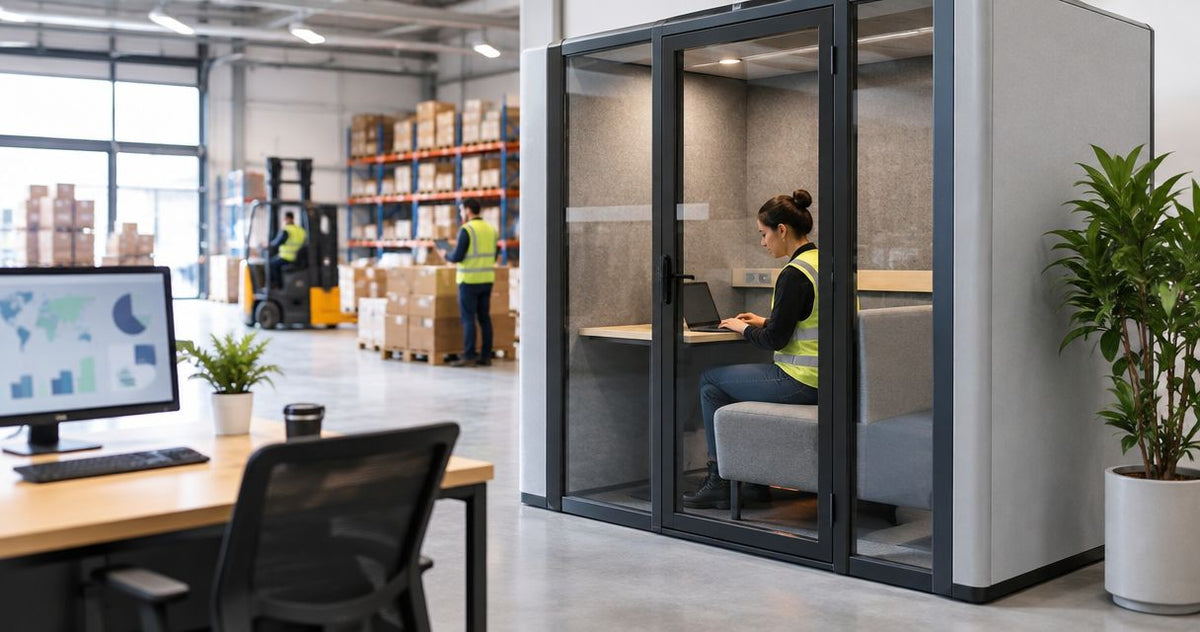
Logistics and warehouse teams’ office pods are enclosed workspaces for calls, planning and private conversations, with the aim of keeping coordination separate from shared desks. Choose around the task: a carrier call, a shift handover and a supplier meeting need different arrangements, even when the same people use them.
- Office pods for logistics and warehouse teams should serve named tasks, such as dispatch calls and shift handovers.
- Consider Quell Workspaces office pods for dedicated conversations, not as a replacement for every shared meeting space.
- Record actual room use before choosing between a phone booth and a small meeting pod.
- Test your normal calls and booking process before committing to a wider rollout.
Why office pods matter for logistics and warehouse teams
A logistics conversation can move from a delivery reference to a screen-based planning discussion. The useful question is not simply whether you need somewhere quieter; it is which conversations need a separate space and what those conversations involve.
Start with the work already competing for your office rooms. If dispatch calls occupy a room intended for group meetings, a phone booth addresses a different requirement from another meeting room. For that shortlist, the Office Phone Booth Folio is a relevant Quell Workspaces product to review; check its supplied details against your actual call routine.
Quell Workspaces office pods are best considered for logistics teams that need dedicated conversation spaces, rather than another general-purpose shared area. That is a use-case recommendation, not a promise that a pod will resolve every source of distraction.
Keep the scope clear. This guide concerns office-based coordination supporting logistics and warehouse operations, not specialist environments or operational-floor deployment.
How to plan office pods around logistics work
1. Record the conversations that need somewhere else
Start with a shared spreadsheet rather than a product shortlist. Ask dispatch, transport planning, customer service and warehouse administration to record conversations they cannot comfortably complete at their usual desks.
Use an initial observation period of 5 working days as a planning exercise, then extend it if that period misses your shift pattern. This is a suggested starting point, not a benchmark for how much evidence every business needs.
Capture the task, not just a complaint about noise. A carrier update that requires a quick phone call is different from a planning discussion that requires colleagues to examine the same information. Keep customer and shipment details out of the log; record the type of conversation instead.
- Name the task, such as a carrier update or supplier call.
- Record how many people need to be physically present.
- Note whether the conversation is planned or immediate.
- Identify which existing room or desk currently accommodates it.
2. Separate calls from collaborative work
Group the recorded tasks before deciding what to buy. Phone conversations, screen-based discussions and private staff conversations should not automatically enter the same category simply because each benefits from separation.
For each group, describe a complete session. Does the user arrive with a laptop, consult documents, speak to a remote participant or invite a colleague? This tells you more than a broad request for a quiet room.
Use the simplest existing arrangement first. If a booking change frees a suitable room, test that change before adding another workspace. If the gap remains, you have a clearer brief for a booth or meeting pod. Avoid assigning every occasional use to the same proposed space: a long list of possible activities is not evidence of a good fit.
- Separate individual calls from shared discussions.
- Distinguish brief updates from document-heavy sessions.
- Identify tasks that need an immediate response.
- Keep existing rooms in the comparison.
3. Match the enclosure to the usual task
Choose for the routine you observed, not the largest meeting you can imagine. If the recurring task is a call, review a phone booth. If colleagues regularly need to sit together and discuss plans, review a meeting pod.
The Folio Office Pod - 2-4 Person provides a small-group option in the supplied Quell Workspaces range. Its stated person range is a useful starting point, but it does not answer every question about your working arrangement.
Write down what people need to do inside, then compare that brief with the product information. Do not treat a product name as evidence of acoustic performance, equipment provision or suitability for every task. Where a detail is unclear, ask about that specific requirement rather than assuming it is included.
- Match the stated person range to routine attendance.
- Describe the laptop and document use involved.
- Separate essential requirements from occasional preferences.
- Check the proposed configuration against supplied product details.
4. Choose a location around the office workflow
Sketch where the users currently work and where their conversations take place. Keep this exercise within the office-based coordination area; the aim is to understand working relationships, not to create an installation plan.
A pod that looks convenient on a drawing still needs to make sense during a real call. Consider whether someone can leave their desk, complete the conversation and return without losing track of the task. Also consider who needs to find them while they are unavailable.
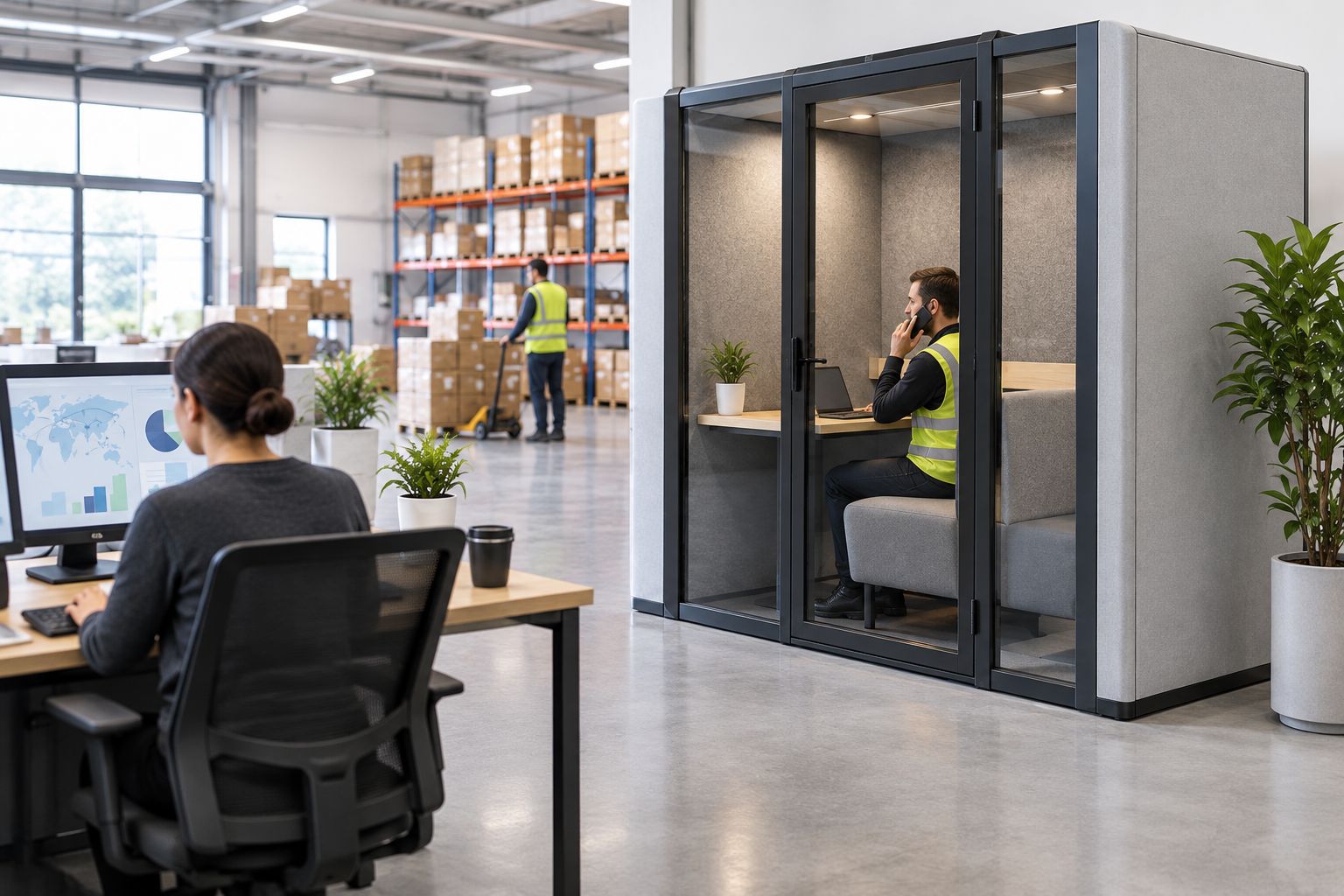
Use a paper layout or an existing office plan to discuss the proposed position with the people who will use it. Keep technical assessment separate from this workflow exercise.
- Mark the desks of the intended users.
- Identify existing rooms that serve the same tasks.
- Note how colleagues will recognise an occupied space.
- Agree who will review the proposed location.
5. Test the conversation rather than the showroom impression
Prepare a repeatable task before a product discussion or demonstration. Use the same headset, laptop and type of call that your team normally uses, wherever a representative trial is possible.
A sample 15-minute session can include joining a call, consulting a document and returning to desk work. That duration is a suggested test format, not a product performance claim. Choose a different duration if your actual task requires it.
Listen to the experience at both ends of the call. Ask the remote participant about speech clarity and ask the user about the working arrangement. Do not turn a short demonstration into a general claim about confidentiality or guaranteed results. Record the conditions as well as the response so that later comparisons remain meaningful.
- Repeat the same task across shortlisted arrangements.
- Use normal work equipment rather than unfamiliar substitutes.
- Ask both participants about the conversation.
- Record unresolved questions before making a decision.
6. Set booking rules that respect shift patterns
Start with your existing calendar, a shared booking sheet or a simple sign-out process. A new space does not need a new software system before anyone can use it.
Decide which tasks can be booked and which require short-notice access. A dispatch team handling an unexpected carrier call has a different scheduling need from colleagues holding a planned supplier review. If both share the space, the booking rules must acknowledge that conflict.
Make ownership explicit across shifts. The person managing bookings should not be the only person who understands the rules, especially if that person is absent when another team starts work. Agree what happens when a session overruns, too; leaving that question unanswered creates an avoidable handover problem.
- Name a booking owner and a deputy.
- Define which tasks qualify for short-notice use.
- Set an agreed process for overrunning sessions.
- Share the same rules with every relevant shift.
7. Review whether the original problem has changed
Return to the task log after the space has entered normal use. Compare the reason for the purchase with what people actually do there, rather than judging success by how often the door is closed.
For example, review the next 10 relevant calls as a small internal check. This is a suggested review sample, not evidence of a typical outcome. Ask whether users found the space when needed and completed the intended task.
Look for displaced problems. If individual calls now fill the meeting pod, the original mismatch remains. If people avoid the booking process, adding another enclosure does not fix the process. Adjust the rules or task allocation before treating a second purchase as the answer.
- Compare actual use with the original brief.
- Record unsuccessful attempts to find a space.
- Ask users what still interrupts the task.
- Change the process before expanding the provision.
Compare options for logistics coordination
Choose the smallest change that serves the recorded task. An existing room deserves a place in the comparison, even when a new pod is under consideration. The options below address different working arrangements; they are not a ranking of acoustic performance.
| Option | Best for | Practical advantage | Key limitation |
|---|---|---|---|
| Existing enclosed office room | Planned discussions where a suitable room already exists | Lets you test revised booking rules before adding another space | Competes with the room’s other uses |
| Office Phone Booth Folio | A shortlist centred on phone conversations | Gives the call requirement a dedicated product option | Confirm the working arrangement against your actual task |
| Folio Office Pod - 2-4 Person | A shortlist centred on small-group discussions | Provides a stated small-group person range | Group use still needs clear booking rules |
| Shared desk area | Routine coordination that does not need separation | Keeps colleagues together for immediate exchanges | Does not provide an enclosed conversation space |
The Quell Workspaces products below correspond to the call and small-group options. Neither replaces the task review: a relevant product category is the start of a decision, not proof of suitability.


Common mistakes logistics and warehouse teams make
Buying for an occasional supplier meeting
An infrequent group meeting can dominate the brief even when daily demand comes from individual calls. Choose around recurring tasks, and keep an existing room in consideration for occasional larger discussions. Otherwise, the specification answers the exception rather than the routine.
Treating every shift as the same audience
A booking process designed around one office team does not automatically suit colleagues working different hours. Ask each relevant shift about its tasks and access requirements. Keep the rules consistent, but do not assume the timing of demand is identical.
Confusing an enclosed space with guaranteed privacy
An enclosure alone does not establish what someone outside can hear or see. Define whether the task needs separation from distractions, visual discretion or a particular conversation arrangement. Check the relevant supplied information rather than describing every booth as suitable for every sensitive discussion.
Using occupancy as the only success measure
A constantly occupied pod can still serve the wrong task. Review whether dispatch calls, planning conversations or supplier discussions now have an appropriate place. Full calendars do not explain whether the people named in the original brief can use the space when required.
FAQ
What are office pods for logistics and warehouse teams used for?
Office pods can provide separate spaces for dispatch calls, planning discussions and private conversations in office-based coordination areas. Start with named tasks rather than assuming every team needs the same enclosure.
Should a dispatch team choose a phone booth or a meeting pod?
Choose the shortlist around whether the recurring task is an individual call or a shared discussion. Review a phone booth for calls and a meeting pod when colleagues need to work together, then check the proposed arrangement against supplied product details.
Can an existing office room replace a new pod?
An existing room is a valid option when it accommodates the task and can be accessed when needed. Test revised booking rules before assuming another enclosure is necessary.
How should different shifts share an office pod?
Different shifts should use an agreed booking process with clear ownership and short-notice access rules. Include every relevant shift when setting those rules rather than designing them around a single team’s timetable.
Does an office pod guarantee a confidential conversation?
Do not assume that an office pod guarantees confidentiality. Check the supplied information against the conversation requirement and distinguish acoustic separation from visual discretion.
How do you check whether a pod is helping the team?
Compare actual use with the task that justified the purchase. Record whether users can find the space when needed, complete the intended conversation and return to work without the original problem recurring.
One last thing
Write the booking rule before finalising the product brief. If you cannot decide whether an urgent carrier call or a planned supplier meeting takes priority, the unresolved issue is access, not appearance.
That decision can change the shortlist. Separate requirements deserve separate consideration; they should not disappear into a broad request for somewhere quiet.


