
8 October 2026 · Editorial Team
Phone booth or meeting pod: what is the difference?
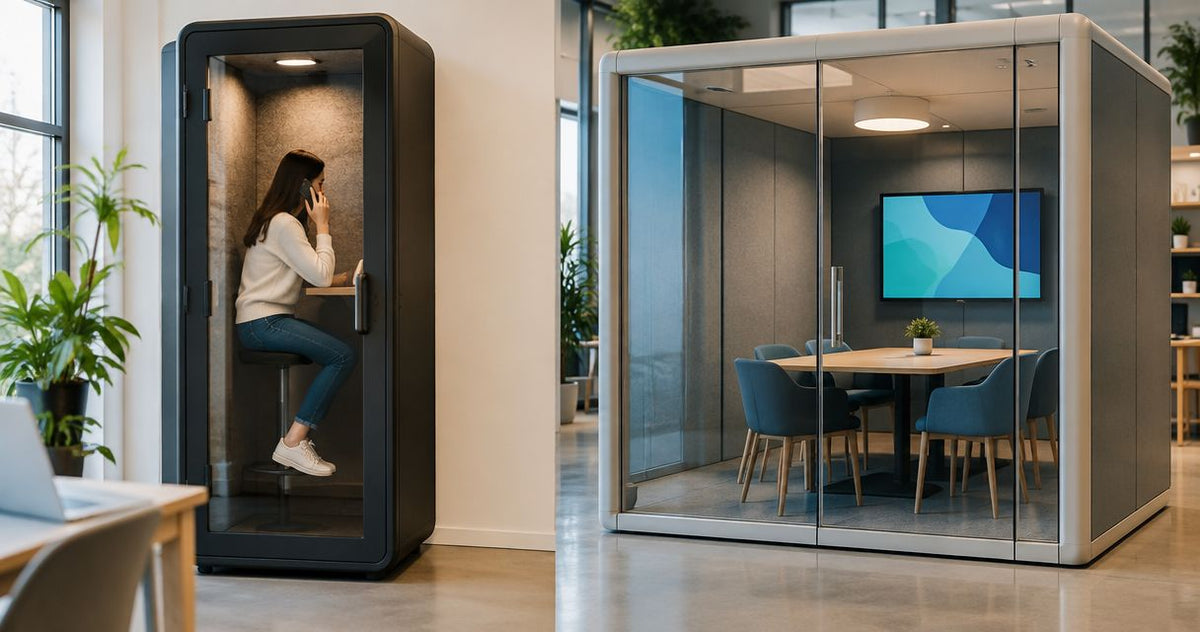
A phone booth is intended for individual calls and private work; a meeting pod is intended for people holding a discussion together. Choose by the number of people physically sharing the space and the task they need to complete, not by whether the product name says booth or pod. Neither label alone tells you the acoustic performance, furniture configuration or equipment included.
- Phone booth vs meeting pod: choose individual call space or shared discussion space according to the task.
- Quell Workspaces offers phone booths and meeting pods; match the product to your workplace use case.
- Remote attendees do not count towards the number of people physically using a booth.
- Check the exact product configuration rather than treating booth and pod as fixed specifications.
Phone booth or meeting pod: what is the difference?
The practical difference is individual use versus shared use. Product names overlap, so compare the intended activity and stated capacity before choosing.
| Option | Best for | What the supplied product information establishes | Main limitation to consider |
|---|---|---|---|
| Office Phone Booth Folio | Individual calls away from shared desks | A product identified as an office phone booth | The name does not establish equipment, working posture or acoustic performance |
| Quell+ - 2 Person Pod | Conversations involving 2 people in the same space | A 2-person pod described for private conversations and focused work | It is not the option for a larger group |
| Quell+ - 4 Person Meeting Booth | Small-group discussions | The description states accommodation for 3 to 4 people | Shared meeting use can compete with individual call bookings |
| Quell+ - 6 Person Meeting Booth | Discussions involving a larger group | The description states accommodation for 4 to 6 people | Using it for individual calls leaves the remaining meeting capacity unused |
The capacities above come from the supplied product titles and descriptions. They distinguish these particular options; they are not universal definitions of a phone booth or meeting pod.
Why this matters
A call booth and a meeting pod address different booking needs. An employee joining a remote interview needs an individual space, while colleagues discussing a proposal need somewhere they can sit together. Treating those activities as interchangeable creates a mismatch between the space you provide and the work taking place.
Solve the recurring task, not the broad category. If individual calls are the problem, start with call space. If teams cannot find somewhere to talk together, start with shared meeting capacity rather than assuming an individual booth will cover both needs.
The distinction also helps you write a clearer purchasing brief. “Space for remote interviews” describes an activity; “we need a pod” leaves the important decisions open. A useful brief states who will use the space, what they will do there and what they need to bring into it.
Phone booths: best for individual calls
An office phone booth gives an individual a separate place to take a call rather than speaking at a shared desk. The relevant use cases include remote interviews, customer calls and video meetings attended by an employee working alone. A video call with many remote participants is still an individual-use task when only the employee is physically inside the booth.
The main advantage is a clear purpose. You can reserve individual call space without allocating a shared meeting room to an activity that does not need group seating. That distinction is especially useful when your meeting rooms serve both calls and face-to-face discussions.
The limitation is equally clear: individual call space is not a substitute for group discussion space. A booth selected for solo use does not become a suitable team meeting space because the conversation happens by telephone or video.
Do not assume every phone booth supports the same way of working. Establish whether your use case involves speaking, taking notes, using a laptop or reviewing documents, then check the actual configuration. The category name does not answer those questions for you.
Meeting pods: best for shared discussions
A meeting pod provides a place for people to hold a discussion together. Relevant tasks include manager check-ins, project reviews and conversations where colleagues need to look at the same material. The distinguishing feature is the shared activity, not whether remote participants also join.
A 2-person conversation needs a different arrangement from a discussion involving 4 people. State the physical attendance in your brief before comparing products. “Hybrid meeting” describes how people connect, but it does not establish how many people need space inside the pod.
The benefit of shared capacity is flexibility across discussions of the appropriate size. The drawback is booking competition: an individual using a meeting pod for a call occupies a space that colleagues also want for group work. That is a scheduling trade-off, not a fault with the product.
Choose meeting capacity for the discussions you actually need to accommodate. Do not treat the largest option as the automatic answer to every workplace requirement. A larger group space and dedicated individual call space serve different purposes.
Why the choice between a phone booth and meeting pod varies
The right choice depends on the work pattern, not a universal preference for either category. Use these factors to distinguish your requirements:
- Physical attendance: Count the people who will be inside, separately from anyone joining remotely. Shared attendance changes the type of space required.
- Individual versus shared tasks: Separate calls and focused work from conversations involving colleagues in the same enclosure.
- Work materials: Identify whether users need a laptop, notes or shared documents. Check the selected configuration against that activity without assuming equipment is included.
- Booking conflicts: Establish whether individual calls and group discussions need space at the same time. A shared booking pool does not create separate capacity.
- Privacy requirements: Distinguish reducing distraction from keeping conversation content private. Neither a product label nor an enclosed appearance establishes the privacy outcome.
- Product configuration: Compare the actual furniture and equipment information for each option. Similar category names do not establish identical interiors or capabilities.
These factors create a practical decision rule: match the enclosure to the activity first, then verify the particular product. That order keeps a broad label from becoming a substitute for a purchasing brief.
How to choose for your workplace
Start with the displaced activity
Ask what employees currently leave their desks to do. Record the activity plainly: remote interviews, customer calls, manager check-ins or project reviews. Avoid grouping everything under meetings, because that hides the difference between individual and shared attendance.
You do not need to invent a productivity score to make this useful. The aim is to identify which tasks need a separate space and which tasks need colleagues together. Keep those requirements distinct until you have compared the relevant options.
Separate attendance from connection method
Record physical attendance and remote attendance separately. An employee joining a video call alone has a different requirement from colleagues joining the same call together. The conferencing platform does not determine the enclosure category.
For example, 2 people discussing a document together need shared space even if nobody joins remotely. Conversely, an individual speaking to a remote team still needs an individual call setting. Count the people in the space, not the people on the screen.
Check the work setting
Write down what users need to do during the session. Speaking without reference materials differs from reviewing a document, typing notes or working through a presentation. Those activities give you a basis for checking the proposed interior configuration.
Confirm equipment and furniture against the specific product information. Do not assume a phone booth includes a particular desk arrangement, or that a meeting pod includes everything required for video calls. Separate what the enclosure provides from what your workplace will supply.
Decide how bookings will work
Define the intended use before opening bookings. If a space is primarily for individual calls, describe it that way; if it is for shared discussions, make that purpose clear. A vague room name leaves users to make their own assumptions.
Also decide how to handle competing requests. If solo calls and group discussions regularly overlap, allocating them to the same space means choosing which activity gets access. Consider separate provision rather than expecting a single enclosure to meet simultaneous needs.
Compare the relevant product information
Quell Workspaces supplies both phone booths and meeting pods, so the useful comparison is between products that match your named activity. Start with the use case and stated attendance, then examine the exact product information. Do not infer specifications from photographs or from the word soundproof in a URL.
The following examples represent the individual-call and shared-meeting categories discussed above. Their supplied titles distinguish the intended product types; detailed configuration still needs to be checked against the current product information.


Acoustic performance and privacy need separate checks
The phone booth versus meeting pod distinction does not establish which product reduces more sound. Capacity describes how people use a space; acoustic performance describes a different characteristic. Do not turn a category comparison into an unsupported performance ranking.
Likewise, visual privacy and speech privacy are different requirements. An enclosure can separate an activity from the surrounding workspace without its appearance establishing how much conversation remains audible outside. Define the outcome you need before requesting product-specific information.
For sensitive conversations, explain the actual use case to the supplier rather than relying on an adjective. A remote interview, a customer call and an internal discussion can have different privacy expectations. Ask for information relevant to that requirement without assuming either category guarantees complete confidentiality.
FAQ
Is a phone booth the same as a meeting pod?
A phone booth and a meeting pod are not interchangeable use cases: a phone booth is intended for individual calls, while a meeting pod supports shared discussions. Product naming overlaps, so check intended use and stated capacity rather than relying on the label.
Which is better for an employee joining a video meeting alone?
An individual-use phone booth is the relevant category for an employee joining a video meeting alone. The number of remote participants does not change physical attendance; check the product configuration against the employee’s laptop and note-taking needs.
What should I choose for a manager check-in involving 2 people?
A 2-person meeting pod is the relevant category for a manager check-in involving 2 people physically together. Compare the stated capacity and configuration with the discussion you need to accommodate.
Are meeting pods quieter than phone booths?
Meeting pods are not inherently quieter than phone booths. The category name and capacity do not establish acoustic performance; compare product-specific information rather than assuming a larger enclosure performs better.
Can employees use a meeting pod for individual calls?
Individual calls can be assigned to a meeting pod, but that booking occupies space intended for shared discussions. Set booking priorities so individual use does not conflict with the group meetings you need to accommodate.
Does choosing a phone booth mean video-call equipment is included?
Choosing a phone booth does not establish that video-call equipment is included. Check the exact product configuration and distinguish supplied equipment from anything your workplace needs to provide.
One last thing
The word meeting is a poor guide to physical space: a remote meeting attended by an employee alone and a discussion between colleagues require different arrangements. Write physical attendance beside each use case in your brief. That small distinction makes the phone booth versus meeting pod decision clearer.
Quell Workspaces suits workplace teams choosing between individual call booths and shared meeting spaces. Select the category that addresses your recurring task, then verify the particular configuration. Do not buy shared capacity as a substitute for defining how the space will be used.


