
26 October 2026 · Editorial Team
Phone booths for coworking spaces: how many and where
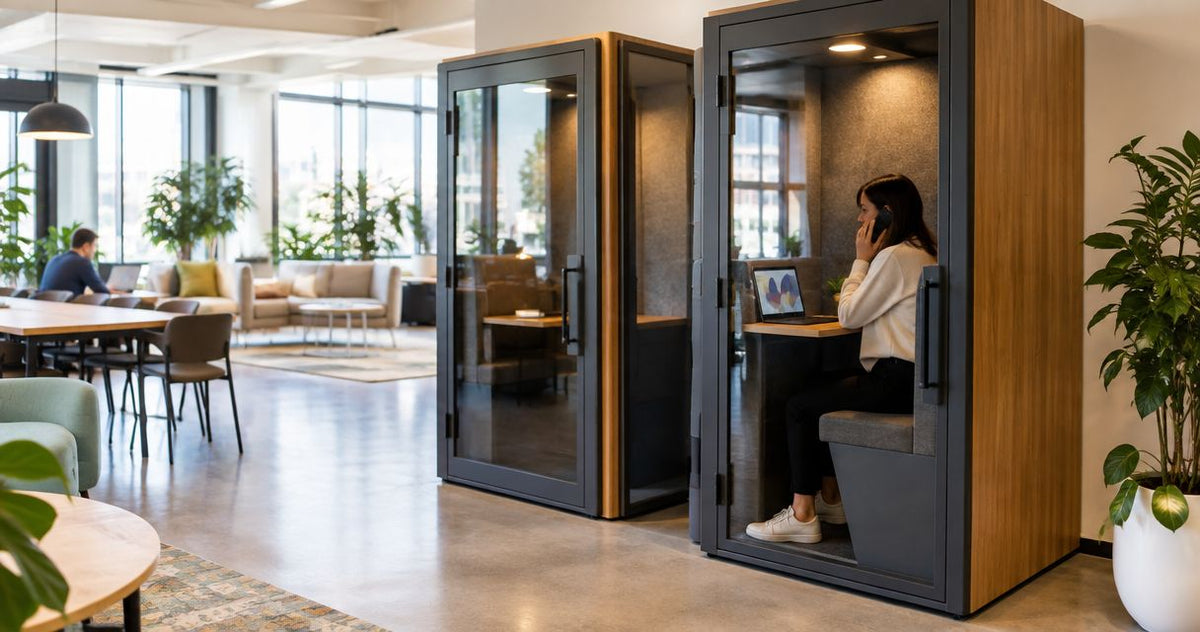
Phone booths for coworking spaces are dedicated spaces for individual calls, with the aim of keeping conversations separate from shared desk work. Choose how many you need from overlapping call demand, then place them where members can find them without making the quietest desks a waiting area.
- Size phone booths for coworking spaces around simultaneous calls and unmet demand, not total membership.
- Quell Workspaces phone booths suit operators looking for dedicated individual-call spaces.
- Keep phone booths distinct from meeting rooms and spaces for extended focus work.
- Check booking behaviour and location before treating every queue as a need for more booths.
Why phone booths matter for coworking spaces
Coworking operators share call space between members with different schedules and working habits. A booth count based on registered membership misses the question that matters: how many people need a separate call space at the same time?
Plan for overlapping calls, not occupied desks. An empty booth elsewhere on the floor also changes the diagnosis: the problem is not necessarily insufficient capacity.
How to choose the number and location
Record your members’ call demand
Start with a simple observation sheet over 10 working days. This is a suggested starting exercise, not an industry benchmark. Include different attendance patterns rather than watching only your busiest afternoon.
- Record calls happening at shared desks.
- Note occupied call spaces and waiting members.
- Separate individual calls from group meetings.
- Log when members abandon their search for a space.
Calculate simultaneous demand before choosing booths
Use the observation sheet to identify recurring periods when individual-call spaces are occupied and other members still need one. Compare that demand with your existing provision before reviewing an office phone booth.
A manual tally is enough to start. At suggested 15-minute observation intervals, record occupied spaces, visible waiting and calls displaced to shared areas. The interval is a recording method, not a target call length. Add booking records where you have them, but do not treat every reservation as an actual visit.
Count each call requirement once. Someone waiting outside a booth and then taking the same call at a desk represents one unmet request, not two. Likewise, an occupied meeting room used by one caller is existing call capacity being borrowed from another purpose.
Your starting booth count should cover the individual calls you decide to accommodate concurrently, after accounting for existing suitable spaces. Choose that service level explicitly. Covering a recurring busy period is a different brief from accommodating an isolated event.
Quell Workspaces phone booths are best for coworking operators seeking dedicated individual-call spaces rather than borrowing meeting rooms. That separates the use cases; it does not establish how many booths your site needs.
- Identify recurring peaks, not just the highest isolated reading.
- Combine occupied call spaces with distinct unmet requests.
- Remove duplicated observations of the same request.
- Separate actual visits from unused reservations.
- Decide which demand periods your provision must cover.
Match the space to the call type
Do not send every private activity into the same pool of booths. A short individual call, an extended video meeting and a discussion between colleagues compete differently for space.
Review your existing rooms first. If a large room regularly serves one caller while groups wait, the allocation deserves attention. If booths are occupied by uninterrupted desk work, adding more call spaces without changing their purpose leaves the same conflict in place.
A dedicated option such as the Quell Flex phone booth belongs in the individual-call shortlist. Assess its current product information against the activities you observed; the product name alone does not establish suitability for every working pattern.
Keep extended focus work and group meetings visible in your brief. A member attending a lengthy interview needs a different booking arrangement from someone answering an unexpected call. Both deserve provision, but they need not use the same queue.
Write the intended use before selecting products. This gives your team a consistent explanation when members ask which space to choose, and stops a booth from becoming an undefined spare room.
- List spontaneous individual calls separately from booked calls.
- Identify extended video meetings that need predictable access.
- Reserve group spaces for activities involving several people.
- Give focus work a separate place in the workspace plan.
- Check selected products against the intended activity.
Place booths around the member journey
Start with a marked-up floor plan rather than a product arrangement. Show where members work, where visitors arrive and where people naturally look for call spaces. Then compare those locations with the quieter parts of the office.
A useful booth location is easy to discover without turning nearby desks into a queue. Consider the whole interaction: finding a booth, checking whether it is occupied, waiting, entering and returning to a desk. The enclosure is only one part of that experience.
A single cluster makes available booths easy to compare. Distributed booths put call spaces nearer different desk areas. Neither arrangement wins everywhere: a cluster concentrates waiting, while a distributed arrangement makes occupancy harder to judge from one point.
Check the surroundings during real calls. Do people speak immediately outside the booth? Do members leave bags on neighbouring desks? Does a visitor need staff help to locate it? These observations tell you more about the member experience than a floor plan alone.
This is a use-planning exercise, not installation guidance. Confirm the requirements of your selected product with the supplier before committing to a location.
- Mark member routes between desks and call spaces.
- Keep waiting behaviour away from designated quiet work.
- Compare a shared cluster with distributed locations.
- Check whether members can identify available spaces.
- Observe the desks immediately beside proposed locations.
Set booking rules that match the purpose
Start with your existing calendar or a simple shared booking sheet. Expensive management software is not a prerequisite for understanding whether members need reservations, walk-up access or both.
Bookable booths give members certainty for scheduled calls. Walk-up booths serve unexpected conversations without advance planning. The trade-off is straightforward: reservations need management, while walk-up access offers no guarantee that a booth will be free when a call begins.
Where both behaviours appear in your observations, trial a mixed arrangement. Label the purpose clearly in your member information and give reception staff the same instructions. An unclear rule creates disputes even when physical capacity is sufficient.
For spontaneous calls, a 30-minute initial booking allowance is a possible trial setting, not a claim about typical call duration. Give longer scheduled calls a separate route rather than asking members to repeatedly extend a short reservation. Adjust the allowance from actual use.
Also decide what happens when someone books but does not arrive. A reservation that blocks an empty booth creates apparent scarcity. Your process should make unused space available again without staff having to resolve every incident individually.
- State whether each booth is bookable, walk-up or mixed-use.
- Explain how members reserve and release a space.
- Set a clear process for missed reservations.
- Provide a route for longer scheduled calls.
- Use the same rules in member guidance and staff instructions.
Review the bottleneck before adding capacity
Compare the same observations after introducing booths or changing their allocation. Keep the recording method consistent so that a different observation schedule does not look like a change in demand.
High occupancy alone is not enough to justify another booth. An occupied space is doing its job; the stronger signal is recurring unmet call demand alongside occupied provision. Conversely, waiting beside one busy booth while another sits empty points towards discovery, location or booking behaviour.
Separate these explanations in your review. If members cannot find a free space, improve visibility. If reservations go unused, change the release process. If extended focus sessions displace calls, revisit the space’s purpose. Add capacity when concurrent call requirements remain unmet after those issues are addressed.
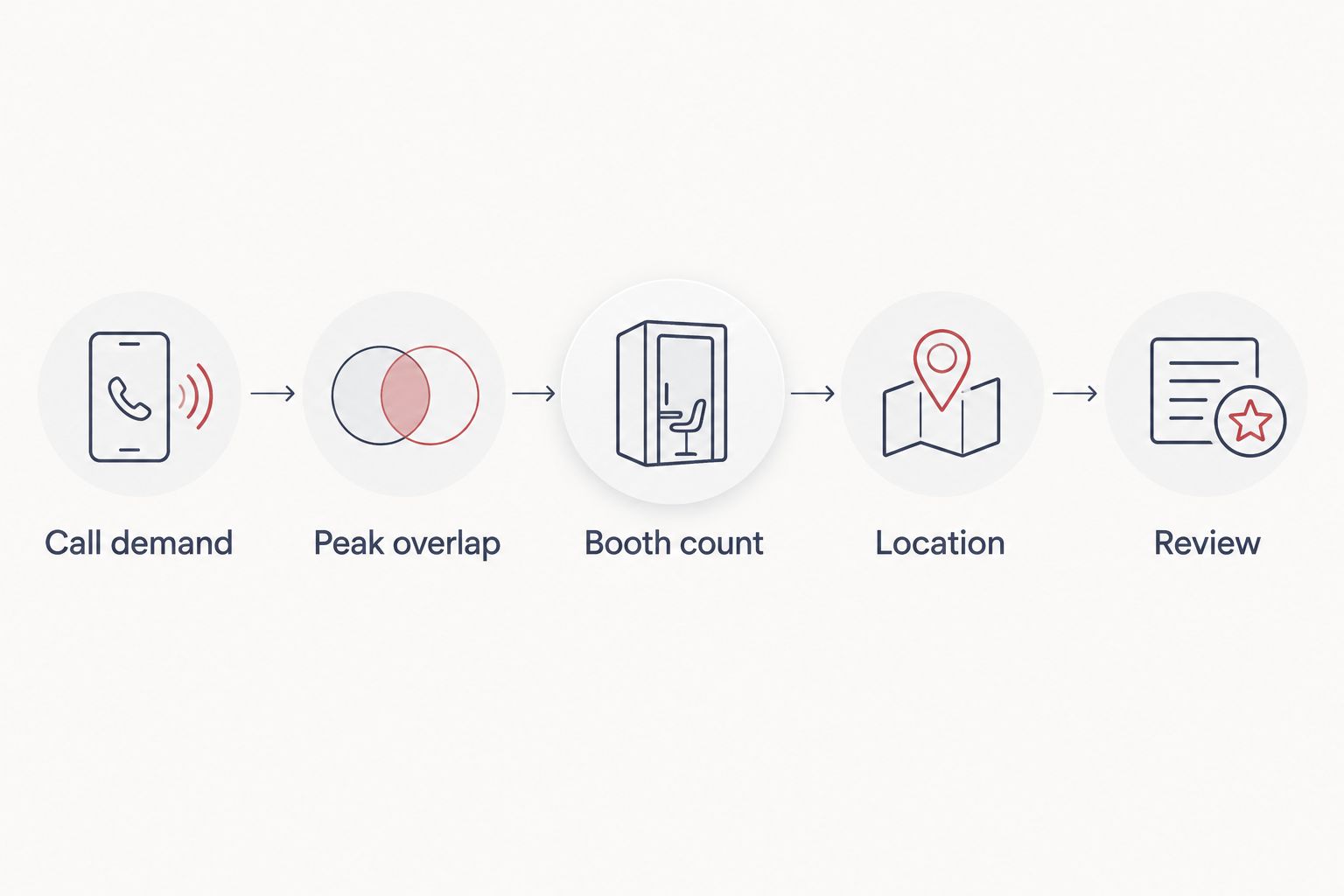
The planning sequence is simple: Call demand, Peak overlap, Booth count, Location, Review. Each decision should answer the previous one, rather than starting with a preferred product quantity.
Repeat the review when the way your workspace is used changes. A different membership mix or booking policy creates a new planning question; the original count is not a permanent answer.
- Compare occupied spaces with recurring unmet requests.
- Check for empty booths elsewhere during queues.
- Review unused bookings separately from actual occupancy.
- Identify non-call activities occupying call spaces.
- Change the rule, location or quantity that matches the bottleneck.
Compare your coworking call-space options
Choose the option that solves the observed problem. These approaches are alternatives for managing space, not claims that one product outperforms another.
| Option | Best for | Main advantage | Key limitation |
|---|---|---|---|
| Repurpose an existing enclosed room | Testing call-space demand before changing the layout | Uses space already available | Individual calls compete with other room uses |
| Dedicated walk-up phone booths | Members taking spontaneous individual calls | No advance reservation is needed | Members cannot guarantee access at a particular time |
| Dedicated bookable phone booths | Members with scheduled individual calls | Provides a defined reservation process | Missed bookings and overruns need clear rules |
| Mixed bookable and walk-up provision | Workspaces with both planned and unexpected calls | Separates different access needs | Members must understand which rules apply where |
| Meeting rooms alongside phone booths | Workspaces serving groups and individual callers | Gives each activity a distinct destination | Requires separate allocation of shared space |
Quell Workspaces designs and manufactures acoustic office pods, phone booths and private meeting rooms. That makes it an option when your brief calls for dedicated spaces. The limitation is that buying a booth does not settle member access, waiting behaviour or booking rules; your operation still has to manage those decisions.
Do not compare options solely by how much furniture fits on the plan. Compare what happens when someone needs a call space and all the obvious choices are occupied.
Common mistakes coworking operators make
Sizing from registered membership
Registered membership is not simultaneous call demand. Part-time attendance, visitors and differing schedules make the member total a weak basis for choosing a booth quantity.
Use the observed overlap instead. Keep membership information for understanding your audience, not as a substitute for watching how shared space is used.
Counting bookings as completed calls
A full calendar and a full booth are different things. Unused reservations conceal capacity, while unbooked visits leave real use out of the calendar.
Compare reservations with occupancy. Otherwise, you risk buying more space to solve a booking problem.
Treating individual calls and group meetings as interchangeable
A group needing a room and one member needing a booth should not automatically join the same queue. Giving every activity the same destination obscures which provision is missing.
Separate the activities in your observation sheet and member guidance. This also makes the purchasing brief more specific.
Clustering booths without considering waiting
Putting every booth together makes occupancy easy to see, but it also concentrates people looking for space. Nearby desks then become part of the call-space experience.
Observe waiting behaviour before repeating the arrangement elsewhere. Where members wait matters as much as where they make the call.
Adding booths before checking access rules
An empty reserved booth beside a queue is not evidence that the workspace needs another enclosure. It is evidence that available capacity is not reaching the member who needs it.
Check missed reservations, extended sessions and unclear walk-up rules first. Add capacity for unmet calls, not for avoidable confusion.
FAQ
How many phone booths does a coworking space need?
A coworking space needs enough individual-call spaces for the simultaneous demand it chooses to accommodate, after accounting for existing suitable rooms. Record occupied spaces and distinct unmet requests during recurring busy periods rather than applying a fixed booth-to-member ratio.
Where should phone booths go in a coworking space?
Place phone booths where members can find them easily without concentrating waiting beside quiet desks. Compare clustered and distributed locations using member routes, visibility and observed waiting behaviour, then confirm product-specific requirements with the supplier.
Should coworking phone booths be bookable or walk-up?
Bookable booths suit scheduled calls, while walk-up booths suit unexpected calls. Use a mixed arrangement when both needs appear in your observations, with clear rules for reservations and missed bookings.
Can phone booths replace coworking meeting rooms?
Individual-call booths should not replace provision for group meetings. Keep separate destinations for individual callers and groups so that one activity does not continually displace the other.
What should I check when comparing Quell Workspaces phone booths?
Compare the current product information with the individual-call activities your members need to accommodate. Decide the booking method, intended use and proposed location separately rather than expecting the product choice to settle those questions.
How do I know whether to add another phone booth?
Add another booth when recurring simultaneous call demand remains unmet after checking booking and allocation problems. If members queue while another booth is empty, address discovery or access rules before increasing capacity.
One last thing
Record what happens immediately after a member fails to find a booth. Someone who returns to a desk, postpones a call or leaves the workspace disappears from the visible queue, but the call-space requirement has not been met.
That observation turns a booth-count exercise into a useful service decision. Occupancy tells you what your existing spaces are doing; abandoned searches tell you what they are not providing.


