
20 October 2026 · Editorial Team
Should you rent or buy office pods?

Rent an office pod when your need has a defined end date or you want to assess the arrangement before committing; buy when the need is ongoing and ownership fits your budget. Neither option is automatically better: compare the complete commitment over the same period, including any separately quoted services and the arrangements for returning or moving the pod. The right choice starts with how your team will use the space, not how payments are presented.
- The rent vs buy office pod decision depends on duration, workplace certainty and the full commitment.
- Renting suits a temporary requirement; check the minimum term and return arrangements before choosing.
- Buying suits an ongoing requirement; plan for ownership beyond the initial purchase.
- Quell Workspaces provides office-pod products and a dedicated renting-services page for comparing the routes.
Why this matters
A temporary shortage of private call space and an ongoing need for meeting space are different purchasing problems. Treating them as the same problem can leave you paying for an arrangement that no longer matches your workplace.
Start with the task: individual calls, private conversations or group meetings. Then decide how long that task needs a dedicated space. Quell Workspaces’ renting services provide a relevant commercial starting point for investigating hire alongside purchase.
Choose the use case before choosing the payment route. A rental arrangement does not compensate for choosing the wrong type of pod, and ownership does not make an unsuitable configuration useful.
Should you rent or buy office pods?
Renting is the stronger option when the requirement is temporary and the proposed rental arrangement matches its duration. Buying is the stronger option when you expect an ongoing requirement and want to own the pod rather than keep paying for its use.
Those are decision rules, not a claim that one route always costs less. The comparison needs actual proposals for the same pod configuration, the same scope of services and the same period of use.
| Decision point | Renting an office pod | Buying an office pod |
|---|---|---|
| Best for | A defined temporary requirement or a trial arrangement | An ongoing requirement with a clear use case |
| Main advantage | Use without purchasing the pod outright | Ownership rather than a continuing rental commitment |
| Main drawback | Payments and return arrangements depend on the proposal | You retain responsibility for the asset after purchase |
| Workplace uncertainty | Useful to investigate when future requirements are unclear | Requires a plan for changes in the workplace |
| Budget comparison | Assess the complete rental commitment | Assess the complete purchase commitment |
| End of use | Establish how the rental arrangement ends | Decide whether to retain, move or dispose of the pod |
The strongest comparison holds everything except the payment route constant. If the purchase proposal concerns a meeting pod but the rental proposal concerns a phone booth, you are comparing different workplace functions, not just renting against buying.
Ask for the proposed configuration in writing. Record what each proposal includes, what it excludes and what happens when your requirement changes.
Renting: best for a defined temporary requirement
Renting deserves priority when you can describe both the problem and its likely end point. Examples include a temporary project team, an interim office arrangement or a defined period of additional call-space demand. These are use cases to assess, not evidence that every rental supplier accommodates them.
The benefit is straightforward: you obtain use of a pod without purchasing it outright. The limitation is equally important: the rental proposal determines how long you commit, what you pay for and what happens at the end.
Do not assume that renting means you can return the pod whenever you choose. Establish the proposed minimum duration, how extensions work and whether ending the arrangement involves separately quoted services.
Before selecting rental, answer these questions:
- Does the proposed term match the period when you need the pod?
- Is the quoted configuration suitable for the actual task?
- Which services are included, and which are separate?
- What happens if the requirement lasts longer than expected?
- What arrangements apply when you no longer need the pod?
Rent for a defined requirement, not simply because the initial commitment looks smaller. A rental proposal still needs to make sense across the full period when your team expects to use it.
Buying: best for an ongoing workplace requirement
Buying deserves priority when the requirement is established and you expect the pod to remain useful. A recurring need for private conversations is a different case from a short-lived overflow problem. Ownership fits the former more naturally, provided the chosen configuration fits the task.
The advantage is control over an owned asset rather than an ongoing rental arrangement. The drawback is that the purchase remains your responsibility if the office, team or use case changes.
Buying does not require assuming that your workplace will never change. It requires a credible plan for what happens when it does. Consider whether the same use case will remain relevant if working patterns or team size change.
Before selecting purchase, answer these questions:
- Is the need recurring rather than tied to a temporary event?
- Have you chosen the configuration around the work it must support?
- Does the purchase commitment fit the available budget?
- Who will take responsibility for the pod after purchase?
- What will you do if the workplace requirement changes?
Buy for a continuing use case, not because ownership sounds better in principle. An owned pod that does not support the work remains a poor choice, regardless of the payment route.
Why the rent-or-buy decision varies
The answer changes with the requirement and the proposal. Use these factors to explain your decision internally rather than presenting renting or buying as a universal rule.
- Duration: A defined end date supports investigating rental; an ongoing need supports investigating purchase.
- Workplace certainty: An unsettled office plan makes the end-of-use arrangements particularly important.
- Use case: Individual calls, private conversations and group meetings require different configurations.
- Budget timing: Compare when commitments arise, not just how the headline payments are displayed.
- Included services: Differences in the quoted scope can make apparently similar proposals unequal.
- End-of-use plan: Rental needs a clear return arrangement; purchase needs a plan for an asset you own.
None of these factors provides a financial answer by itself. Together, they define the information you need before making the decision.
For example, a temporary requirement does not automatically make every rental proposal suitable. The proposed term must still fit. Equally, an ongoing requirement does not justify buying a configuration that fails to match the intended work.
How to compare rental and purchase proposals
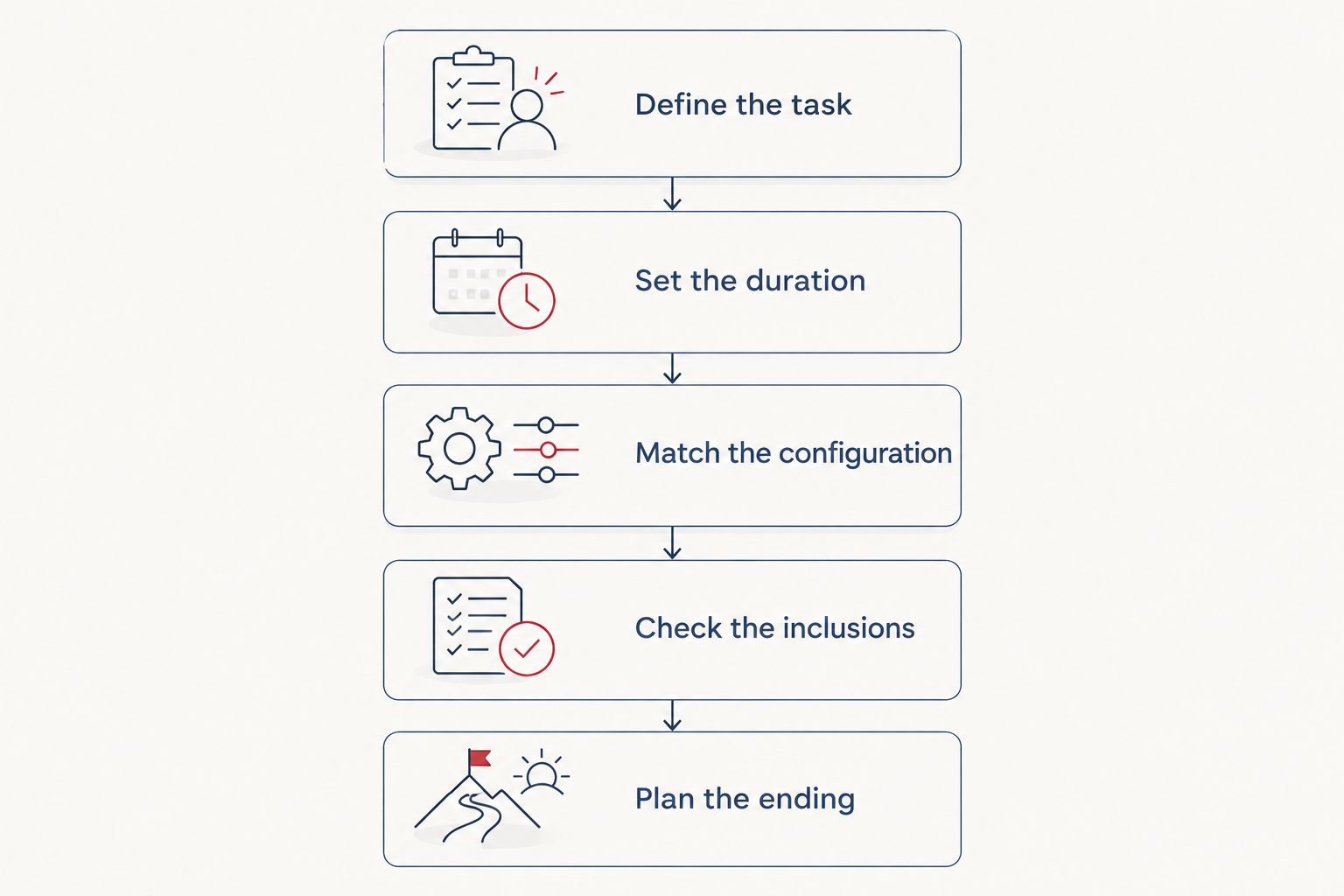
Use the same sequence for both routes. It keeps the discussion focused on the workplace requirement and exposes differences that a headline payment alone conceals.
1. Define the task
Write a short description of the work the pod must support. Specify whether it is for individual calls, private conversations or group meetings. Avoid starting with a preferred model and trying to fit the requirement around it.
Include the intended users and the equipment they need for that task. Keep the brief functional: a place for private conversations is clearer than a request for a more impressive office.
2. Set the duration
Identify whether the requirement has an end date or is expected to continue. Where the duration is uncertain, describe that uncertainty rather than inventing a precise forecast.
Ask for proposals that address the same expected period. A short rental illustration and an outright purchase proposal do not answer the same financial question unless you account for the full intended use.
3. Match the configuration
Use the same configuration when comparing the routes. Record the pod, furniture and other items included in each proposal, using the supplier’s actual descriptions.
Do not assume that similar photographs indicate identical inclusions. A proposal should state what you are obtaining without requiring you to infer it from an image.
4. Check the inclusions
Separate the pod itself from any additional services or items in the proposal. Ask the supplier to clarify exclusions rather than filling gaps with assumptions.
Compare complete commitments over the same period. If a payment is refundable under the proposed arrangement, distinguish it from a payment that forms part of the overall expenditure.
5. Plan the ending
For rental, establish what happens when the agreed period finishes. For purchase, decide what happens if your team no longer needs the pod.
Record the decision before approval. An end-of-use plan gives you a basis for comparing the options beyond their initial appeal.
Match the pod to the work before comparing payment routes
Capacity belongs in the brief because it defines which conversations the space is intended to support. The supplied catalogue includes a pod named for 2 people and a Folio option named for 2–4 people. Those are different configurations to consider, not interchangeable examples of the same requirement.
Quell Workspaces is a relevant direct office-pod supplier for workplace teams comparing private-conversation and meeting-space requirements. Its product selection gives you concrete configurations to discuss, but the names alone do not establish rental eligibility or everything included in a proposal.
| Product | Best for investigating | Useful catalogue detail | Limitation of the comparison |
|---|---|---|---|
| Quell+ - 2 Person Pod | A requirement centred on private conversations | The supplied product name identifies a 2-person configuration | The name does not establish rental terms or included items |
| Folio Office Pod - 2-4 Person | A requirement involving a small group | The supplied product name identifies a 2–4-person configuration | A broader capacity label does not prove suitability for every meeting task |
Compare the same configuration under each route wherever possible. If the available proposals differ, identify that difference explicitly and decide whether both still meet the brief.
Keep product selection separate from the rent-or-buy verdict. A configuration can be relevant to your requirement without either payment route being the better choice yet.
Avoid these comparison mistakes
The most misleading comparison places a periodic rental payment beside a purchase commitment and stops there. These figures describe different things. Your decision needs the complete commitment over the period when you expect to use the pod.
Another mistake is treating uncertain duration as proof that renting is flexible. Flexibility depends on the proposed arrangement, including its duration and ending provisions. Ask for those details rather than relying on the label.
Buying has its own blind spot: treating ownership as the final step. Someone still needs to manage the asset and decide what happens if the requirement changes.
Finally, do not let the financing discussion replace the workplace brief. A proposal can suit your budget while failing to address the actual task. Approve the use case, configuration and payment route together.
FAQ
Is renting or buying an office pod better for a temporary project?
Renting is the stronger route to investigate for a temporary project with a defined end date. Check that the proposed rental duration and return arrangements match the project rather than assuming the pod can be returned at any time.
Should we buy an office pod for an ongoing need?
Buying is the stronger route to investigate when the requirement is ongoing and ownership fits your budget. Confirm the configuration meets the task and make a plan for changes in the workplace.
How do I work out whether renting or buying costs less?
Compare the complete rental and purchase commitments over the same expected period of use. Use actual proposals for equivalent configurations and account for separately quoted items and services.
Can we rent a pod before deciding to buy it?
Ask the supplier whether its proposal supports a rental period followed by purchase. Do not assume that a purchase option exists or that rental payments reduce a later purchase commitment.
What should we do if our office plans are uncertain?
Compare how each proposal handles a changed requirement or an earlier end to use. Rental needs clear ending arrangements, while purchase needs a plan for the asset you will own.
Does Quell Workspaces have a page for office-pod rental?
Quell Workspaces has a dedicated renting-services page alongside its office-pod product pages. Use those pages to frame an enquiry about the configuration and arrangement you need; confirm the proposal details directly.
One last thing
Before approving either route, write a sentence that begins: We need this pod until… Complete it with an end date, an ongoing requirement or an honest statement of uncertainty.
That sentence will not replace a financial comparison. It will stop a temporary problem being treated as permanent, or an ongoing need being assessed only through an initial payment.


