
10 August 2026 · Editorial Team
Best Replica Mid Century Rug UK 2026: Ranked Picks
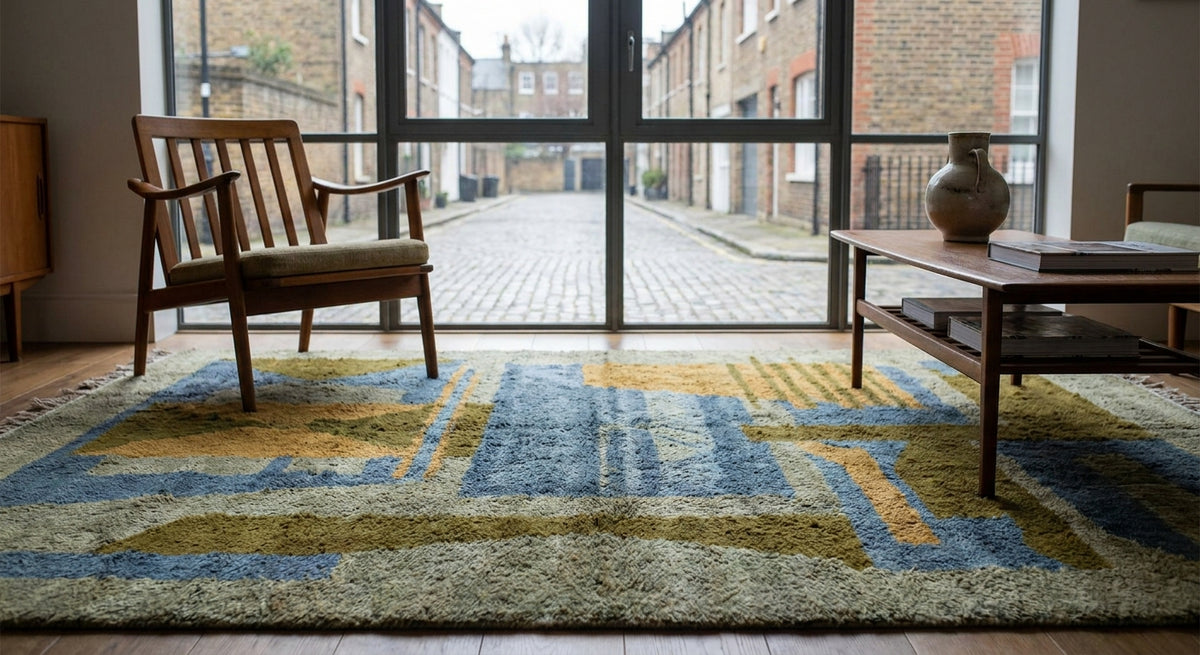
A genuine mid-century rug does more to sell the era than any chair in the room, and the UK market for replica versions is flooded with prints that borrow the palette but skip the pattern logic entirely. This guide ranks the pattern families worth buying in 2026 and flags the ones that look right in a thumbnail and wrong on your floor.
- Boomerang and atomic prints are the safest replica mid century rug uk buy for 2026 living rooms.
- Scandinavian wool flatweave wins on durability but costs more per square metre than printed synthetics.
- Kilim-labelled 'mid-century' rugs are usually mislabelled Persian patterns — skip unless provenance is stated.
- Op-art black and white rugs work best in rooms under 3m wide; they read busy at larger scale.
- Check pile height before buying — anything under 5mm wears flat within a year of daily foot traffic.
Why this matters
Pattern does the heavy lifting in a mid-century room because most of the era's iconic furniture — Eames shells, tulip tables, wishbone chairs — comes in wood tones and neutral upholstery. The rug is where the period's boldness actually shows up: boomerang curves, atomic starbursts, colour-blocked grids.
Buy the wrong pattern and the whole room reads as generic Scandi rather than mid-century. Layering rugs with replica furniture gets harder to fix retroactively than swapping a chair, because rugs anchor a floor plan and most UK living rooms only fit one.
Pattern authenticity also affects resale and long-term satisfaction. A rug with a genuine period pattern lineage holds its visual interest for a decade; a generic "retro geometric" print off a marketplace listing looks dated within two years because it was never tied to a real design movement in the first place.
How this list was ranked
Each pattern family below is judged on four things: whether the motif traces to an identifiable mid-century design movement, how the pile material performs in a UK household over 2026-typical usage, standard UK sizing availability (170x240cm and 200x300cm are the two sizes most rooms need), and how forgiving the pattern is if your existing furniture is mixed rather than fully matched. Patterns that only work in a fully committed, single-era room score lower here than ones that blend into eclectic UK living rooms, because most buyers are furnishing incrementally, not decorating from scratch.
The ranked list
1. Boomerang and atomic pattern rugs
The safest pick on this list. The boomerang curve and atomic starburst motifs trace directly to 1950s American design and reproduce accurately even at synthetic-fibre price points. Look for a repeat pattern at least 60cm across — anything tighter reads as a decorative print rather than a period-accurate weave.
These rugs pair with almost any mid-century seating without needing the rest of the room to match. Verdict: Buy — highest pattern-authenticity-to-cost ratio on the list.
2. Panton-style colour-block rugs
The bold pick. Verner Panton's saturated colour blocking translates well to rug form, typically in reds, oranges and mustards against a neutral ground. This only works as the room's single statement piece — pair it with plain upholstery, not a patterned sofa.
Check the dye process before buying; UK households report faster fading on cheap synthetic dyes under south-facing windows. Verdict: Consider — strong visual impact, but fading risk with poor-quality synthetics.
3. Bauhaus grid pattern rugs
The minimalist's choice. Grid and primary-colour-block patterns from the Bauhaus school work in smaller UK flats where a busier pattern would overwhelm a 3m x 3m room. The trade-off is that a bad reproduction looks like a generic geometric rug with no design lineage at all.
Buy only from listings that reference the actual Bauhaus textile source. Verdict: Consider — good for tight spaces, weak provenance in most UK marketplace listings.
4. Scandinavian wool flatweave
The durable pick. Danish modern flatweaves in wool or wool-blend hold their shape and colour far longer than printed synthetic rugs, and the geometric motifs common to the style age well because the pattern was woven, not printed on top. Expect an 8mm-plus pile height on quality flatweaves versus 3-5mm on budget synthetics.
This is the pattern family most worth paying up for if the rug sits in a high-traffic hallway or living room. Verdict: Buy — best long-term durability of any category on this list.
5. Eames-era abstract swirl rugs
The collector's pick. Abstract, hand-drawn-looking swirl and organic-shape patterns associated with the Eames era work well as a single anchor piece under a coffee table, but the pattern is easy to get wrong — too literal a reproduction looks like a child's drawing rather than a period motif.
Buy from a listing with a clear reference image to the original textile, not a vague "retro abstract" description. Verdict: Consider — high reward if the pattern is accurate, high risk if it isn't.
6. Op-art black and white rugs
The small-space trick. High-contrast op-art patterns make narrow hallways and box rooms feel larger by drawing the eye along the pattern's lines, but scale matters enormously here — the same rug that reads sharp in a 2.5m room looks chaotic across 4m or more.
Measure the room before ordering; this is the one pattern family on this list where size genuinely changes the verdict. Verdict: Consider for rooms under 3m wide, Skip for anything larger.
7. Kilim-labelled "mid-century" rugs
The budget wildcard, and the one to be most careful with. A large share of UK marketplace listings tag flat-woven kilim-style rugs as "mid-century" when the pattern actually traces to Persian or Turkish weaving traditions with no connection to the design movement at all. That's not a dealbreaker if you just want a kilim rug, but it's false advertising if you're buying specifically for a mid-century room.
Verdict: Skip unless the listing states an actual mid-century textile source rather than just using the keyword.
“If the rug pattern doesn't repeat at least twice across a 200cm width, it's a decorative print, not a period-accurate weave.”
Comparison at a glance
| Pattern family | Pattern authenticity | Best room size | Verdict |
|---|---|---|---|
| Boomerang / atomic | High | Any | Buy |
| Panton-style colour block | Medium-high | Single-statement room | Consider |
| Bauhaus grid | Medium | Under 3m x 3m | Consider |
| Scandinavian flatweave | High | High-traffic areas | Buy |
| Eames-era swirl | Medium | Anchor piece only | Consider |
| Op-art black and white | High | Under 3m wide | Consider/Skip |
| Kilim-labelled "mid-century" | Low | Not mid-century specific | Skip |
Where to buy
- Cross-check the pattern name against the design movement it claims. A five-second search of the motif name should return an actual designer or era — if it only returns marketplace listings using the same keyword, treat the claim as unverified.
- Buy the size before the pattern. UK rooms rarely accommodate a rug larger than 200x300cm comfortably; measure the space first and filter listings by size, not by pattern appeal.
- Ask for fibre content, not just "wool-look." Wool-blend flatweaves and pure synthetic prints are priced and marketed almost identically in some UK listings, but they perform very differently after two years of daily use.
For the furniture side of the room, the mid-century replica furniture guide and the Scandinavian replica furniture roundup cover which pieces pair naturally with each rug family above.
FAQ
What is the best replica mid century rug uk buyers should start with?
Boomerang and atomic pattern rugs are the safest starting point in 2026 because the motif traces directly to 1950s design and reproduces accurately at most price points. They also pair with mixed or eclectic furniture without needing the whole room to match.
Is wool or synthetic better for a mid-century replica rug?
Wool and wool-blend flatweaves hold shape and colour longer than printed synthetics, particularly in high-traffic rooms. Synthetic prints cost less upfront but typically show flattening within a year under daily foot traffic.
How do I know if a rug pattern is actually mid-century or just labelled that way?
Search the specific motif name, not just the word 'mid-century' — a genuine pattern returns a design movement or era. Listings that only use the keyword without naming a source are usually generic geometric prints.
What size rug fits a standard UK living room?
Most UK living rooms take a 170x240cm or 200x300cm rug comfortably under a sofa and coffee table arrangement. Measure the room before choosing a pattern, since scale changes how busy a print reads.
Are kilim rugs the same as mid-century rugs?
No — kilim weaving traditions come from Persian and Turkish textile history, not the mid-century design movement. A rug can be both a genuine kilim and a poor fit for a mid-century room if the pattern has no connection to that era's designers.
Do op-art patterns work in small rooms?
Yes, high-contrast op-art patterns work well in rooms under 3m wide because the lines draw the eye and make the space feel larger. In rooms over 4m, the same pattern often reads as busy rather than sharp.
How thick should a mid-century replica rug pile be?
Look for at least 5mm pile height, with 8mm or more on quality wool flatweaves. Anything thinner tends to flatten within a year of regular foot traffic.
Can I mix a bold rug pattern with patterned furniture?
Generally no — bold pattern families like Panton-style colour blocking work best as the room's single statement piece. Pair them with plain or neutral upholstery rather than another patterned fabric.
One last thing
The pattern-repeat test catches more mislabelled rugs than any spec sheet: if the motif doesn't repeat cleanly at least twice across a 200cm width, it was designed as a decorative print, not woven from an actual period textile. Run that check before checking the price tag.


