
11 July 2026 · Editorial Team
How to Style an Eames Lounge Chair in Any Room (2026)
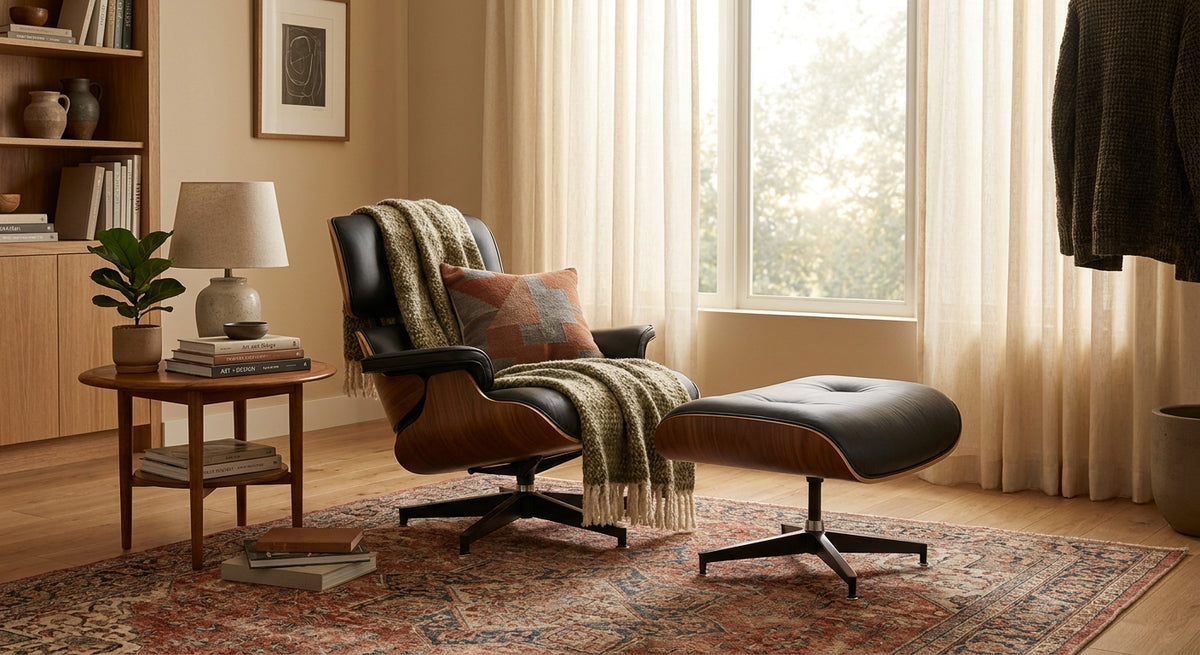
Styling an Eames lounge chair well comes down to space, contrast, and restraint - get those three right and the chair does the rest.
TL;DR
An Eames lounge chair works in almost any room if you give it clearance, a rug to anchor it, and one contrasting material nearby. The verdict on how to style an Eames lounge chair: pair it with a low side table, keep the wall behind it plain, and match the wood tone to your nearest large piece of furniture rather than trying to coordinate everything. Quell Workspaces' Eames lounge chair replica buyer's guide is a useful reference point if you're still deciding on leather colour or shell finish before you start planning the room around it.
Why this matters
The Eames lounge chair and ottoman is a big, sculptural object - roughly 84cm wide and 88cm deep with the ottoman - and it reads as either a centrepiece or a clash depending on what surrounds it. Drop it into a room with no plan and it looks like a leftover from a different house. Give it 15 minutes of thought on placement, rug, and one accent piece and it looks intentional in a living room, a home office, or a quiet reading corner. Most of the mistakes people make in 2026 aren't about the chair itself - they're about crowding it, under-lighting it, or fighting its wood tone with three other different woods in the same sightline.
What you'll need
- A tape measure and a rough floor plan of the room
- At least 900mm of clearance in front of the chair for the recline and swivel
- A rug sized to sit under both the chair and the ottoman, not just the chair
- One low side table for a lamp, book, or coffee cup
- A single accent colour or texture (a throw, a plant, or an art piece) - not three
- A sense of your existing wood tones (walnut, oak, or dark rosewood-style veneer)
The steps
1. Measure the clearance before you commit to a spot
The chair swivels and reclines, so it needs breathing room the way a static armchair doesn't. Leave at least 900mm from the front of the ottoman to the nearest wall or furniture, and check there's nothing directly behind the headrest that stops the recline. Skipping this step is the single most common reason an Eames lounge chair feels cramped rather than commanding. Expected outcome: you can sit down, recline, and swivel 90 degrees without knocking anything.
2. Decide the chair's job in the room
A reading corner wants the chair angled toward a window or a lamp, not facing a TV. A home office wants it near - but not at - the desk, as a break-out spot rather than a second seat. A living room wants it as a secondary anchor, not competing with the sofa for the room's main sightline. Common mistake: placing it dead-centre in a room with no other furniture nearby, which makes it look stranded rather than deliberate.
3. Match the wood tone to what's already dominant
If your existing furniture leans walnut, buy or style the chair in a matching dark wood shell rather than a lighter ply. If you're starting from scratch, the sizes and dimensions guide breaks down shell finish options alongside footprint, which matters if the room is tight. Two clashing wood tones in the same eyeline reads as unplanned, even when both pieces are good on their own.
4. Choose a rug that includes the ottoman
A rug that only sits under the chair and leaves the ottoman on bare floor looks unfinished. Size the rug so both pieces sit on it with at least 15-20cm of rug visible on the open side. A flat weave or low pile in a neutral tone works better than a busy pattern, which competes with the chair's own curves. Expected outcome: the chair and ottoman read as one grouped object, not two separate pieces of furniture.
5. Add one low table, not a full side-table set
A single low table - something in the 40-50cm height range - gives you somewhere for a mug or a book without crowding the recline space. The Noguchi coffee table replica is a common pairing because its organic shape doesn't fight the chair's curved shell, and its low profile keeps the sightline open. Skip anything with hard right angles directly beside the chair - it breaks the soft geometry the design relies on.
6. Keep the wall behind it plain
A busy gallery wall or patterned wallpaper directly behind the chair competes with its silhouette. A single piece of art, a plain painted wall, or a window is enough. This is a common mistake in smaller flats where every wall gets used for storage or decor - the chair needs one clear backdrop to actually register as a statement piece.
7. Add exactly one accent, not three
A plant, a throw, or one piece of wall art - pick one, not all three. Over-accessorising is the second most common styling mistake after crowding the clearance space. The chair and its leather (or fabric) upholstery is already the visual anchor; anything competing for attention dilutes it.
Troubleshooting
The chair looks too big for the room. Pull it away from the wall by 30-40cm rather than pushing it into a corner - corners exaggerate bulk, open space diffuses it.
Glare or fading from a nearby window. Reposition so direct sun hits the chair for under 3 hours a day, or add a sheer curtain - leather and veneer both degrade faster under constant UV.
The ottoman keeps getting kicked or bumped. Angle it 10-15 degrees off the chair's centre line instead of dead straight ahead - it reads more natural and takes up less of the walking path.
Chair clashes with existing decor style. Don't try to match a mid-century piece to a fully modern-minimalist room. Instead, pick one shared material (leather, walnut, brass) that already exists elsewhere in the room and let that be the bridge.
Leather colour looks off under your lighting. Warm bulbs (2700K) push tan and cognac leathers warmer than they look in daylight photos - check the colour under your actual room lighting before committing, not just on a screen.
Chair feels stranded with nothing nearby. Add the rug and side table from steps 4 and 5 before judging placement - an Eames lounge chair styled with zero supporting pieces will always look unfinished, regardless of position.
Tools and resources
- A tape measure and masking tape to map the clearance zone on the floor before moving furniture
- Quell Workspaces' Eames lounge chair replica buyer's guide for shell finish and leather colour options
- The broader mid-century modern replica furniture roundup if you're building out the rest of the room around the chair, not just the chair itself
- A room-scale photo taken from the doorway, so you can check sightlines before you buy anything else
What to do next
Once placement and rug sizing are settled, the next decision is usually shell colour and leather tone - both covered in the buyer's guide linked above. If you're still comparing footprint against a smaller room, check the sizes and dimensions guide before ordering anything, since the standard chair-and-ottoman combination needs more clearance than most people expect on a first measure.
FAQ
What's the best room for an Eames lounge chair? A reading corner or a secondary seating spot in a living room works best in 2026 layouts, since the chair needs its own clearance zone rather than fitting into a tight seating cluster.
Is an Eames lounge chair too big for a small living room? Not necessarily, but it needs at least 900mm of clearance in front for the recline and swivel - measure that space before deciding it won't fit.
Should the ottoman face the chair directly? No - angling the ottoman 10-15 degrees off-centre looks more natural and takes up less floor space than a straight-on placement.
What rug size works under an Eames lounge chair? Size it so both the chair and ottoman sit fully on the rug with 15-20cm of rug showing on the open side, not just under the chair alone.
Does the Eames lounge chair work in a home office? Yes, as a break-out reading or thinking spot near - not at - the desk, rather than as a second desk chair.
What colour walls work best behind the chair? A plain, uncluttered wall in a neutral tone lets the chair's silhouette read clearly; busy wallpaper or gallery walls compete with it.
How much clearance does the chair need to recline fully? At least 900mm from the ottoman's front edge to the nearest wall or furniture, plus room for a 90-degree swivel.
Can you mix wood tones in the same room as an Eames lounge chair? You can, but match the chair's shell to whichever wood tone already dominates the room rather than introducing a third, different tone.
One last thing
Most styling guides tell you to build the room around the chair. The better move in 2026 is the reverse: pick your rug and side table first, then place the chair into that finished vignette - it's far easier to judge whether the clearance and sightlines work when the supporting pieces are already down.


